
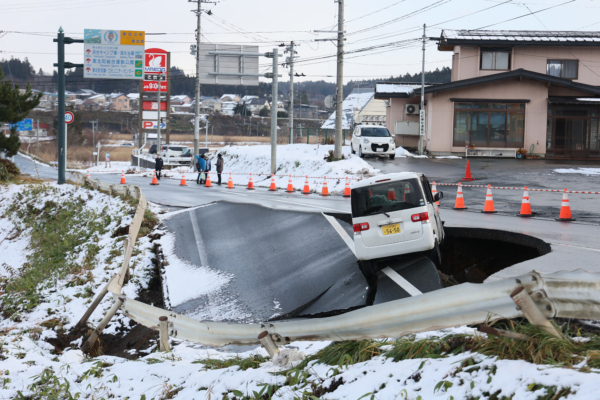
Japan issued a rare “Megaquake” warning after a magnitude 7.5 earthquake struck late Monday, indicating the possibility of a major earthquake of magnitude 8 or higher in the future. This has raised concerns about travel safety for visitors planning to travel to Japan, especially during the peak winter tourism season in Hokkaido.
Authorities emphasized that this warning, issued for the first time since the introduction of this category in 2022, will remain in effect until December 16. However, officials clarified that it is not a prediction but based on statistical possibilities of large nearshore earthquake patterns.
The 7.5 magnitude earthquake occurred late Monday near the eastern coast of Aomori Prefecture, Honshu Island, Japan, reaching a weak 6 on the Japanese seismic scale. The seismic waves reached Hokkaido and briefly triggered tsunami warnings for Iwate Prefecture, Hokkaido, and Aomori Prefecture.
However, according to Japan’s national public broadcaster NHK, the earthquake did not result in any casualties or severe damage to critical infrastructure, and the tsunami warnings were completely lifted early Tuesday morning.
A Megaquake refers to an earthquake of magnitude 8 or higher, which could occur in the Japan Trench near Hokkaido and the Kuril Trench.
Authorities pointed out that stronger tremors could bring a 3-meter-high tsunami to the region. Historically, Mega Thrust Zone earthquakes along the Nankai Trough, another active seismic zone, have led to thousands of fatalities.
The Japan Earthquake Research Committee has stated that the probability of a Megaquake occurring in the Nankai Trough in the next 30 years is as high as 60% to 90%.
However, Robert Geller, an honorary professor of seismology at the University of Tokyo, told the BBC that such warnings are “almost unrelated to science.”
Despite the warning, current travel and transportation conditions have not been significantly affected.
Flights and most railway lines are operating normally. The Tohoku Shinkansen resumed services after a brief suspension. Authorities have not imposed restrictions on travel to northern Japan or Hokkaido.
Major skiing areas in Hokkaido, including Niseko and Furano, have not reported any direct impact, significant building damage, or closures of ski resorts.
Japan’s Meteorological Agency stated, “The likelihood of a new major earthquake is higher than normal, but this does not mean that a major earthquake will definitely occur.”
The Japan National Tourism Organization (JNTO) advises that as Japan is one of the most seismically active countries globally, tourists should prepare for emergencies by:
Downloading applications:
Download the “Safety Tips” app, which provides earthquake, tsunami, and other weather alerts in 15 different languages.
Familiarizing with evacuation routes:
Check evacuation routes and shelters in the area where you are staying.
Preparing an emergency kit:
Include food, water, portable toilets, and other essentials.
Securing items:
Ensure that large items like furniture are fastened in your accommodation (if possible).
Knowing the three life-saving steps:
Follow the safety instructions of Drop, Cover, and Hold on in the event of an earthquake.
During an earthquake, stay away from windows indoors, take cover under sturdy tables; outdoors, move away from buildings, trees, and power lines to avoid falling debris. Additionally, during or immediately after an earthquake, avoid using elevators.
(This article referenced reporting from EuroNews)