
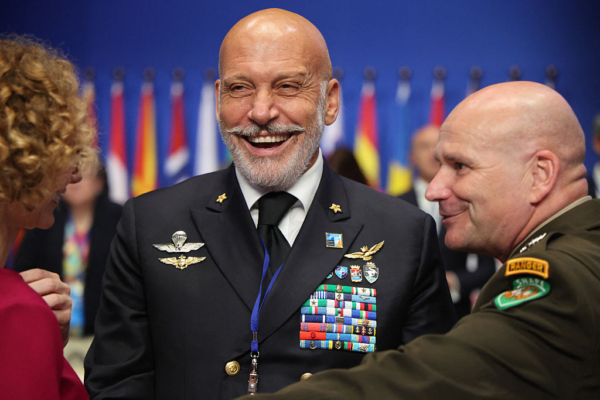
NATO Military Committee Chairman and Italian Navy Admiral Giuseppe Cavo Dragone stated in an interview with the Financial Times that NATO is planning to adopt more proactive measures to respond to the hybrid warfare threats posed by Russia, such as cyber attacks, deliberate sabotage, and violations of airspace activities.
European countries have recently experienced several incidents of hybrid warfare, including the cutting of undersea cables in the Baltic Sea and cyber attacks targeting all of Europe. Some cases have been attributed to Russia, while the causes of others remain undetermined. Some European countries, especially in Eastern Europe, are calling for NATO to not only passively respond but also to actively counterattack.
A diplomat from a Baltic country remarked, “If we continue to passively respond, we are inviting Russia to continuously attempt to harm us. Especially in asymmetric hybrid warfare situations – where the cost to them is low, but high for us. We need to try more creative ways of responding.”
Dragone stated that NATO is exploring all available means and planning to shift from a passive to a more proactive strategy, for example, in the cyber domain, “we are currently more reactive, but we are considering a more active or proactive approach rather than just a passive response.”
He pointed out that “preemptive strikes” can be seen as a form of “defensive action”, and “taking more aggressive offensive actions than the opponent might be an option. (However, issues to consider include) legal frameworks, jurisdictions, and who will execute these actions?” He noted that these methods differ from NATO’s past strategies.
Dragone mentioned that NATO has achieved significant results in the recent Baltic Sentry operation, where naval vessels, military aircraft, and drones patrol the Baltic Sea, thwarting multiple incidents of undersea cable cuts linked to Russian shadow fleets. He said, “Since the Baltic Sentry operation began, nothing has happened. This means that this deterrent method is proving effective.”
Regarding the challenges faced by NATO member countries, Dragone stated, “Due to moral, legal, and jurisdictional constraints, our operational space is smaller than that of the opponent. This is indeed a problem. I don’t want to say it’s a disadvantage, but it is certainly more challenging than the opponent’s situation.”
He highlighted the most critical issue of how to prevent future aggressive actions from the other side. “How deterrence is achieved – whether through retaliation or preemptive strikes – these are issues we must thoroughly analyze as we may face greater pressure in the future.”
On October 3rd, a Finnish court rejected the prosecution of three crew members of the vessel “Eagle S”. They were accused of dragging an anchor 90 kilometers (56 miles) underwater in the Gulf of Finland last December, resulting in the cutting of five undersea cables and causing losses amounting to tens of millions of euros.
The Finnish court ruled that as the incident occurred in international waters beyond Finland’s jurisdiction, they had no authority to try the case. The judge stated that this falls under the jurisdiction of the United Nations Convention on the Law of the Sea, and if Finland wishes to hold criminal responsibility, it must be pursued in the vessel’s country of registration or the crew members’ home country. The vessel in question, “Eagle S”, is registered in the Cook Islands, and the crew members are from Georgia and India.
When asked by the media whether this means Russian vessels can act with impunity in international waters, Finnish Foreign Minister Elina Valtonen stated, “Yes, this is indeed a problem.”
These shadow fleets aim to evade Western sanctions.