
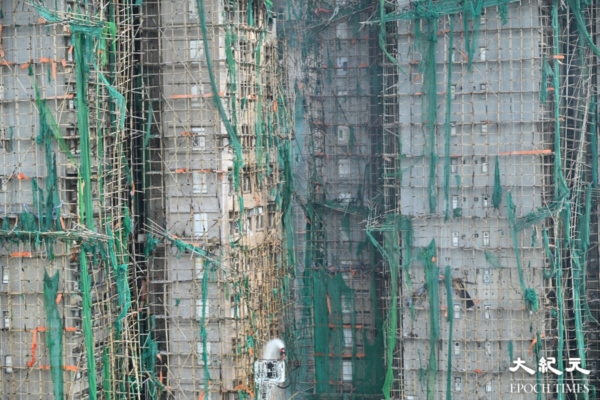
In a devastating fire that broke out at the Hong Kong Tai Po Wang Fu Yuan recently, the most severe in decades, hundreds of people have been killed, injured, and reported missing. The incident has raised concerns from the public regarding the use of bamboo scaffolding in the residential building, leading to a debate on why the construction industry in Hong Kong continues to utilize this traditional scaffolding method. Experts have shared their perspectives on this matter.
Ehsan Noroozinejad, a senior researcher at the Urban Transformations Research Centre at Western Sydney University in Australia, wrote in an article on The Conversation website, emphasizing the importance of fire safety and the considerations of when and where bamboo scaffolding should be used.
Noroozinejad explained that the use of bamboo scaffolding has a history of hundreds of years in the city. The decision to use bamboo scaffolding involves historical, engineering, and economic factors.
Bamboo is a rapidly-growing grass plant with a hollow stem structure, known as bamboo poles, giving it a high strength-to-weight ratio. When properly supported and tied up, bamboo poles are lightweight and sturdy enough to support platforms and workers, making them easy to transport up stairs.
Construction workers tightly bind bamboo poles into a grid pattern, securing them to buildings with brackets and anchors. Well-designed bamboo scaffolding can withstand wind forces and workloads.
Aside from Hong Kong, bamboo scaffolding is widely used in parts of mainland China, India, Southeast Asia, and South America.
The reasons for the usage of bamboo scaffolding in Hong Kong are explained by Noroozinejad:
Firstly, speed. Experienced teams can quickly wrap buildings with bamboo poles due to their lightweight nature and ability to be cut into irregular shapes, especially crucial in narrow streets with limited crane operation space.
Secondly, cost. Bamboo scaffolding is significantly cheaper than metal scaffolding, enabling contractors to lower their bids. Additionally, bamboo is readily available locally, aiding in controlling the costs of building maintenance and repainting.
The third reason is tradition and craftsmanship. Bamboo scaffolding is depicted in the famous Chinese painting “Along the River During the Qingming Festival,” a work by the Song Dynasty painter Zhang Zeduan. Training and certification for bamboo scaffolding construction workers are still provided in Hong Kong, highlighting the importance of this skill in Hong Kong’s architectural culture.
These reasons explain why bamboo scaffolding continues to be present in Hong Kong’s skyline, despite metal scaffolding dominating elsewhere.
Unlike metal, bamboo is renewable, requires minimal processing to turn bamboo poles into columns, and has a smaller overall climate impact.
Noroozinejad believes that the use of bamboo scaffolding presents two main risks:
The first risk is fire, as seen in the recent Hong Kong fire. Dry bamboo is flammable, and the green protective net covering bamboo scaffolding is highly combustible.
Videos and reports of the fire show the flames rapidly spreading along the bamboo scaffolding and protective net, leading to the destruction of the building facade.
Therefore, some advocate for the construction of non-combustible temporary structures on residential buildings or at least the use of flame-retardant nets, treated bamboo, and setting gaps in the scaffolding to prevent fire from easily spreading from one area to another.
The second risk is related to the variability of bamboo and weather conditions. Bamboo, being a natural material, varies in strength based on species, age, and moisture content. Loose fastenings and storms are common risks.
Noroozinejad noted that in March 2025, the Hong Kong Development Bureau instructed that at least 50% of new public works contracts must use metal scaffolding. The Bureau is also encouraging the use of metal materials as much as possible in maintenance work.
Private engineering projects can still use bamboo under current regulations. However, for public projects, the default material is now metal, signaling a shift towards non-flammable systems in building materials.
He stated that the lesson learned from the Hong Kong fire is not about whether bamboo scaffolding is good or bad but rather depends on the specific circumstances. Bamboo has clear advantages in small-scale, short-term, ground-based projects with narrow streets and tight budgets. Still, in residential buildings, especially when external mesh structures are involved, stricter controls are needed due to the fire risk and instability of bamboo.
Bamboo scaffolding has helped shape Hong Kong’s skyline due to its speed, ingenuity, and cost-effectiveness. However, the current fire concerns and the realities of living in high-rise buildings require stricter measures – using the appropriate tools and transitioning to non-combustible systems as risks increase.
By doing so, the city can preserve this proud traditional craft while ensuring the safety of its residents.
According to a report by Taiwan Public Television, Dai Yunfa, founding chairman of the Taiwan Building Safety Credentials Association, mentioned that Hong Kong’s close proximity of buildings and complex topography make bamboo scaffolding essential for construction in Hong Kong, becoming a characteristic of the construction industry. However, fire safety precautions must be taken when using bamboo scaffolding, notably ensuring that the protective net has flame-retardant properties.
Dai Yunfa also emphasized that globally, including Taiwan, most external wall scaffolding is now made of metal, with flame-retardant materials used for the protective netting, enhancing fire protection measures.