
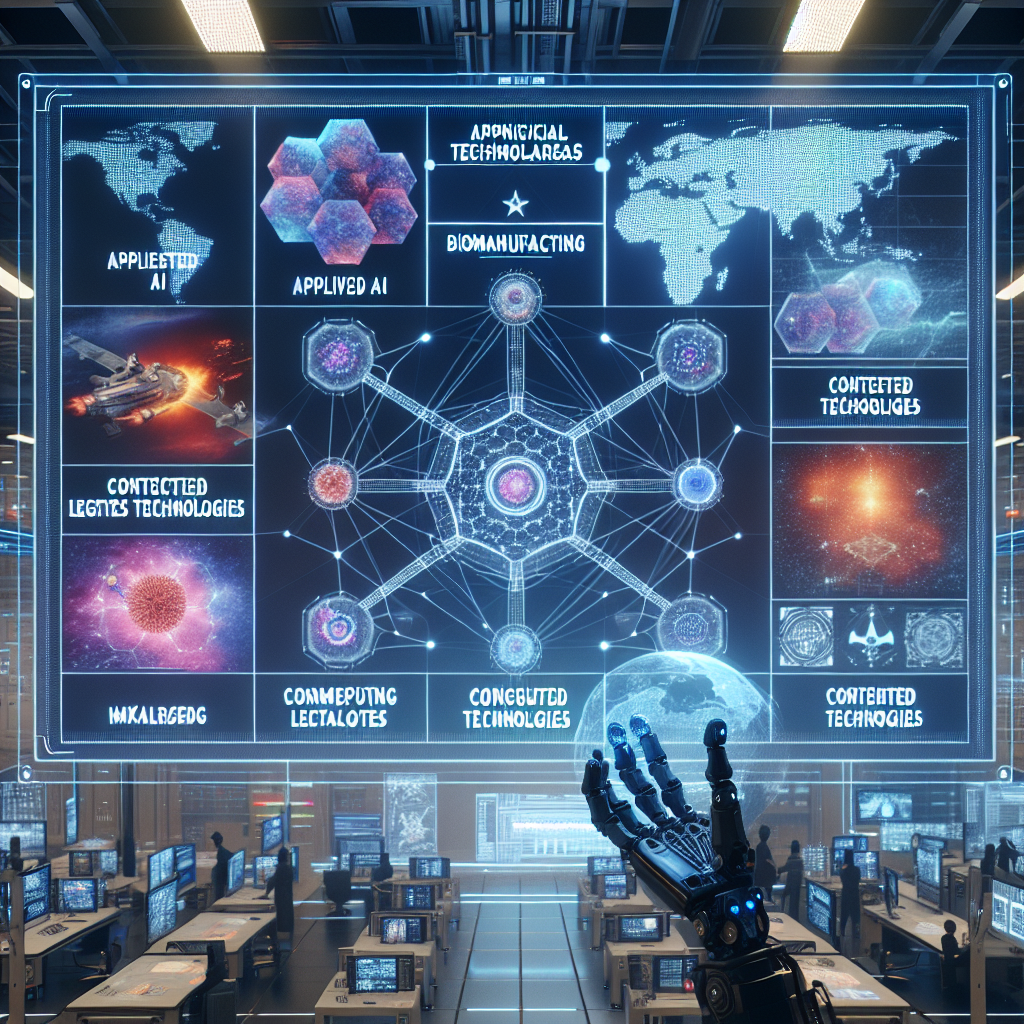
The United States Pentagon announced on Monday its latest research strategy, focusing defense research resources on six Critical Technology Areas (CTAs) to maintain technological advantage in global competition. The six areas include Applied AI, Biomanufacturing, Contested Logistics Technologies, Quantum & Battlefield Information Dominance, Scaled Directed Energy weapons, and Scaled Hypersonics technology.
According to a press release from the Department of Defense, these areas will define the future military superiority of the United States. These critical technology areas represent cutting-edge research and engineering technologies aimed at providing immediate and tangible force enhancements for warfighters, ensuring the U.S. continues to maintain its position as the world’s most powerful military force. From harnessing the potential of artificial intelligence to expanding the arsenal of hypersonic weapons, the Department of Defense is committed to providing key technologies that will shape the fate of American military power for generations to come.
While the specific funding scale was not disclosed, the document emphasizes leveraging “sprints” to accelerate research and development, enabling technologies to move faster from prototype to production.
Emil Michael, Deputy Under Secretary of Defense for Research and Engineering, stressed the need for the U.S. military to invest in technology research and development faster and more concentrated in the face of current threat environments. He stated that consolidating the previously scattered 14 technologies into 6 key areas aims to deliver battlefield-ready technologies to military personnel faster, emphasizing the need to outpace adversaries who are accelerating their own technological developments.
Pete Hegseth, Secretary of Defense, stated that as the vanguard of global military power, the U.S. military must ensure it never gets into a “stalemate battle” and always maintains overwhelming lethality and absolute superiority.
An internal memo obtained by Epoch Times from the Pentagon shows that the establishment of the six areas is directly related to recent international situations, including the logistics importance reflected in the war between Russia and Ukraine, China’s advancements in hypersonic weapons, and the strategic pressures brought by global AI competition.
The memo issued by Michael on November 13 to senior Pentagon and Combatant Command officials points out that the rapid integration of artificial intelligence will completely reshape military operations, from administrative management and intelligence integration to tactics and weapon systems. This directive aligns with the Trump administration’s America’s AI Action Plan proposed in July, which calls for the Department of Defense to fully adjust towards an “AI-first” framework.
The memo highlights that “Biomanufacturing” aims to utilize biological systems for large-scale production of critical substances and materials, strengthening the resilience of the U.S. military supply chain and reducing reliance on foreign, particularly hostile, countries. “Contested Logistics Technologies” focuses on ensuring troops can maintain supplies and operations when communications are disrupted, supply lines are under attack, or when entering denied areas.
In the “Quantum & Battlefield Information Dominance” realm, the U.S. military will accelerate quantum computing, secure communication, anti-jamming location, and electromagnetic spectrum utilization to maintain information superiority in complex battlefield environments. “Scaled Directed Energy Weapons” will drive the mass production of high-energy lasers and high-power microwave systems primarily used for counter-drone, air defense, and interception purposes.
The “Scaled Hypersonics Technology” covers both offensive and defensive aspects, including accelerating real-world deployment of hypersonic weapons and developing interception systems to counter China and Russia’s rapid expansion in related fields.
Since the Trump administration took office, there has been a significant increase in the involvement of civilian technology companies in defense research and development. In addition to traditional defense giants like Lockheed Martin, Raytheon, Boeing, and General Dynamics, innovative and high-tech companies such as Palantir, Anduril, and SpaceX have been actively brought into the military system, allowing advanced technologies to enter the military system more rapidly.
In June this year, several senior executives from technology companies were directly appointed as U.S. Army Reserve colonels (O-5) and incorporated into the Executive Innovation Corps, including Palantir’s Chief Technologist Shyam Sankar, Meta’s Chief Technology Officer Andrew Bosworth, and former Head of Product at OpenAI Kevin Weil. This move breaks the convention of military colonels typically requiring more than ten years of military experience and is seen as a signal of the military’s complete restructuring of talent and research and development models.
Michael emphasized that advancing these six critical technology areas requires strengthening collaboration between the various branches of the Department of Defense and Combatant Commands and closely coordinating with the industry and allied partners. He stressed that this will be an “unprecedented level of coordination.”
This article is based on a report from Epoch Times.