
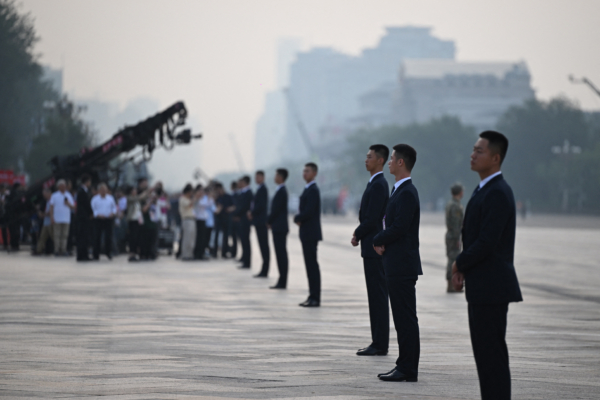
On September 3rd, the Chinese Communist Party held a grand military parade, showcasing a series of so-called cutting-edge domestic weapons, releasing positive information for the military industry market. However, the performance of the A-share market turned out unexpectedly, with the national defense military industry sector not only failing to rise with the occasion but instead collectively leading the market downturn.
According to a report by the “China News Weekly,” a grand military parade was held on Tiananmen Square in Beijing on September 3rd, with a significant increase in the proportion of new equipment. Newly unveiled equipment included the “Thunder-1” air-launched long-range missile, the “Giant Wave-3” submarine-launched intercontinental missile, the “Dongfeng-61” and “Dongfeng-31” new land-based intercontinental missiles, the “Dongfeng-5C” liquid-fueled intercontinental strategic nuclear missile, and the J-20S new stealth multi-role fighter.
The report stated that this military parade showcased advanced technologies such as hypersonic precision strikes, unmanned combat, and anti-drone equipment for the first time, highlighting China’s enhanced capabilities in independent research and development in the military industry and combat deterrence.
However, in stark contrast to the military parade, the A-share market on September 3rd performed poorly, with the military industry sector in particular becoming a hard-hit area, leading the market downturn.
During the morning trading session, the Shanghai Composite Index led the decline, with the combined turnover of the Shanghai and Shenzhen stock exchanges reaching 1.45 trillion yuan, a decrease of 456.7 billion yuan from the previous trading day. Across the market, more stocks fell than rose, with over 4300 stocks experiencing declines.
By the end of trading on September 3rd, the Shanghai Composite Index fell by 0.96%, the Shenzhen Component Index fell by 0.63%, and the ChiNext Index remained unchanged. According to the “Securities Times,” stocks related to military-civil fusion concept dropped by 4.67%, ranking among the top decliners in the concept sector. Within the sector, Northern Dragon plummeted by 20%, while Aerospace Science and Technology, Li Jun Shares, China Rocket, Jeque Equipments, and Chenxi Aviation were among those with significant declines.
In terms of funding, the military-civil fusion concept sector saw a net outflow of 11.073 billion yuan from major funds on that day, with 191 stocks witnessing a net outflow, and 28 stocks experiencing net outflows exceeding one billion yuan, with Changcheng Military leading the outflows, followed by Aviation Industry Corporation of China, China Aerospace Science and Technology Corporation, and Guangqi Technology.
The fluctuations in the A-share market following the military parade have drawn attention from financial experts. On September 3rd, a netizen named “Stock Trader” posted on Platform X expressing that the aerospace and military industry sector has been continuously speculated in recent years and the bubble is severe, suggesting that the military parade has provided a good opportunity for major institutions to offload their positions.
The netizen has previously written warnings about market risks and predicted that major players would take advantage of the high-profile atmosphere of the military parade to massively offload positions.
He further pointed out that ordinary investors often find it difficult to discern the direction of major players’ control in the market, with retail investors’ optimism conflicting with the strategies of major players. While the military parade is seen as a positive for the military industry sector, major players view it as the best time to offload their positions.
Financial commentator “Cold-eyed Financial” commented on social media, questioning the massive spending on large-scale military parades, which are more common in authoritarian countries, whereas other countries tend to showcase their military strength through actual combat demonstrations rather than formal military parades.
He raised doubts about the authenticity of some weapons displayed during the military parade, suggesting that some equipment might be merely models intended to create a deterrent effect. He believed that the collective plunge of military industry stocks after the military parade might stem from the market sensing issues with the authenticity of weapon development, similar to the historical scenario of the Beiyang Fleet, which appeared strong on the surface but was actually vulnerable.
Regarding the “AJX002” giant unmanned submarine-ar,ine vehicle that appeared at the military parade in Beijing, Taiwan Institute for National Defense and Security researcher Shen Mingshi also expressed skepticism, questioning whether its large size would effectively evade detection underwater and in the air. He told Da Ji Yuan that the static display of these weapons cannot verify their actual performance and does not rule out the possibility that they are “completely empty shells intended to scare others.”
Renowned Chinese writer Li Chengpeng sarcastically commented on Platform X, suggesting that the weapon formations in military parades are actually supported by the public’s social security, medical insurance, retirement pensions, taxes, fines, and housing loans.
He also mentioned that children of Chinese Communist Party officials often choose to study and live in so-called “hostile countries” such as the United States, Japan, Europe, Canada, and Australia rather than attending military parades in “friendly countries,” urging the public to rationally discern the meaning behind military parades.
(Extended Reading: Exposed Weapons in Beijing Military Parade Drawing Attention)
The reactions to the military parade in Beijing have elicited a wide range of comments and criticisms from financial analysts, commentators, and netizens alike, reflecting the complexities and nuances surrounding the intersection of military display, market dynamics, and public perception.