
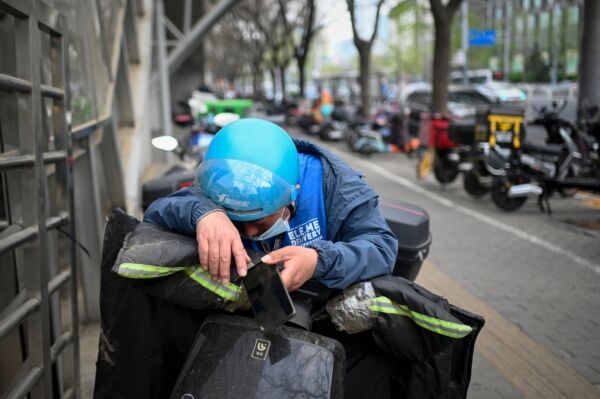
China’s three major food delivery platforms released their second-quarter financial reports one after another, showing the heavy price of the market reshuffle. Alibaba and JD.com have eaten into part of Meituan’s market share, forming a tripartite situation with Meituan. Meituan’s attempt to expand internationally has not been smooth either, as it got embroiled in legal disputes with Didi in Brazil, spiraling its struggles overseas.
Recently, China’s three major food delivery platforms have revealed their respective second-quarter (Q2) financial reports. Meituan, in its bid to maintain its leading position in the food delivery market, and Alibaba along with JD.com’s efforts to grab market share have all come at significant costs.
A report by UBS showed that the food delivery market in China has shifted from Meituan’s dominance to a tripartite scenario with Meituan’s market share dropping from 74% to 65%, Alibaba’s “Ele.me” increasing from 13% to 28%, and JD.com gaining a 7% share.
Meituan, primarily focused on food delivery, released its Q2 financial report on August 27, showing a revenue of 91.8 billion yuan, a 11.7% year-on-year growth. However, its net profit plummeted by 89% to 1.49 billion yuan, far below the expected 9.85 billion yuan. Its operating profit margin dropped from 13.7% to 0.2%, and its core local business operating profit margin tumbled from 25.1% to 5.7%.
Meituan saw a 52% year-on-year increase in sales and marketing expenses in Q2, reaching 22.6 billion yuan. However, new businesses, including food delivery, suffered severe losses of 14.8 billion yuan, showcasing the significant subsidies poured into the food delivery platform resulting in substantial losses.
In its Q2 financial report on August 14, e-commerce giant JD.com reported a revenue of 356.7 billion yuan, a 22.4% year-on-year growth. However, its net profit plummeted by 51%, reaching only 6.2 billion yuan. This reflects the painful cost of “burning money” by JD.com in this year’s food delivery battle.
During the food delivery battle, JD.com invested heavily in subsidies. However, its Q2 adjusted net profit was only 7.4 billion yuan, a 49% year-on-year drop. Its new business incurred losses as high as 14.8 billion yuan, and free cash flow decreased significantly by 55% from 49.6 billion yuan in the same period last year.
Alibaba’s Q2 financial report on August 29 showed a revenue of 247.6 billion yuan, a 2% year-on-year increase, lower than expected. However, its net profit surged by 76% to 42.4 billion yuan, mainly due to products related to AI. Alibaba’s real-time retail revenue also saw a 12% growth, but it came at a cost as its capital expenditure for food delivery and “Taobao Flash Sale” surged from around 10 billion yuan in Q1 to 38.7 billion yuan in Q2.
Professor Xie Tian from the School of Business at the University of South Carolina Aiken commented that these platforms are engaged in an “extremely intense competition” of mutually destructive competition through heavy subsidies, which is alarming.
Jiang Pinchao, the CEO of a financial and real estate investment company in the United States, stated that these trade giants are fiercely competing for a share of the food delivery market using subsidies, reaching a terrifying level of “winner takes all.” He remarked about the staggering order volumes in the millions and tens of millions, describing the situation as terrifying for enterprises to incur such heavy losses.
Chinese issues expert Wang He analyzed that the financial strength of these three platforms is formidable. If this aggressive competition continues long term, it may result in a situation where none can outlast the other, leading to mutual losses. “Their ultimate outcome may be the three reaching an internal agreement to delineate power spheres,” even though it would go against the Anti-Monopoly Law.
Wang He believes that the relentless competition stems from two main reasons: China’s unfair economic system, where those in power control everything, leading to monopolization; and the destruction of traditional morals and the Confucian merchant spirit in China.
Several experts have pointed out that China’s economic system lacks fairness and independent economic rules, characterized by capitalistic tendencies controlled by the privileged. Under this system, power leads to monopolization and relentless exploitation and expansion.
Moreover, within this framework, traditional Confucian merchant spirit and morals have been eroded, creating a fierce competitive landscape where everything revolves around money. The competitive scene among Chinese enterprises is likened to a jungle competition, leading to an impasse in China’s economic direction.
Recent reports from mainland media have shown that Meituan and Didi’s overseas food delivery platforms have replicated the aggressive competition seen domestically on the global stage, specifically in Brazil, showcasing a self-destructive competition.
On August 19, Didi’s food delivery platform, 99Food, sued Meituan’s overseas platform, Keeta, for trademark infringement in Sao Paulo, Brazil.
Five days earlier on the 14th, Meituan’s Keeta counter-sued Didi’s 99Food for violating competition laws, accusing 99Food of signing exclusive agreements with merchants, offering substantial prepayment (over 1 billion yuan in total), hindering Meituan’s entry into Brazil.
The leading player in the Brazilian food delivery market is local iFood, holding over 80% market share, followed by Uber Eats in second place.
99Food entered Brazil in 2019 but ceased operations in 2023. Meituan announced in May this year that Keeta would enter Brazil in the coming months. Subsequently, 99Food announced its return to Brazil in June.
The overseas competition between Didi and Meituan has garnered public attention. Xie Tian stated that some Chinese companies bringing the domestically practiced aggressive and destructive competition overseas will undoubtedly have a significant impact on international markets, bringing embarrassment to both Chinese nationals and enterprises.
Jiang Pinchao believes that the competitive tactics employed by Chinese companies are not viable in the international arena. Their competition without boundaries and rules will ultimately lead to their downfall, and the international community will be vigilant in response.