
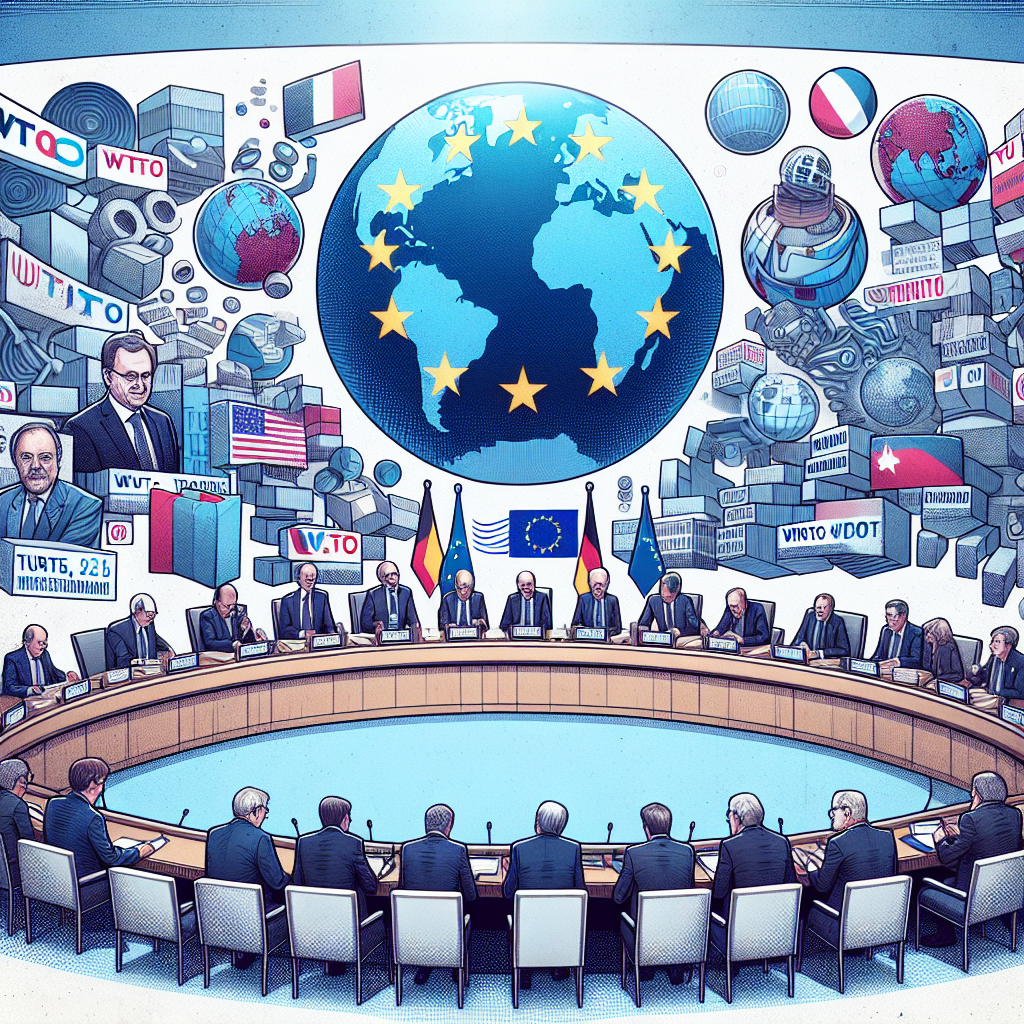
Amidst the stalled reform of the World Trade Organization (WTO) and the global multilateral trade system facing a deadlock, European Union leaders expressed during a European Council meeting held in Brussels on Thursday (June 26th) that if the WTO continues to be ineffective, Europe will consider establishing an alternative mechanism to reshape the international economic and trade order in response to multiple challenges, including the United States’ imposition of large tariffs.
German Chancellor Friedrich Merz bluntly stated, “If the WTO continues to malfunction, those of us countries that still value free trade must find alternative paths.”
“This idea is still in its infancy,” Merz said, referring to the proposal put forth by Ursula von der Leyen, the President of the European Commission.
Von der Leyen proposed that the EU could work with members of the Comprehensive and Progressive Agreement for Trans-Pacific Partnership (CPTPP) to design a new rules-based trade organization to gradually replace the now defunct WTO.
She stated, “This initiative is worth investing in because the combination of CPTPP and the EU will form a powerful force.” She also emphasized that the EU should learn from the WTO’s experience to avoid repeating past mistakes.
Meanwhile, the EU is also actively preparing to reach an emergency trade agreement with the Trump administration. With less than two weeks left until the July 9th deadline set by Trump, if the EU does not accept his conditions, the US may impose punitive tariffs of up to 50% on European imports.
On May 23rd, US President Trump proposed imposing a 50% tariff on EU imports starting from June 1, citing a lack of progress in trade negotiations. This percentage is much higher than the 20% “reciprocal tariffs” briefly implemented on April 9th. Trump had given countries a three-month window to negotiate further with the US.
According to Reuters, European countries are weighing whether to quickly reach a temporary agreement to avoid escalating trade wars or continue to seek more favorable terms. French President Emmanuel Macron stated, “The ideal situation would be zero tariffs, but if necessary, 10% is the bottom line.”
In May, the UK reached a preliminary trade arrangement with the US and secured a fixed 10% tariff treatment. This agreement serves as a reference point for negotiations between the US and the EU. Prior to this, on April 2nd, Trump announced the “Large-scale Reciprocal Tariff Framework” at the White House, including imposing a 10% basic tariff on almost all imported goods from various countries as a unified trade baseline.
Lithuanian President Gitanas Nausėda admitted on Thursday that at this stage, the EU may only “hope to receive treatment similar to that of the UK,” but he also acknowledged that “the UK is always seen as a different type of partner in the eyes of the US, so we can only wait and see.”
Merz advocates for quickly reaching an agreement, even if it is just a framework. He pointed out, saying, “Industries from chemicals, steel to automotive are facing impacts, and business risks are rising. With less than two weeks until July 9th, it is impossible for us to negotiate a comprehensive agreement during this period, so we must find a solution as soon as possible.”
At the same time, European leaders also acknowledge that von der Leyen’s proposed cooperation with CPTPP, while strategically significant, may only be a transitional strategy used to shift pressure and gain negotiating space.
Polish Prime Minister Donald Tusk stated that in the current situation, the EU must be “innovative like friends across the Atlantic, and at times even unpredictable.” He suggested that Europe may need to adopt a more aggressive negotiating style similar to that of Trump.
“We certainly view the US as one of our closest partners, but to some extent, we also need to act like our partners,” he said.
The CPTPP currently has 12 member countries, including Japan, Australia, Canada, and the UK. The US was originally a promoter of the former TPP but announced its withdrawal in 2017 under the Trump administration and has not returned since.