
On the morning of June 7, the annual National College Entrance Examination, known as the Gaokao, officially began in China, drawing attention to the essay topic once again. One of the essay prompts required students to cite works by Lao She and two others to write about “patriotism for the country,” sparking discussion due to the severe persecution faced by all three individuals under the Chinese Communist Party.
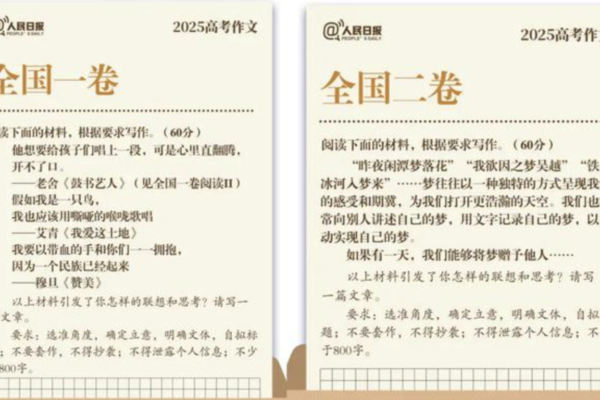
The national essay question for the Gaokao on June 7 in China featured excerpts from writings by Lao She, Ai Qing, and Mu Dan during the Anti-Japanese War, prompting students to reflect on the relationship between the individual and the nation, as well as their understanding of the spirit of patriotism, in an essay of no less than 800 words.
The materials provided for the essay included three passages: “He wanted to sing a song for the children, but his heart was in turmoil and he couldn’t speak. – Lao She’s ‘The Drum Singers,'” “If I were a bird, I should also sing with a hoarse voice. – Ai Qing’s ‘I Love This Land,’ ” “I want to embrace you with bloodied hands – because a nation has risen. – Mu Dan’s ‘Praise.'”
Ironically, Lao She, Ai Qing, and Mu Dan, who once harbored illusions about the Chinese Communist Party, all suffered severe persecution after the CCP came into power.
Public records show that the renowned Chinese writer Lao She (February 3, 1899 – August 24, 1966), whose real name was Shu Qingchun, was a Christian. In December 1951, he was awarded the title of “People’s Artist” by the Beijing Municipal Government. During the Cultural Revolution in 1966, Lao She was arrested, forced to kneel in front of a fire burning Beijing Opera costumes, beaten, and either jumped into a lake to commit suicide or was killed and thrown into the lake the next day.
The poet Ai Qing (March 27, 1910 – May 5, 1996), whose original name was Jiang Zhenghan, was expelled from the Communist Party and had all his positions revoked during the “anti-rightist” movement in 1957. During the Cultural Revolution, Ai Qing was subjected to several rounds of criticism.
Also a renowned poet, Mu Dan (April 5, 1918 – February 26, 1977), whose real name was Zha Liangzheng, returned to China from the United States in 1953. After returning to China, Mu Dan’s father-in-law, Zhou Shuta, was the Deputy Mayor of Tianjin at that time. In 1966, during the Cultural Revolution, Mu Dan’s whole family was “relocated” to a farm for labor reform. In 1968, Mu Dan was sent to a “cowshed,” and his wife Zhou and Liang were also labeled as “suspected American agents” and underwent isolated interrogations.
An article published by mainland China’s self-media “Countdown to the Senior Year” stated, “This national essay topic seems rather abstract at first glance. To be honest, when Brother Shi saw it for the first time, he was completely baffled! It feels like it’s hard to understand what they’re talking about without knowing the background of the relevant works. It can be said that without understanding the creative background of the works, it’s probably difficult to relate to the spirit of patriotism.”
On the tightly controlled official Weibo platform, many mainland Chinese netizens commented according to the so-called standard CCP thinking:
“It’s too difficult. Can you give something more relevant to high school students?”
“It’s not that difficult. The first sentence of Lao She may be unclear, but the latter two sentences are pretty obvious. It’s just missing a direct hint to write about the rise and fall of the nation. To write well, you need to seriously memorize some patriotic and nationalistic points. It’s not easy.”
“I wrote about patriotism + youth.”
“Inheritance, dedication, national self-confidence.”
“#GaokaoEssay #OneVolume→Centennial Changes; Two Volumes→Leading the Way, Shared Fate, Global South, Three Major Initiatives.”
Some expressed confusion: “If patriotism and the spirit of resistance during the war are not written, will points be deducted?”
On an overseas platform X, the way the Chinese Gaokao essay was framed led to mockery among Chinese netizens:
“If the Gaokao asked students to interpret the poem Mu Dan (Zha Liangzheng) wrote before his death, that would be a real sign of national progress.”
“Those who know the truth but can speak so convincingly in public are exactly the kind of people they need.”
“This is blending the Gaokao with political scrutiny. They’ve merged them into one.”
“Children’s minds are filled with one-sided information. When they grow up and maintain their curiosity and exploration, fill in the gaps with information, they may wake up.”
“Anyone who knows a bit of history won’t pass this essay.”
“Anyone brave enough to write about the experiences of these three individuals during the Cultural Revolution will definitely get a zero.”
“The examiners should be suspended and investigated for the charge of ‘low-level red high-level black’!”
“Now brainwashing is so blatant? Starting Gaokao essays with a nationalist narrative? This sets a bad precedent, they are already starting to filter out those with incorrect thoughts. The Gaokao is shifting from selecting talents to selecting minions.”
“The title should be: those who run slowly will meet this fate.”
“This is the true relationship between the individual and the nation. When someone tells you to have ‘national righteousness,’ they are either coming to rob you or to ensure you perish.”
“On the surface, promoting Sino-Japanese cooperation, but behind the scenes playing on emotions of war and aggression, later becoming unemployed and working in Japan, brainwashed to engage in mischief in Japan, polluting and damaging Japan, and even causing turmoil over Okinawan independence. This is the CCP. Anyone who gets close to the CCP will not have a good ending.”
“Conclusion: when the CCP needs me, I’m one of them; when the CCP no longer needs me, I’m a spy, a traitor, a sellout. Fact: the CCP has transferred their families and assets to the West.”
“Those who answer correctly are all ‘wall jumpers’! This is a trap question testing political inclinations!”
“Hope the subject of next year’s Gaokao essay will be about how many tanks can fit in front of Tiananmen Square.”