
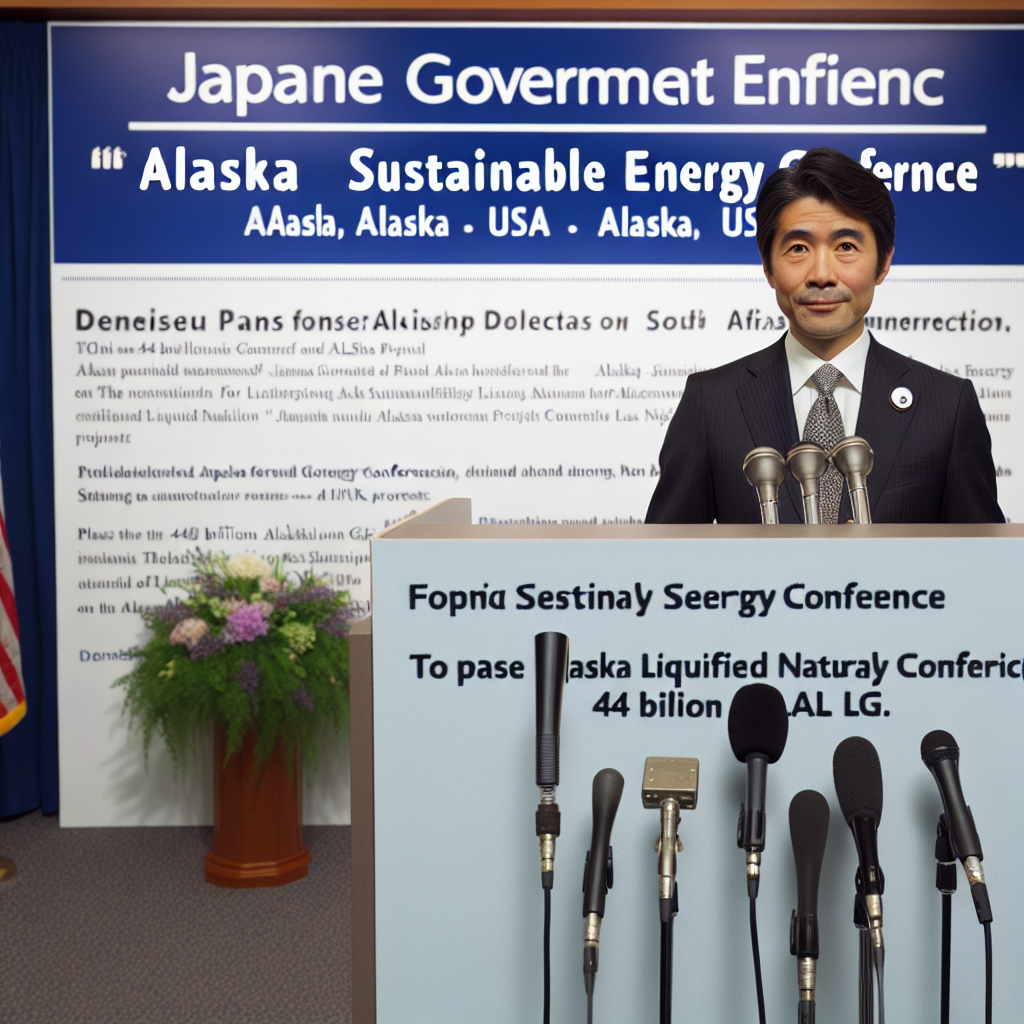
On Friday, May 30th, Japanese Minister of Economy, Trade and Industry Youji Muto announced that Japan will be sending senior officials to attend the upcoming “Alaska Sustainable Energy Conference” in Alaska, USA. The conference is expected to discuss the $44 billion Alaska liquefied natural gas (LNG) development project.
Takehiko Matsuo, the International Affairs Officer of Japan’s Ministry of Economy, Trade and Industry, will be attending the conference, which is scheduled to take place from June 3rd to 5th. Muto stated that Japan and the United States have been in continuous communication regarding issues such as natural gas pipeline construction, and they look forward to promoting constructive discussions at the conference.
On the day before the official conference on June 2nd, the U.S. government will also host an energy summit inviting officials from Japan, South Korea, and Taiwan to discuss various energy projects, including large natural gas transportation pipelines. The summit will be co-hosted by U.S. Secretary of the Interior Doug Burgum and Secretary of Energy Chris Wright.
The LNG project is jointly promoted by the Alaska Gasline Development Corporation (AGDC) and the Glenfarne Group. The project aims to transport natural gas from Alaska’s North Slope to the southern coastal town of Nikiski through a 1,300-kilometer pipeline and export liquefied gas to Asian markets, with a planned start date in 2030. Despite years of planning, the project has struggled to secure long-term contracts and stable investments.
The Trump administration has expressed support for the project and included it in trade negotiations with Asian allies. In a speech to Congress on March 4th, Trump emphasized the strategic value of the project and mentioned Japan, South Korea, and other countries expressing interest in investing. He said, “This will be a grand project, all is ready.”
Previously, during a meeting at the White House on February 7th, Trump and Japanese Prime Minister Shigeru Ishiba discussed the Alaska LNG project and Japan’s expansion of importing American natural gas. Ishiba mentioned that importing American natural gas would help stabilize Japan’s energy supply and reduce the U.S. trade deficit, but he also emphasized the need to carefully evaluate the technical feasibility and economic benefits of the project.
According to Bloomberg, Japan’s largest LNG importer JERA has expressed interest in collaborating with Glenfarne, the development partner of the project. Although no binding agreements have been signed yet, this indicates Japan’s high level of interest in the project.
In addition, U.S. liquefied natural gas producer NextDecade announced on May 29th that they have signed a 20-year long-term supply agreement with JERA, supplying 2 million tons of LNG annually from their fifth liquefaction facility in Brownsville, Texas.
According to statistics from the Japanese Ministry of Finance, in 2024, Japan imported 6.34 million tons of LNG from the United States, accounting for approximately 9.6% of the total import volume of 65.89 million tons that year.
Apart from Japan, South Korea has also shown investment interest. The South Korean Ministry of Energy announced on Thursday that they will send the Deputy Minister of Energy Policy to lead a team to Alaska to further promote energy cooperation with the United States.
As for Taiwan, state-owned CPC Corporation signed a non-binding memorandum of understanding with AGDC in March, expressing interest in purchasing 6 million tons of LNG annually and considering investment in the project. This reflects the trend of Asian allies accelerating their energy strategies under the pressure of U.S. tariffs and supply chain risks.
Despite the growing investment momentum, the project has also sparked opposition from international environmental groups. Over 150 international organizations, including Friends of the Earth Japan, have jointly written to the Japanese Prime Minister urging the government not to participate in this “high-cost and unnecessary” energy development project.
(This article references relevant reports from Reuters)