
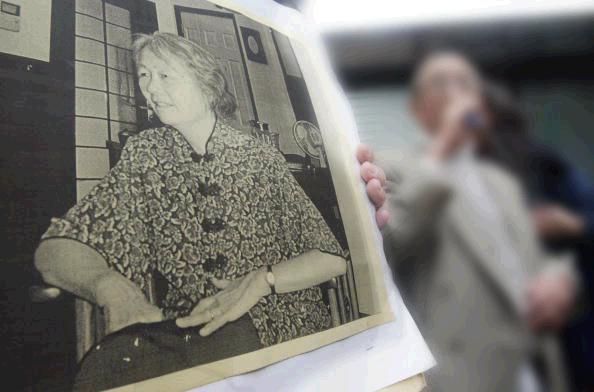
On the eve of the 36th anniversary of the Tiananmen Square massacre, the group “Tiananmen Mothers”, established by the families of the victims of the June Fourth crackdown, faces suppression as they annually call on the Beijing authorities to reveal the truth about the events of June Fourth. One of the founders of “Tiananmen Mothers,” Zhang Xianling, whose 19-year-old son was killed by the Chinese army at Tiananmen Square on June 4, 1989, expressed her commitment to speaking out about the truth of the massacre and vowed not to remain silent.
At 88 years old, Zhang Xianling, one of the founders of Tiananmen Mothers, stated in an interview prior to the 36th anniversary of June Fourth that although she now has limited mobility and requires a wheelchair, she will make sure to visit Wan’an Cemetery on the anniversary to pay respects to her son Wang Nan, who died on June Fourth.
Zhang Xianling revealed to Radio Free Asia that during what the authorities consider “sensitive periods,” her phone always faces interference, and last year before June Fourth, she was completely unreachable. The authorities have not eased their surveillance on her, and since her return to Beijing in April from another city, she has been closely monitored.
Upon her return home from Hainan late at night, Zhang Xianling recounted that the political security personnel immediately called her tensely and stationed guards at her doorstep, with someone stationed there the next morning at 6:00 a.m.
“I don’t know why they are so afraid of me. I am already 88 years old, can’t walk 200 meters without needing a wheelchair. Am I that terrifying?” she questioned.
The authorities demanded Zhang Xianling to guarantee no meetings with reporters or speaking out, a demand she stated she couldn’t fulfill. “I speak the truth, why should I not speak when asked? If anyone, be it a reporter or not, asks me about June Fourth, I will speak,” she said.
As the anniversary of her son’s death approaches each year, Zhang Xianling expressed the enduring pain of losing a child that time cannot fade or erase.
She noted that members of Tiananmen Mothers are scattered across different locations and cannot meet frequently; however, the number of individuals participating annually in signing open letters reflects many bereaved families like her steadfast in their commitment to seeking justice for June Fourth, reinforcing her beliefs and will.
People commemorating June Fourth across various regions continue to support the Tiananmen Mothers group. Zhang Xianling emphasized that as long as everyone remembers the massacre that took place in Beijing and Tiananmen Square, there is a strong belief that one day the truth will be revealed and the victims properly mourned.
On the night of June 3, 1989, Wang Nan asked his mother, “Mom, do you think they will open fire tonight?”
Zhang Xianling replied, “During the ‘Gang of Four’ era, they did not open fire. How could they open fire now?”
Zhang Xianling, a former senior engineer at the Ministry of Aerospace Industry, had a son, Wang Nan, who was a second-year high school student at Beijing Yuemantang School in 1989, aged 19. Her husband, Wang Fandi, a renowned Chinese musician and professor at the China Conservatory of Music, passed away in 2017, never witnessing justice for June Fourth.
Wang Nan, an aspiring photojournalist who was passionate about photography, was keenly interested in the student movement and often visited Tiananmen Square to take photos during his lunch breaks. However, on the night of June 3 when he was out, the Chinese military opened fire, and he fell in a pool of blood at the southern end of Nan Chang Street on the west side of Tiananmen Square. It was not until 10 days later that Wang Nan’s parents were informed of his death.
According to investigations by Wang Nan’s parents after the incident, a bullet had pierced Wang Nan’s helmet, striking his left frontal lobe and exiting from the back of his left brain, leaving a bullet hole at the back of the helmet. Using the excuse that the wounded were rioters, troops threatened citizens on the scene from providing aid. Medical students following the troops only managed to bandage Wang Nan due to excessive bleeding, with his condition beyond saving.
The martial law troops originally planned to “destroy the bodies” to prevent live broadcasts via foreign satellites, cover up the truth of Tiananmen Square and spread the false narrative that “not a shot was fired and no one died.” Hence, the bodies of Wang Nan and two others were buried on the lawn in front of Beijing No. 28 Middle School on the west side of Tiananmen Square. Shortly after, heavy rain exposed the bodies, leading to a foul smell. Following complaints from the school, the troops had no choice but to unearth the bodies.
Misidentifying Wang Nan as a military personnel due to his uniform, he was not immediately cremated like others dubbed “rioters.” Instead, he was taken to the mortuary at the Huguosi Traditional Chinese Medicine Hospital. It was only then that Wang’s family could locate his body.
Despite finding their son’s remains, on June 9, Deng Xiaoping classified the student movement as a “counter-revolutionary riot,” resulting in orders barring the cremation of the bodies. After numerous negotiations with the authorities, and given that he was a member of the ’93 Society, appointed by the Beijing United Front Work Department and relevant city committees, Wang Nan was finally allowed to be cremated on June 20. However, the cause of death listed on the cremation certificate was “died outside,” concealing the fact that he had been shot.
Both Wang Fandi and his wife persisted in seeking justice for June Fourth, uncovering the truth about the incident, and demanding justice for the victims. In August 1989, Wang Fandi and his wife visited the parents of Jiang Jielian, another victim of June Fourth, Jiang Peikun, and Ding Zilin. The families formed a close bond and together established the “Tiananmen Mothers” group.
Within the “Tiananmen Mothers” group, most members are mothers and widows serving as spokespersons, but there are also many fathers, with Wang Fandi being one of the key figures. Despite his illness, he actively participated in the group’s activities, gave media interviews, and disclosed the monitoring of the Tiananmen Mothers group by the authorities to the public.
Wang Fandi was born in Shanghai in 1933. A distinguished teacher at the China Conservatory of Music and a master of traditional Chinese pipa music, he was also known as the “saintly hand” in the world of the pipa. His solo pipa pieces such as “Spring of Tianshan” and “Give Me a Rose” were renowned in the pipa community.
In March 2013, Wang Fandi was invited to serve as the expert consultant for the “Qing Yue Cup” 2013 Hong Kong International Youth Pipa Competition held on May 28. Amidst this, Wang Fandi and his wife faced harassment from public security authorities, with impediments to their travel to Hong Kong. It was not until the day before their departure for Hong Kong that the China Song Qingling Foundation, the organizing entity, suddenly called Wang Fandi, citing the nearing of June Fourth as a reason to politely rescind their invitation to Hong Kong.
On December 8, 2017, Wang Fandi passed away at the age of 84 due to heart failure. Zhang Xianling shared that as her husband lay dying, one of his eyes remained open, still urging her to continue the fight for justice for June Fourth. She promised to fulfill her husband’s unfinished business, continuing to carry the responsibility of the Tiananmen Mothers group, and then closed his eye.
In a self-penned note in 2004, Zhang Xianling wrote, “Speak the truth, refuse to forget, seek justice, and appeal to conscience,” a sentiment that not only resonates within the Tiananmen Mothers group but also echoes the collective voice of all conscientious individuals in China.