
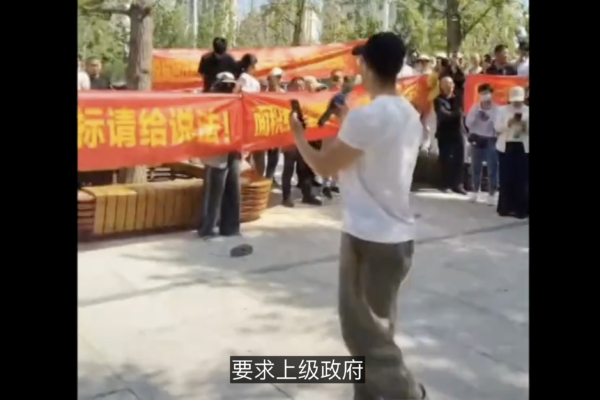
Recently, Beijing Daxing International Airport has been touted by the official as the world’s largest airport. However, this “political achievement project” has plunged the lives of thousands of farmers in Langfang, Hebei Province into hardship due to issues such as unfair compensation and reduced resettlement housing, leading them to start rounds of rights protection protests.
Being hailed as the “national glory” by the authorities, Beijing Daxing International Airport is a key national project personally decided by the Chinese Communist Party leader Xi Jinping. The airport is located in the Linzhang Economic Zone with a total planned area of 150 square kilometers, spanning across Beijing and Hebei. The area in Hebei’s Langfang City covers over ten villages and thousands of residents.
In May 2020, the Guangyang District of Langfang City completed the land requisition work in just 10 days, promising to provide resettlement housing to the villagers and letting them choose housing units by signing contracts.
However, the resettlement housing project “Yuehang Jiayuan” at Daxing Airport did not begin handing over units until April 2025, with significantly reduced housing sizes that are too small to accommodate many household appliances and furniture, resulting in unanimous resistance from the villagers.
Since May, hundreds of villagers from over ten villages like Fashang, Beiwangli, and Huotouying have launched multiple rounds of rights protection actions.
A local villager, Mr. Liu, stated on May 20 that on May 12, the villagers gathered in front of the Guangyang District government, submitting applications to withdraw from the housing contracts, with all villagers signing the petitions, demanding compensation at market prices as they were planning to buy houses on their own.
“We have submitted withdrawal applications from over ten villages,” he said. The four largest villages have over a thousand residents each, while the smaller ones have between three to five hundred residents. “We don’t want these houses anymore, either compensate us at market prices or rebuild them.”
He mentioned that at least several hundred people attended the gathering, but due to the dispersed living locations, some couldn’t make it.
“The district and city government leaders have not met with us until now, and the issue remains unsolved,” he continued. “The city government told us they would respond within three days, but it has been a week now, and we have not heard anything.”
Mr. Liu revealed that the rights protection actions have faced heavy surveillance and control. “We elected a representative, but now warnings have been issued, there is a gag order, and everyone is under surveillance. Even lawyers are afraid to take our case.”
He also mentioned that relevant information regarding the rights protection actions has been swiftly deleted from the internet, with some protesters even being detained, causing strong dissatisfaction among the villagers.
In December 2020, it was reported by the Langfang Daily that the Guangyang District government of Langfang City completed the signing of relocation agreements for the Daxing Airport Linzhang Economic Zone, involving 19 villages and streets, 2,773 households, and 12,660 individuals, in a remarkable “ten days and nights” speed.
The report described the operation as a “blitz” where the officials “mobilized all resources,” with loudspeakers broadcasting policy propaganda, and officials conducting late-night “heart-to-heart” talks to pressure villagers to sign the agreements towards completing this “relocation miracle.”
Behind this “relocation miracle” is the sacrifice of the local villagers’ livelihoods. On May 13, villagers disclosed injustices during the demolition and resettlement process for the Daxing Airport project to the “Yesterday” website, a platform that tracks collective resistance incidents in China:
1. The compensation standards for demolition and relocation were extremely unfair: while the compensation in Beijing’s area was around 250,000 yuan per mu, Hebei farmers received only about 60,000 yuan. Some local officials colluded with thugs to force villagers to transfer land use rights through threats, and then, disguised as “landholders,” fraudulently obtained high compensation from the government, later dividing the proceeds among themselves.
2. Reduced resettlement housing size: The housing areas provided to villagers were significantly smaller than the houses they were vacated from, and the compensation amount was insufficient for renovation.
3. Severe delays in handing over resettlement housing, delayed by nearly two years.
4. High-pressure controls at the resettlement site’s handover, with police monitoring the scene and forcibly demanding villagers to “pay first, look at the house later.”
5. Severe reduction in size: The public area of the resettlement house exceeded 36%, yet the term “public area” was not mentioned in any of the relocation agreements, indicating severe deceptive practices.
6. Suppression of rights protection actions and deletion of information.
During the 2020 relocation, villagers selected house types based on government-provided floor plans, filled with expectations. “Don’t you trust the government?” Mr. Liu, a local villager, told Epoch Times, “At that time, the pictures showed cabinets and beds, but without dimensions specified.”
He explained that the viewing period was from April 30 to May 8 or 9, the first viewing time, “Only after seeing the units did we realize the housing area reductions, so everyone said they wouldn’t take them.”
“Everyone knew the houses were small. They claimed the unit was 74 square meters when it should have been 85 square meters. Now when we receive the keys, the officials say the unit was built too large,” Mr. Liu said. “They said there was a public area, which everyone recognized, but it was indeed too big.”
He described, “One person from my area tried to fit a mattress, an air conditioner compressor, and a washing machine, and none of it could fit. Even the water pipes and the machine itself couldn’t fit.”
He mentioned the kitchen’s width was only about 1.4 meters, with cramped operating space. “If we install a stove, it’ll take up at least 70 centimeters.”
“And the bedroom, it won’t fit a larger bed,” he continued. “No matter how you arrange it, the bedroom needs to be more spacious. The design and layout of the unit are also unreasonable, making it even smaller after the reductions.”
Mr. Liu believed that the authorities were well aware of the housing area reductions. Only those who received their keys could view their units, and others were not allowed to observe.
In addition to severe reductions in resettlement housing sizes, since the handover date, the authorities have halted transitional payments for villagers who have not collected their keys. Mr. Liu stated, “Starting from the handover date, whether you sign or not, the transitional payment will be suspended. If you are supposed to receive your keys and you don’t, they say the transitional payment will stop.”
What’s more worrisome for the villagers is that the compensation fee for the residential land was based on 1,550 yuan per square meter, while current local property prices have increased to 5,500 yuan per square meter. Most villagers have purchased units of 85, 110, or 135 square meters, exceeding the government’s free replacement area of 60 square meters per household.
“It’s like getting a house-to-house exchange, but we’re not getting anything for free because they’re valuing it at 55 square meters per person, and a household can purchase 60 square meters at the standardized price,” Mr. Liu said.
“Compared to five years ago, isn’t the housing price higher now? Our 60 square meters at the standardized price is 5,500 yuan per square meter.” Therefore, if calculated based on current property prices, there would be “tens of thousands short and hundreds of thousands in excess.” So, in essence, there’s hardly any money left.
“Where can you afford to buy a house?” Mr. Liu concluded. “Our demand is simple: compensate us based on market housing prices, we don’t want these houses, it’s either a fair compensation or rebuilding them.”
Currently, the villagers’ rights protection movements continue. Villagers hope for attention and support from all sectors of society to provide more assistance and solidarity for the persecuted villagers.