
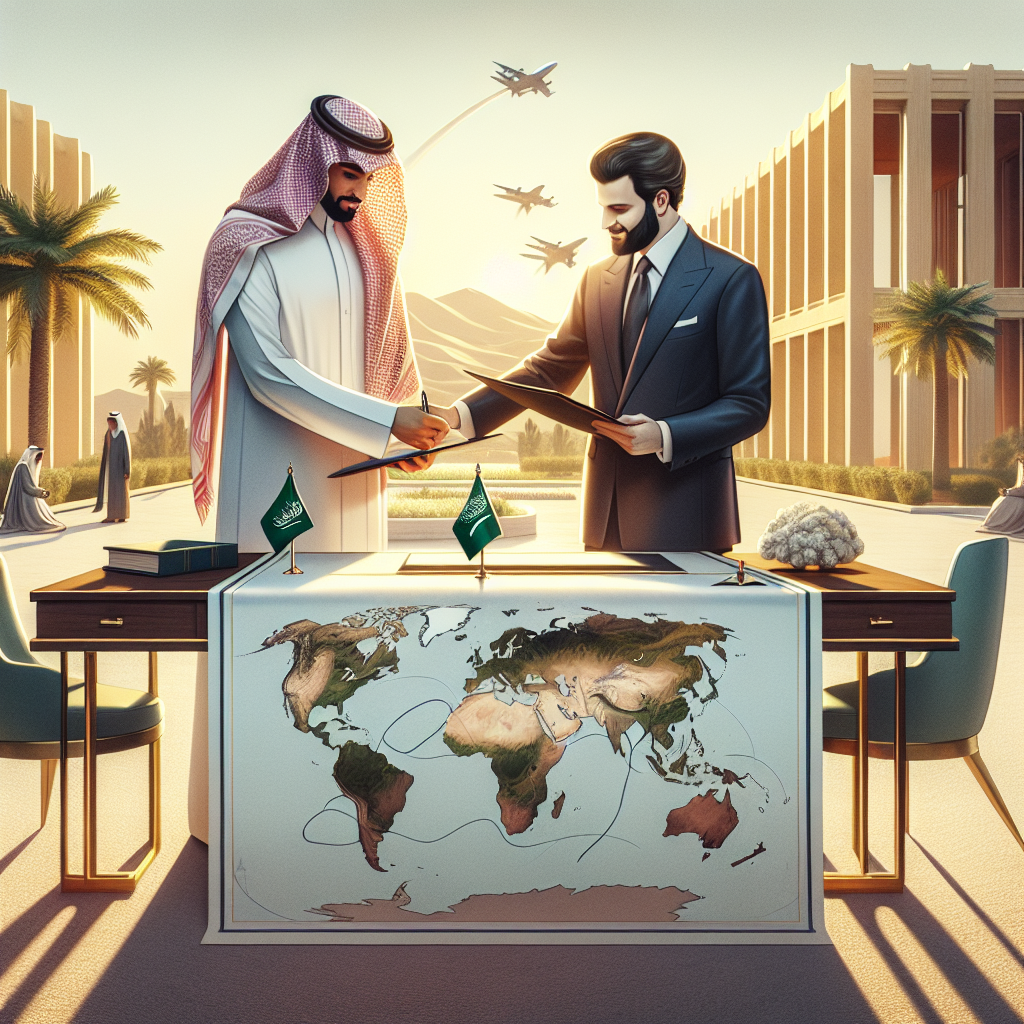
On Tuesday, May 13, during his visit to Saudi Arabia, U.S. President Trump signed a strategic economic partnership agreement with Saudi Crown Prince Mohammed bin Salman, also known as MBS. The agreement covers cooperation between the two countries in various areas including energy, mining, and defense.
Upon his arrival in Riyadh on Air Force One, Trump was warmly welcomed by Salman, and the Saudi side even rolled out a lavender carpet to greet the U.S. president. Subsequently, Trump visited the Royal Court of Saudi Arabia.
In a luxurious room, the U.S. president and Saudi leaders sat in front of a desk and signed the strategic economic partnership agreement, with applause erupting on-site.
The White House announced that Saudi Arabia would invest $600 billion in the U.S., including a nearly $142 billion arms deal, the largest inter-alliance arms sales agreement.
“I truly believe that we appreciate each other,” Trump said during his meeting with the de facto ruler of Saudi Arabia, Crown Prince Salman. Trump referred to Salman as a friend and mentioned the good relationship between the two parties.
He also recalled his visit to Saudi Arabia during his first term in 2017 and the experience of Salman visiting the White House, praising Salman’s wisdom.
Trump stated that Saudi investments in the U.S. would help create job opportunities. He jokingly mentioned that the $600 billion promised investment from Saudi Arabia could potentially be equivalent to $1 trillion, a figure he has previously cited while seeking investments from important strategic partners.
The agreements signed by the two leaders also encompass military cooperation, focusing on enhancing Saudi Armed Forces capabilities, developing defense systems, ammunition training for the National Guard, support services, system upgrades, spare parts supply, and education, as well as improving the healthcare capabilities of the Saudi Armed Forces.
Other agreements include cooperation between the customs departments of both countries, infectious disease related medical research, judicial cooperation, as well as a partnership between the Saudi Ministry of Interior and the Federal Bureau of Investigation.
The agreements signed by Trump and Salman also include a memorandum of understanding on energy, a memorandum of understanding on mineral resources, and cooperation in space-related matters.
As Saudi Arabia strives to position itself as a key U.S. ally, this moment highlights the deepening cooperation between the two nations.
Accompanying Trump on his visit are Secretary of State Pompeo, Defense Secretary Esper, Commerce Secretary Lutenik, and numerous U.S. business leaders, including billionaire Elon Musk. Trump is set to travel from Riyadh to Qatar on Wednesday and visit the United Arab Emirates on Thursday.
The White House described the U.S.-Saudi arms deal as the “largest arms sales agreement in history” – almost $142 billion, which includes providing the Saudi military with the most advanced combat equipment and services from over a dozen U.S. defense companies.
A White House press release detailed the five main categories covered by the deal:
– Air Force upgrades and space capabilities
– Air defense and missile defense
– Maritime and coastal security
– Border security and army modernization
– Information and communication system upgrades
The White House mentioned that the agreement also includes “providing extensive training and support for the Saudi Armed Forces, including enhancing Saudi military academies and military medical services.”
Before President Trump’s visit to Saudi Arabia, the anticipation for the signing of the arms deal had been widely reported, as the U.S. had resumed offensive weapon sales to Saudi Arabia last year.
The White House stated that the U.S.-Saudi agreement announced today includes the “largest defense sale agreement in history.”
During Trump’s visit, Saudi Arabia hosted a Saudi-U.S. investment forum, attended by figures like Larry Fink, CEO of BlackRock, Su Shimin, CEO of Blackstone, and U.S. Treasury Secretary Scott Bessent.
Saudi Investment Minister Khalid al-Falih at the forum’s opening ceremony stated: “While energy remains the cornerstone of our relationship, the investment and business opportunities of the Kingdom of Saudi Arabia have expanded and grown multiple times.”
“Therefore… when Saudis and Americans work together, very good things happen, and when these joint ventures are established, great things often come from them,” he said before Trump’s arrival.
At the forum, Nvidia announced its provision of high-end chips to Humain, Saudi Arabia’s newly established AI company, for its 500-megawatt data center construction.
Among those who lunched with Trump and the Crown Prince were American business titans like Elon Musk of Tesla and SpaceX, and Sam Altman of OpenAI.
The Crown Prince of Saudi Arabia is committed to diversifying the Saudi economy and has launched a major reform plan called the “2030 Vision,” which includes “mega-projects” such as NEOM – a future city equivalent in size to Belgium. Last year, oil contributed 62% of the Saudi government’s revenue.
Rayan Fayez, Deputy CEO of NEOM, stated at the forum: “Approximately $1 billion of investment is being poured into cutting-edge technology areas, with most of the investments flowing to U.S. companies, which is not surprising.”
For decades, Saudi Arabia and the United States have maintained a strong connection, built on a solid agreement: Saudi Arabia provides oil, and the U.S. provides security.