
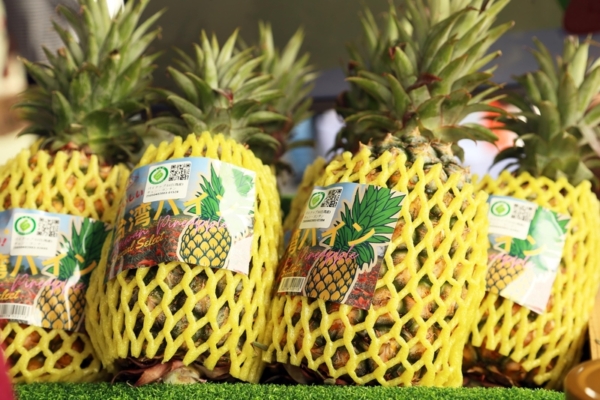
The Ministry of Agriculture of the Republic of China (Taiwan) announced that Taiwan’s pineapple exports to Japan reached 19,373 metric tons in 2024, hitting a record high. This achievement demonstrates the increasing competitiveness and popularity of Taiwanese agricultural products in the international market.
To deepen the promotion of Taiwanese agricultural products in the Japanese market, the Ministry of Agriculture of the Republic of China held the “Taiwan Fruit Supplies Japanese Ibaraki County School Children Nutrition Lunch Press Conference” today, officially marking the seventh year of this cooperation program. The press conference was hosted by Deputy Minister of the Ministry of Agriculture, Hu Zhongyi, with honored guests including Director Yuki Tsuboi of the Kasama Taiwan Office in Japan, Mayor Huang Wei-Che of Tainan City, and Chairman Zhang Yuping of the Taiwan Excellent Agricultural Product Development Association, coming together to witness this significant milestone of Taiwan fruit expanding into the international market.
The Ministry of Agriculture of the Republic of China explained that in order to promote locally-grown fruits in the Japanese market, the Taiwan Council of Agriculture signed a “Memorandum of Cooperation for Enhancing Dietary and Cultural Exchange Development” with Kasama City, Ibaraki Prefecture, Japan on July 24, 2019. Over the past six years, this partnership has steadily progressed, with Taiwan providing bananas, pineapples, mangoes, and ponkans to be used for the nutrition lunches of elementary and junior high schools in cities, towns, and villages in Ibaraki Prefecture, Japan, pursuant to the memorandum.
The Ministry of Agriculture of the Republic of China stated that through deep integration with the Japanese grassroots education system, not only are more students directly exposed to the natural sweetness and flavor of Taiwanese fruits, but it also effectively establishes a positive impression of Taiwanese agricultural products among the younger generation in Japan, laying a solid foundation for the future expansion of the consumer market. This year, starting with pineapples from Taiwan, it is anticipated that nearly 3,000 tons will be supplied to 92 elementary and junior high schools in cities such as Mito, Ishioka, Omitama, Kasama, and Mooka in Ibaraki Prefecture, benefiting over 33,000 students. The sweet and juicy taste of pineapples will introduce Japanese children to appreciate and enjoy Taiwanese fruits from a young age, further enhancing emotional connections between the people of the two regions.
During his speech, Deputy Minister Hu Zhongyi emphasized that Taiwanese fruits are of excellent quality with unique flavors, highly favored in the international market. Especially in Japan, Taiwanese pineapples have shown remarkable sales performance. Since 2021, due to their good quality and active promotion by the Ministry of Agriculture, market demand has significantly increased, with Taiwan exporting a record high of 19,373 metric tons of pineapples to Japan in 2024, affirming the continuous rise in competitiveness and popularity of Taiwanese agricultural products in the international market.
In recent years, the Ministry of Agriculture of the Republic of China has actively promoted measures to enhance cold chain logistics for fresh products, not only improving the preservation capabilities of fresh produce but also encouraging food processors to utilize domestic high-quality agricultural raw materials to produce a diverse range of processed agricultural products. The press conference was specially held at the Green Garden Farm Processing Plant to introduce Taiwanese frozen-cut pineapples in addition to fresh pineapples to the Japanese side. Frozen-cut pineapple products retain the sweet flavor of pineapples while offering advantages such as convenient storage and transport, flexible supply periods, and ease of use in school kitchens, effectively meeting the demand for school nutrition lunch programs.
Deputy Minister Hu Zhongyi also stressed that this initiative is not only about fruit supply but also serves as a bridge for cultural exchange. By allowing children to taste Taiwanese fruits in their nutritious lunches, they naturally develop an appreciation for Taiwanese agricultural products, which will help nurture a long-term and stable emerging consumer group in overseas markets. This will inject continual momentum into the deep cultivation and expansion of Taiwanese agricultural products in the Japanese market.
The Ministry of Agriculture of the Republic of China expressed hope that through this event, the Japanese side would understand the strength of Taiwan’s frozen fruit processing industry and encourage the incorporation of frozen-cut pineapples as a future procurement option for nutrition lunches, expanding the diverse applications and sales opportunities for Taiwanese fruits in the Japanese market. They further aim to explore opportunities for collaboration with various local government agencies, school systems, and private distributors in Japan, promoting more forms of international promotion and exchange activities, allowing consumers from around the world to discover, taste, and fall in love with the natural deliciousness from Taiwan, expanding multiple channels for exporting to global markets.