
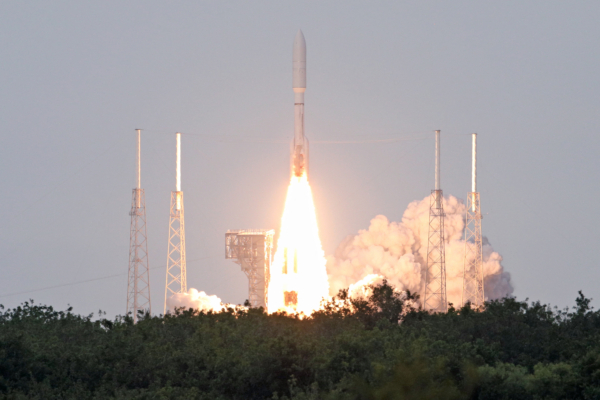
On Monday night, April 28th, the American e-commerce giant Amazon successfully launched the first batch of 27 “Project Kuiper” satellites into near-earth orbit, officially declaring its entry into the satellite internet market and launching a direct challenge to Elon Musk’s SpaceX company’s Starlink project.
The launch took place on the evening of April 28th local time, lifting off from Space Launch Complex 41 at Cape Canaveral Space Force Station in Florida. The satellites were sent into a near-earth orbit at an altitude of approximately 630 kilometers by the United Launch Alliance’s Vulcan Centaur rocket.
The “Project Kuiper” is a large-scale low-earth orbit satellite network project funded by Amazon with an investment of $10 billion. The goal is to deploy over 3,200 small satellites to provide high-speed, low-latency broadband internet services to global users, particularly targeting remote or underserved areas.
This project will directly compete with Musk’s Starlink. Starlink currently dominates the satellite internet market, having started providing services since October 2020 with over 8,000 satellites in orbit, covering 125 countries and regions, and having over five million users worldwide.
However, Amazon founder Bezos stated that there is a huge global demand for high-speed satellite internet, and the market is large enough to accommodate multiple competitors. He also emphasized that while the focus of the “Project Kuiper” is on commercial applications, its network architecture also holds potential value for national defense and emergency communications.
The “Project Kuiper” was originally scheduled for its first launch in early 2024 but was delayed by over a year due to technical factors. The satellites launched this time underwent several upgrades compared to the two prototype satellites launched in October 2023, including the addition of “mirror coatings” to reduce interference with astronomical observations.
Amazon plans to begin offering limited services by the end of this year and aims to deploy at least half of the satellites by mid-2026 to meet the requirements of the Federal Communications Commission (FCC) in the United States. The United Launch Alliance stated that within 2025, they may execute up to five more Project Kuiper satellite launch missions to accelerate the deployment progress.
With this significant step, Amazon is set to revolutionize the satellite internet industry, offering new possibilities for global connectivity and access to high-speed internet in even the most remote corners of the world.