
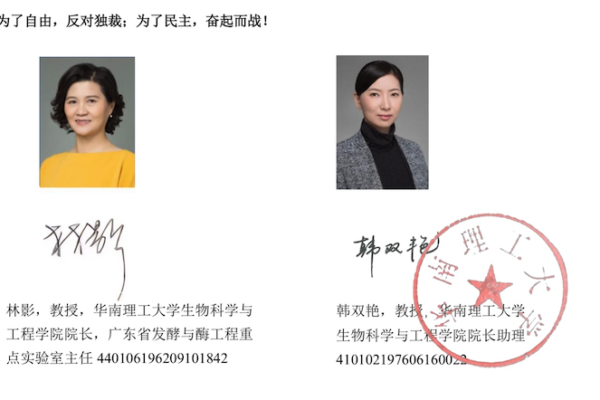
In a recent online post, Professor Lin Ying, dean of the School of Biological Science and Engineering at South China University of Technology, along with her assistant professor Han Shuangyan, issued a public call urging the public, especially young students, to oppose dictatorship, strive for democracy and freedom, and rise up for these values. The post was widely shared on social media by a popular self-media figure known as “Laodeng” with hundreds of thousands of followers.
The screenshot of the statement titled “A Spark Can Start a Prairie Fire!” reveals Professor Lin Ying’s strong stance against the oppressive regime in China. She begins by expressing her deep concern about the decline and oppression witnessed in Chinese society and criticizes the Communist Party of China for intensifying its authoritarian rule, controlling every aspect of society, and stripping away people’s freedoms.
The statement emphasizes the perpetuation of one-party rule under Xi Jinping, who eliminated term limits for the president in 2018, consolidated personal power through slogans like the “Great Rejuvenation,” and extended his influence. The political environment in China has become more closed, leaving little room for genuine expression of ideas, especially for the younger generation who see little hope for political reform and democracy.
Moreover, Professor Lin’s statement addresses recent events such as the “Zero COVID” policy and the anger it has sparked among citizens, as well as the “996 work system” that exploits and traps the youth in endless hardships with limited job options, lack of social security, and restricted personal freedom. The draconian measures by the government to maintain political stability create a suffocating web of oppression affecting various segments of society.
The plight of Chinese university students is highlighted in the statement, pointing out the severe restrictions imposed on their freedom of thought and expression due to stringent ideological control and censorship by authorities. The suppression of dissenting voices and the silencing of criticisms, whether historical or political, further exacerbate the challenges faced by the educated youth in China.
The document includes a reference to the 2020 incident where Professor Li Haipeng, a faculty member from Nanjing University, was dismissed for voicing dissatisfaction with the current state of affairs in China. It urges the students to realize their pivotal role in shaping the future of the nation and calls for them to speak out for freedom, democracy, and justice, securing their rights for independent thinking and expression.
The statement outlines key demands for democratic reform, including ending one-party rule, restoring freedom of speech and press, improving social welfare for equal opportunities, and establishing a rule of law to safeguard human rights. It beseeches all compatriots, especially the youth, to join forces in opposing dictatorship, advocating for democracy and freedom, and fighting for the fundamental rights and social justice of every citizen.
Amidst the challenges faced in the current political climate in China, the call to action resonates with a powerful message encouraging individuals to stand up for their beliefs and work towards a brighter future for the nation. While the authenticity of the statement could not be independently verified due to the Chinese Communist Party’s tight control on information dissemination, the plea for freedom, democracy, and human rights rings loud and clear in the voices of those demanding change.