
A groundbreaking study, conducted with the James Webb Space Telescope, has provided the strongest evidence to date of potential extraterrestrial life within our solar system. Scientists detected a chemical fingerprint of a gas in the atmosphere of an exoplanet that could only be produced by biological processes on Earth.
According to a report from Reuters on April 16th, the Webb telescope observed two gases – dimethyl sulfide (DMS) and dimethyl disulfide (DMDS) – on a planet named K2-18 b. These gases are known to be produced by biological organisms on Earth, primarily by microorganisms like marine phytoplankton.
Researchers suggest that this finding indicates the potential presence of microbial life on this planet. However, they emphasize that this doesn’t confirm the discovery of actual organisms but rather a possible biological signature, indicating a biological process. They urge caution in interpreting this discovery and emphasize the need for further observations.
Despite the cautious approach, scientists are excited about this new discovery. The research findings were published in the Journal of Astrophysics Letters.
Nikku Madhusudhan, an astrophysicist at the University of Cambridge, who is the lead author of the study, described this new discovery as the first signs of potentially habitable worlds beyond our solar system.
Madhusudhan stated, “This marks a turning point in the search for extraterrestrial life beyond our solar system. We have demonstrated that existing facilities can detect biological features on potentially habitable planets. We are entering the era of observational astrobiology.”
Madhusudhan pointed out that ongoing efforts are being made to search for signs of life within our solar system on planets like Mars, Venus, and various moons that may host environments conducive to life.
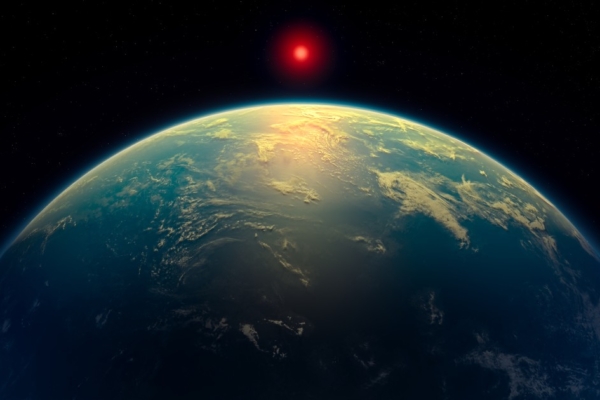
K2-18 b, with a mass 8.6 times that of Earth and a diameter approximately 2.6 times that of Earth, resides in the habitable zone where liquid water, a crucial component for life, could exist on the planet’s surface. It orbits a smaller, dimmer red dwarf star in the Leo constellation, approximately 124 light-years away from Earth. Scientists have also discovered another planet orbiting this star.
Since the 1990s, scientists have identified about 5800 exoplanets outside our solar system. Scientists hypothesize the existence of exoplanets known as hycean worlds, covered by liquid water oceans suitable for microbial life and possessing hydrogen-rich atmospheres.
The Webb Space Telescope, launched in 2021 and operational since 2022, initially detected methane and carbon dioxide in the atmosphere of K2-18 b, marking the first discovery of carbon-based molecules in the atmosphere of an exoplanet located in the habitable zone of a star.
“Based on all the data obtained by the James Webb Space Telescope to date (including past and present observations), the only hypothesis that currently explains the data is that K2-18 b is a hycean world teeming with life,” Madhusudhan said. However, he emphasized the need to remain open-minded and explore other possibilities.
Madhusudhan mentioned that if hycean ocean planets indeed exist, “we are talking about microbial life, possibly akin to what we see in Earth’s oceans.”
Both dimethyl sulfide (DMS) and dimethyl disulfide (DMDS) belong to the same chemical family and are predicted to be significant biological indicators on exoplanets. The Webb telescope found that at least one of these gases, or possibly both, existed in the atmosphere of K2-18 b with a high confidence level of 99.7%, leaving a 0.3% probability of statistical coincidence.
The concentration of these gases in the atmosphere was detected to be over a million parts per ten million (volume). Madhusudhan stated, “For reference, this concentration exceeds by orders of magnitude the levels in Earth’s atmosphere, and based on current knowledge, it cannot be explained without biological activity.”
K2-18 b is classified as a sub-Neptune exoplanet, larger than Earth but smaller than Neptune – the smallest gaseous planet in the solar system.
To determine the chemical composition of exoplanet atmospheres, astronomers analyze the light emitted by a planet as it transits in front of its host star from the perspective of Earth, a method known as the transit technique. During planetary transits, the Webb telescope can detect the slight decrease in the star’s brightness, as a fraction of starlight passes through the planet’s atmosphere before being detected by the telescope, enabling scientists to identify the gases composition of the planet’s atmosphere.