
Amidst the ongoing fallout of corruption cases within the CCP’s military-industrial complex, it appears that there may be another high-level issue brewing within the China Aviation Industry Corporation (referred to as AVIC). The absence of Chairman Zhou Xinmin, who has been in office for less than a year, during a recent visit to retired officials by senior executives of the group has sparked speculation.
According to a report on the AVIC official WeChat account on January 25, AVIC General Manager Wei Yingbiao, along with several other senior executives, visited retired leaders and academicians last week. However, the report did not mention Chairman Zhou Xinmin.
A report by Hong Kong’s Ming Pao on January 27 highlighted the buzz surrounding Zhou Xinmin’s absence.
Currently, Zhou Xinmin’s profile still remains on the AVIC official website.
Public records show that Zhou Xinmin, born in November 1969 in Linchuan, Jiangxi, worked nearly 30 years at Changhe Aircraft Industry Group before serving as Chairman and Party Secretary. In January 2018, he became Deputy General Manager of Commercial Aircraft Corporation of China (COMAC), and in February 2023, he was appointed Deputy Chairman and General Manager of COMAC.
Former AVIC Chairman Tan Ruisong was dismissed in March 2023 and officially placed under investigation in August 2024. During this period, Zhou Xinmin assumed the position of AVIC Chairman in March 2024.
Zhou Xinmin’s most recent public appearance was on January 18 this year when he chaired an anti-corruption meeting at AVIC in Beijing. On the same day, AVIC’s General Manager Hao Zhaoping and Deputy General Manager Yang Wei were unexpectedly dismissed, and their profiles were removed simultaneously.
On January 22 this year, the AVIC website announced that Wei Yingbiao, former Deputy General Manager of COMAC, had taken over as AVIC’s General Manager.
Guo Shengjie, who held senior positions at COMAC for an extended period, has been appointed as AVIC’s Deputy General Manager.
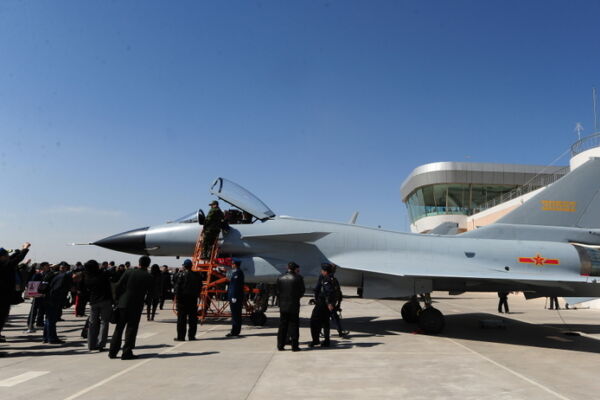
AVIC is responsible for producing combat aircraft for the CCP. Yang Wei, who was recently dismissed, had been involved in the design and development of fighter aircraft for a long time, including contributing to the development of the third-generation J-10 aircraft and serving as the chief designer of the CCP’s J-20 stealth fighter, dubbed the “Father of the J-20.”
Regarding the fall of the “Father of the J-20,” researcher Shen Mingshi from the Taiwan Institute of National Defense Studies previously told Dajiyuan that there are likely flaws in the research and production of the CCP’s J-20 aircraft. These issues could include corruption, such as bribing and stealing technology for personal gain, misreporting project expenses, exaggerating aircraft performance, and using substandard materials as qualified components.
COMAC produces large commercial aircraft for the CCP, including the C919 aircraft assembled from international components.
In response to the reshuffling of senior COMAC executives to oversee AVIC’s fighter aircraft production, Shen Mingshi told Dajiyuan that this indicates Xi Jinping has lost faith in the military system and must bring in personnel from the commercial aircraft sector. While this move may temporarily curb corruption, it could potentially hinder research and production efficiency in the long run.
Political scientist Chen Daoyin recently told Voice of America that Beijing’s deployment of COMAC personnel may help combat corruption in the short term but could become an obstacle in the development and production of weapons.
He said, “Historically, the practice of transferring personnel from COMAC aligns with the CCP’s internal power struggles, using ‘foreign bodies’ to thoroughly reform this system. Each step opens up a gap, and using outsiders to lead the system means they may interfere and disrupt the process. It remains to be seen how these individuals transferred from COMAC will lead the system; there’s a risk of them giving orders without understanding the system – ‘outsiders leading insiders’.”