
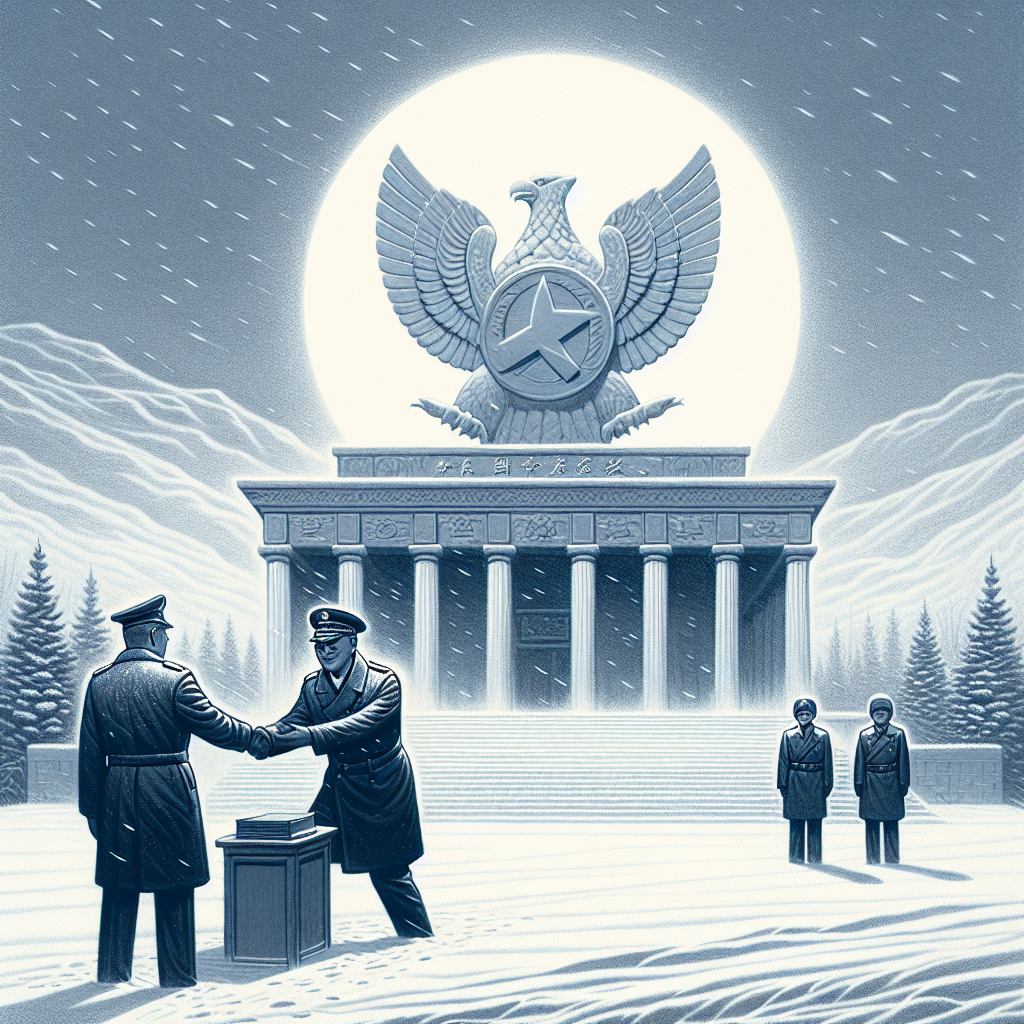
South Korean President Yoon Suk-yeol issued a statement on January 15th, expressing his voluntary cooperation with the South Korean Public Prosecutor’s Office to be arrested in order to prevent bloodshed. This marks the first time in South Korean history that a sitting president has been arrested. The fierce struggle between the two factions has not only triggered a constitutional crisis in South Korea but also led to a comprehensive review of the current constitutional system and government operations in South Korea. A large number of awakened young people took to the streets to support Yoon Suk-yeol and chanted slogans against communism.
Experts believe that South Korea is currently at a critical position in global future conflicts, and the constitutional crisis reflects the country’s future path, which is crucial for South Korea and even the future of the Northeast Asian situation.
Independent television producer Li Jun stated on the New Tang Dynasty TV program “Elite Forum” that Yoon Suk-yeol issued a statement voluntarily going to the Public Prosecutor’s Office for investigation. In his public statement, he mentioned that South Korea is experiencing its darkest moment in legal collapse, as an investigative agency without investigative authority is conducting investigations and a court without review authority is issuing arrest warrants. He also mentioned that the awakening and passion of young citizens make him believe that the future of this country is full of hope.
Yoon Suk-yeol is detained in a detention center in Seoul. On January 19th, a South Korean court approved the extension of Yoon Suk-yeol’s detention period. According to the new detention order, President Yoon Suk-yeol can be detained for a maximum of 20 days, and the case will be handed over to the prosecution.
The arrest of Yoon Suk-yeol has led to an increasing proportion of the public supporting him and the National Power Party. A survey released by the Korean polling agency Realmeter on the 20th showed that the National Power Party’s support rate is 46.5%, an increase of 5.7% from a week ago; while the Democratic Party of Korea is at 39%, a decrease of 3.2%. This represents a significant change.
The support for Yoon Suk-yeol among the South Korean public has also significantly increased, with thousands of people waiting for him in the cold winter. Unfortunately, a 60-year-old South Korean set himself on fire near the Public Prosecutor’s Office to protest the arrest of Yoon Suk-yeol, shocking many people.
Li Jun mentioned that South Korean online influencer Wen Rui stated in a video program that a large number of South Koreans have come out to support Yoon Suk-yeol, and such a massive gathering has never been seen at Gwanghwamun Square. Many young Koreans at the event were holding American flags, and many were chanting anti-communist slogans. South Korean citizens have started paying attention to the relationship between their country and the world, including the relationship between the Democratic Party of Korea and the Chinese Communist Party.
Chairman Kim Sang-chun of the East Asia Peace Research Institute stated on the “Elite Forum” that in reality, the Public Prosecutor’s Office does not have the power to investigate President Yoon Suk-yeol for the crime of rebellion, as it is illegal. The purpose of the Public Prosecutor’s Office is only to investigate crimes of corruption and bribery committed by senior public officials, and it does not include charges of rebellion. Additionally, the declaration of martial law by the president is one of his legal powers and does not constitute a crime. The Public Prosecutor’s Office illegally invaded the presidential residence, threatened the commander of the 55th Security Division during the process, obtained the official seal, falsified documents, and entered the residence, which is also illegal and must bear legal responsibility for.
Kim Sang-chun stated that President Yoon and his legal team reported the Director of the Public Prosecutor’s Office, Woo Dong-yun, and Yoo Jong-su, head of the National Investigation Headquarters of the Police Department for treason. Although President Yoon has been arrested, he has started to fight back against the leftists, and now the defense of the right-wing democratic system is in progress.
Senior editor Guo Jun stated on the “Elite Forum” that accusing the incumbent president of attempting rebellion and coup in South Korea is indeed very strange. In addition to accusing Yoon Suk-yeol of so-called rebellion, the opposition also put forward many other charges, including something called “Northern Wind crime,” claiming that he increased the risk of a northern attack on South Korea, which seems absurd.
Kim Sang-chun expressed on the “Elite Forum” that why would President Yoon stage a coup or rebellion? He has already been the president and more than half of his five-year term has passed. If we talk about coup or rebellion, it would be when he reaches the fifth year and intends to change the stipulated single-term system in the constitution to multiple terms, and that would be considered rebellion. It is very strange to accuse him of rebellion now.
Kim Sang-chun stated that the leftists’ idea is to push for an early election, using the opportunity of President Yoon’s failed declaration of martial law to impeach and arrest him on charges of rebellion. This will make it easier for the representative of the Democratic Party, Lee Jae-myung, to win in the early election. On the other hand, it will naturally alleviate Lee Jae-myung’s ongoing judicial crisis in the court. However, they think it is not safe as long as the charge of rebellion is not firmly established. In case the Constitutional Court judges against it, and President Yoon returns to power, Lee Jae-myung is likely to face consecutive guilty verdicts. As the initial verdict for Lee Jae-myung was one year of imprisonment with a two-year suspended sentence, and Lee Jae-myung did not appeal against it. Therefore, they aim to charge President Yoon with rebellion and the “Northern Wind crime,” a direction that makes the citizens, especially the youth, very resentful. They are moving towards the right-wing. Initially, they were leftists, but now they have emerged. I have been to the scene of several events and never expected to see young people in their twenties and thirties, some with children. This is a phenomenon that is unique to the history of South Korean constitutional politics or the democratization process, but now the right-wing has also shown this development.
Currently, some of the attack targets of the Democratic Party have shifted to the First Lady of the President, and the parliament is preparing to investigate her. The Democratic Party is also preparing to recommend a new constitutional justice, which would change the existing 8-member to 9-member panel, benefiting the Democratic Party. They may take these actions in the coming days.
Kim Sang-chun mentioned that as the majority force in the parliament, Lee Jae-myung is utilizing various national organizations and media to incite public sentiment against the martial law of the president. Therefore, South Korea is now in a state of civil war to defend its democratic and free system. Therefore, I have organized some election teams in preparation, launching an early election and beginning a democratic defense campaign. During the 2022 election, I organized Yoon Suk-yeol’s election team and served as vice chairman, and our team has made achievements. Now my friends are preparing for the early election.
Veteran media figure Guo Jun noted on the “Elite Forum” that the short-lived martial law issued by President Yoon Suk-yeol in December has indeed raised significant questions about the political system in South Korea. The constitutional crisis in South Korea is also a crisis that reflects the country’s future direction. Previously, South Korea mainly developed relying on the United States, Japan, and the West, and even its national security largely depended on the US for about 70 years. After the 1980s, South Korea rose through the Miracle on the Han River economy and it has been over thirty years. The time of two generations is enough to make many people forget the fundamental basis of South Korea’s economic rise.
Currently, politics in South Korea is essentially a struggle between conservatives and progressives. Conservatives are pro-Western, pro-American to counter North Korea’s threats and also to counter China; while progressives, radical leftists, mainly oppose the US and the West, favor closer ties with North Korea and China. This time is a battle for the country’s future path, it can be said to be a matter of life and death.
In this case, the Democratic Party of Korea accuses President Yoon Suk-yeol of provoking North Korea, including broadcasting towards North Korea and adopting various hardline policies, claiming that this could escalate the risk of a North Korean attack on South Korea, referred to as the “Northern Wind crime,” which seems ridiculous to outsiders. The South Korean parliament also accused the Chief of the South Korean military staff of deliberately not clarifying if the unmanned drone discovered by North Korea was released by South Korea, intentionally raising this “Northern Wind” from North Korea, which is even more ludicrous. Theoretically, the Korean War is only on armistice, not officially ended, and military actions must be kept confidential, this is basic common sense. If this is considered a form of rebellion, then all actions to defend national security might be criminal acts, this is absurd.
Therefore, the current constitutional crisis in South Korea is not just a simple political struggle, but a battle for the country’s future path. I believe that the whole event has now raised high concern among all South Korean citizens. Everyone needs to think seriously about how South Korea’s future national path should be chosen. So, this time’s political struggle is somewhat different than before.
Guo Jun stated that South Korean politics is at a turning point in facing significant changes, with three key factors. Firstly, all South Korean citizens must choose the country’s future path, which is crucial. Secondly, the South Korean political system may require comprehensive changes, including issues related to the president’s term and no re-election. Thirdly, South Korea must establish a mechanism where both the left and right can internally compromise and coordinate, and cannot continue the current struggle model of life and death, otherwise, South Korean politics can never transition peacefully. Every transition of top-level power involves a significant political turmoil. Currently, South Korean political elites are discussing these constitutional questions, which is a fact that reflects the need for changes in the South Korean political system.
Kim Sang-chun stated on the “Elite Forum” that when President Yoon issued martial law, the South Korean military did not take substantive action proactively, which was the main reason for the failure of the martial law, as the military did not display normal operational capabilities, and it can be said that it was just for show.
After democratization in 1987, the South Korean military did not have the same strength as before but was politically influenced. I believe the US will not engage in any interference in South Korean internal politics, as it would provoke widespread protests and antagonize most of the populace, which is detrimental to both the ruling party and the US. Therefore, the US will not engage in such actions.
Kim Sang-chun mentioned that regardless of the current political situation in South Korea, the country’s future has no other choice but to strengthen its defense capabilities, enhance the South Korea-US alliance, and prevent provocations from North Korea. However, if a pro-North Korea, pro-China figure like Lee Jae-myung of the Democratic Party comes to power, North Korea and China will strengthen ties with the Democratic Party and deliberately disrupt the South Korea-US alliance, creating disputes with the US. South Korea in the next five years, if Lee Jae-myung becomes the president, will face a dual crisis of politics and economy.
Shi Shan stated on the “Elite Forum” that during the presidency of Moon Jae-in, we saw a significant decrease in South Korea’s relations with the US and Japan, especially relations with Japan dropping to freezing point. However, relations with China, North Korea have improved. China’s economic erosion of South Korea was particularly severe during those years, including theft of many industries of the Samsung Group, with entire teams being poached to China. Thus, I believe South Korean citizens should take a step back and see what has happened in history.
Guo Jun mentioned on the “Elite Forum” that in the next twenty years, the central focus of global situations is likely to be the US-China rivalry. The US-China rivalry could escalate to a very intense level, where there won’t be the simple option of balancing relations with both countries. All countries will have to choose sides. The previous option of relying on China economically and on the US for security will no longer be available, which is the most likely possibility, especially for countries in the Asia-Pacific region which will either be allies or enemies. Therefore, how South Korea chooses its future not only affects South Korea itself but also reflects the direction of global situations in the future.
The new TV program “Elite Forum” launched by New Tang Dynasty and The Epoch Times is a high-end television forum rooted in the Chinese world, which will bring together elites from various fields globally, focusing on hot topics and analyzing global trends, providing viewers with in-depth insights into current affairs and historical truths.
For the complete content of the program “Elite Forum,” please watch online.
Production Team of “Elite Forum”
Reproducing and quoting articles from “Elite Forum” should retain the original content and indicate the source.