
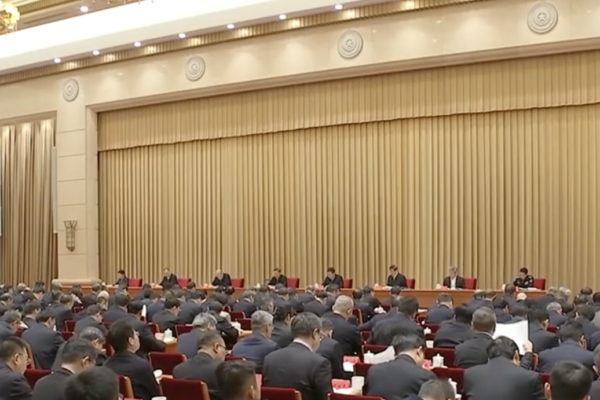
On January 12-13, the Central Political and Legal Affairs Commission of the Communist Party of China held a meeting in Beijing. General Wang Chunning, the commander of the People’s Armed Police Force, was the only member absent from the committee. His repeated absence from several important meetings has sparked speculation.
The evening news broadcast on January 13 by CCTV, the state-owned television network, showed Secretary Chen Wenqing and Deputy Secretary Wang Xiaohong of the Central Political and Legal Affairs Commission, along with other members including Zhang Jun (Chief Justice of the Supreme People’s Court), Ying Yong (Chief Prosecutor of the Supreme People’s Procuratorate), Yin Bai (Secretary-General of the Political and Legal Affairs Commission), Chen Yixin (Minister of State Security), He Rong (Minister of Justice), and Wang Renhua (Secretary of the Military Commission Political and Legal Affairs Committee), sitting at the conference table. However, General Wang Chunning, as a member of the Central Political and Legal Affairs Commission representing the People’s Armed Police Force, was notably absent.
The unusual circumstances surrounding General Wang Chunning had been noted earlier. On November 21 of last year, during a national video conference for public security agencies convened by the Communist Party, Minister of Public Security Wang Xiaohong gave a speech about launching winter operations. Sitting to his left was Zhang Hongbin, the political commissar of the People’s Armed Police Force, rather than the expected Wang Chunning. Subsequently, Wang Chunning was absent from events such as the promotion ceremony of General Chen Hui as the new Army Political Commissar and the Central Commission for Discipline Inspection conference.
61-year-old Wang Chunning has previously served as the commander of the 12th Group Army and the commander of the Beijing Garrison. He comes from a background known as the “Second Red Generation” and is the son of Wang Yongming, a former deputy political commissar of the Nanjing Military Region.
Recent cases have shown that when senior Communist Party leaders are conspicuously absent from important meetings, they are often later confirmed to be implicated in corruption investigations.
In November 28, 2024, Xi Jinping’s confidant and member of the Central Military Commission and Director of the Political Work Department of the Military Commission, Miao Hua, was officially announced to be “under investigation and suspended from duty.” Afterward, a group of generals close to Miao Hua were rumored to be implicated, including Wang Chunning.
Australian scholar Yuan Hongbing had previously revealed that conscientious insiders within the Chinese Communist system disclosed that Miao Hua had served as the Director of the Political Work Department of the CMC for a period of 7 years. There were rumors circulating within the Communist Party circles that over 108 generals and around 500 colonel-level officers were considered his confidants, and now they have become a focal point of the ongoing crackdown.
During the Central Commission for Discipline Inspection conference on January 6, Xi Jinping stated, “The existing corruption cases have not been cleared, and new cases are still occurring continuously.” He emphasized the necessity for officials to maintain a high level of consistency with the central leadership, stating that they must “do what they say.”
Commentator Li Linyi previously expressed to Dajiyuan that this situation indicates that many officials are only paying lip service to Xi Jinping, showing loyalty on the surface but acting against him in secret. Xi is allegedly surrounded by so-called “two-faced” individuals. Even powerful figures within the military like Zhang Yuxia might appear to comply with Xi on the surface but could have hidden agendas, potentially sidelining Xi’s authority in reality.