
Recently, on social media platforms in China and overseas, news broke out that the family of the late Chinese Vice President Rong Yiren has all immigrated to Canada, and they have packed up and moved all the furniture from their villa in Shanghai. Currently, the authenticity of this news cannot be verified.
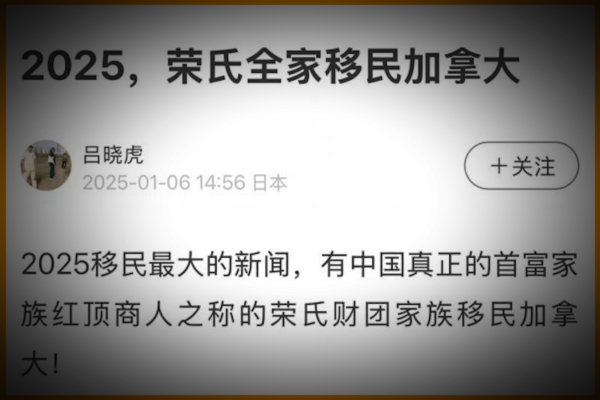
On January 6th, a post by a mainland NetEase account named “Lu Xiaohu” published an article titled “In 2025, The Rong Family Immigrates to Canada.” The article mentioned that in 2025, the biggest immigration news was the migration of the Rong family, who are known as the true first family of Chinese national capital and prominent red capitalists, to Canada.
The article indicated that the Rong family is an important representative of Chinese national capital, and their decision to immigrate overseas undoubtedly carries profound symbolic significance. Firstly, it reflects the plight of red capitalists who are essentially dependent on the power system. However, a regression in reforms may lead them to lose balance between politics and economy, becoming victims of policy adjustments.
Secondly, it is about the family’s development strategy. The Rong family has always valued international perspectives, and immigrating overseas may be seen as a strategic choice to address domestic risks and ensure the family’s legacy.
Lastly, it sends a social signal. The departure of a prominent family may release a strong signal that could affect the confidence of other entrepreneurs and capital, potentially triggering a larger capital outflow and brain drain.
The so-called “Rong Family” mentioned above refers to the family of the former Chinese Vice President Rong Yiren, known as the “red capitalists.”
Furthermore, there were reports circulating online that Shanghai residents filmed a video showing the Rong family packing up and moving precious furniture from their luxury villa in Shanghai, including mostly antique pieces made of redwood, rosewood, and huanghuali.
Additionally, on an overseas social media platform “X,” there was footage of a shipping company packing up precious furniture in a luxury villa in Shanghai for the Rong family to be transported overseas. According to sources, the Rong family hired the shipping company to pack and transport the valuable furniture to Canada.
On January 7th, overseas commentator Cai Shenkun analyzed on platform X, “If Jack Ma’s downfall marked the beginning of the decline of private economy, in fact, Li Ka-shing (former richest man in Hong Kong) withdrawing capital had already sent a signal. The Rong family’s full immigration to Canada is the groundbreaking news of this year, frightening all private entrepreneurs.”
Cai Shenkun wrote, “Since 1949, the Rong family has been a red capitalist engaged in external united front work. With a revered status, Rong Yiren served as Vice President of the country, enjoying all the political and economic benefits in China. Today, such a prominent family has also immigrated, what does it signify? In simple terms, you may not believe in the character of the powerful, but you cannot doubt their vision; the information they receive is beyond your imagination.”
Public records show that in the early days of the Communist Party’s governance, Shanghai entrepreneur Rong Yiren actively cooperated with the authorities’ “public-private partnership” policy and gave up his massive family business, hence being called a “red capitalist” by Chen Yi. Rong Yiren had held positions such as Vice Mayor of Shanghai, Vice Chairman of the National Committee of the Chinese People’s Political Consultative Conference, and Vice President of the country, ranking among the top leaders of the Communist Party. During the Cultural Revolution, both Rong Yiren and his son were persecuted. In 1979, to boost the confidence of private entrepreneurs, Deng Xiaoping appointed Rong Yiren to establish China Trust Investment Corporation in Hong Kong, which later developed into the Fortune Global 500 company CITIC Group, the first enterprise in mainland China to obtain financial full licensing.
Rong Yiren had four daughters and a son. His son, Rong Zhijian, was the former chairman of the Hong Kong-listed company CITIC Pacific Limited, considered a member of the “princeling party” and a close associate of the Communist Party authorities. As early as 1996, Rong Zhijian and other management received a 25% discounted price to purchase 320 million shares of CITIC Pacific from the CITIC Group. Rong Zhijian bought 291 million shares, becoming the second largest shareholder, significantly increasing his personal wealth. Rong Zhijian’s daughter, Rong Mingfang, held positions such as director of the finance department at CITIC Pacific.
After the outbreak of the Asian financial crisis in 1998, CITIC Pacific’s stock price plummeted, and the Communist Party intervened to help Rong Zhijian navigate through the crisis. However, by 2009, CITIC Pacific was exposed to massive losses. Following a high-profile police investigation, Rong Zhijian was forced to step down as chairman of CITIC Pacific.
Commentator Tang Jingyuan analyzed on his program “Insights Express” aired on January 8th, stating that Li Ka-shing’s departure from the mainland coincided with Xi Jinping coming to power. Two years after Li Ka-shing sold significant assets in Hong Kong, the anti-extradition bill protests erupted, and the Communist Party introduced the National Security Law, dismantling Hong Kong’s financial center. The migration of the Rong Yiren family and Li Ka-shing’s capital withdrawal signify equally major signals, even carrying more significant and urgent meanings.
This news has sparked discussions and speculations on the implications of the Rong family’s immigration to Canada, shedding light on the evolving landscape of Chinese politics, economy, and the strategies of prominent families in navigating uncertainties.