
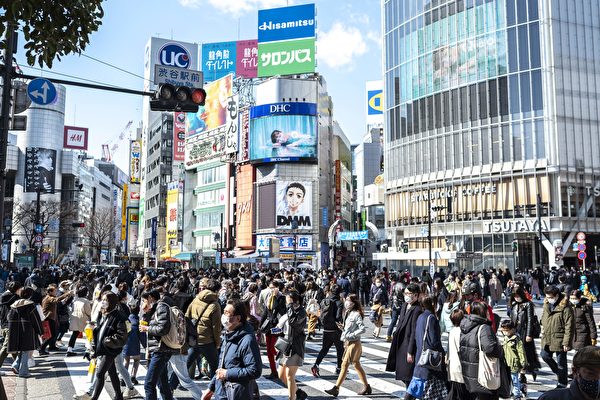
Japan’s young people are facing a new era of opportunities. With the impact of a declining birth rate and a tight labor market, Japanese businesses are struggling with the dilemma of “unable to hire employees,” a critical issue for many companies, especially small and medium-sized enterprises.
According to data from the Japan Information Analysis Company, Teikoku Databank, in the first half of 2024, the number of bankruptcies in Japanese companies reached the highest level since 2013, with 4,990 bankruptcies recorded. Among these bankrupt companies, 163 cited the reason for their failure as labor shortage.
Data compiled by the Japanese Ministry of Internal Affairs shows that the labor force aged 20 to 24 has decreased by 36% over the past thirty years. According to the Organization for Economic Cooperation and Development, by 2022, only 9.4% of Japan’s population will be between the ages of 15 and 24, making it particularly challenging to hire young talent.
In order to attract top talent, Japanese companies have begun to adopt various strategies. Firstly, they are considering wage increases. Following the burst of the economic bubble in the 1990s, Japan entered the “Lost 30 Years” with deflation and stagnant wage levels. According to the latest data from the OECD, the average annual salary in Japan was $46,792 in 2023, compared to $80,115 in the United States and $57,617 in the United Kingdom.
As Japan’s economy recovers and the labor market remains tight, wages are starting to rise. Japan’s largest life insurance company, Nippon Life, plans to increase salesperson salaries by about 6% in the next fiscal year, while Tokyo Energy Systems is considering raising basic salaries during spring wage negotiations.
According to Bloomberg, Takashi Imai, the human resources manager for Tokyo Energy Systems, stated, “Recruiting young people is the biggest challenge for the company.” He added, “Many companies that fail to raise wages cannot hire enough employees and are forced to close.”
Some companies are enticing employees by providing modern dormitories. In 2023, Nippon Life built a men’s dormitory with 200 rooms in a prime residential area near Tokyo Disneyland, and also leased other residential properties as dormitories, offering housing subsidies for female employees.
Itochu Corp., a trading company, previously had four dormitories in different locations for young male employees until 2018. These dormitories are just a 30-minute train ride from the company’s Tokyo headquarters, providing breakfast and weekday dinners, along with a cafe, bar, and communal sauna. As reported by Yomiuri Shimbun, Itochu Corp. plans to open dormitories for female employees in 2025.
An increasing number of companies are offering benefits to help new employees repay student loans. According to the Japan Student Services Organization, the number of companies providing such assistance doubled in the past year, reaching 2,600 by November 2024.
Tokyo Energy Systems provides a subsidy of up to 20,000 yen per month to help employees repay student loans, with a total limit of 3.6 million yen ($22,800). This program has been successful, as Tokyo Energy Systems recruited 63 employees this spring, surpassing their target for the first time in recent years.
Bloomberg reported that 23-year-old Hideo Negishi, a 2024 graduate in business studies, had five job offers upon graduation. He cited student loan repayment assistance as the key factor in choosing to join Tokyo Energy Systems, saying, “The company helps with loan repayment, and I plan to work here long-term until retirement, dedicating myself to the company, which is the best way to repay.”
With intense competition for talent, some Japanese companies even offer benefits to new graduates before they join the company. Alsok, a security company based in Tokyo, provides discount coupons to potential employees, which can be used in restaurants, hotels, and karaoke bars once they join the company.
(Adapted from Bloomberg reports)