
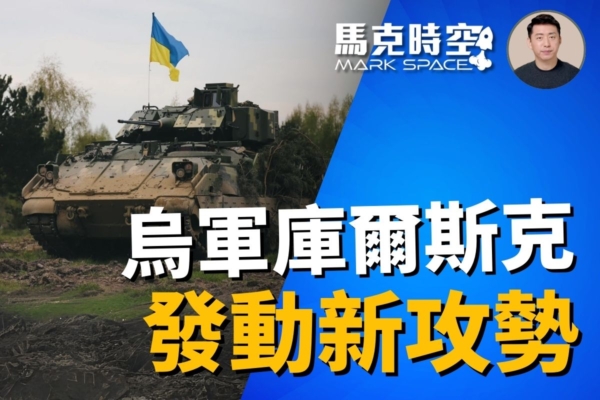
In recent months, the Russian military has launched a large-scale counteroffensive in Kharkiv, causing the occupied territories in Ukraine to decrease by half or more. Just after the New Year, on the morning of January 5th, Ukrainian forces suddenly launched a new attack in Kharkiv. According to the latest report from the American War Research Institute, the Ukrainian forces launched a three-pronged attack in the Kharkiv region, advancing towards the eastern and southeastern parts of the main operational base in Sujah City in Kharkiv, and also towards the northwest direction of the town of Kolnevo.
The Russian side was “shocked” by the Ukrainian forces’ renewed attack, admitting that the Ukrainian forces achieved a “tactical victory” which they did not anticipate. The Russian Defense Ministry reported on the 5th that the Northern Group of Russian forces defeated the strength of 14 Ukrainian regiments, repelling two counterattacks by the Ukrainian forces. This sudden attack by the Ukrainian forces in Kharkiv is likely aimed at turning around the passive situation they have been facing, hoping to shift from defense to offense, or perhaps it is a feint to divert attention, in order to open up a new battlefield.
The Ukrainian forces deployed a large number of armored vehicles in this offensive, especially the American-made M2A2 Bradley infantry fighting vehicle, which has shown satisfactory survivability in actual combat, especially in terms of protecting the crew. Many Bradley infantry fighting vehicles were able to continue operating even after sustaining multiple hits. The United States has provided Ukraine with over 300 M2A2 Bradley infantry fighting vehicles, which have received wide praise from the frontline Ukrainian forces, who consider the importance of this vehicle to be greater compared to tanks, with a higher cost-effectiveness.
Recently, the Wall Street Journal revealed that about 60% of the ammunition used by the Russian military comes from North Korea, and about one-third of the ballistic missiles launched by Russia against Ukraine last year also originated from North Korea. North Korea can be seen as “bloodying its hands”, transferring around 20,000 containers of ammunition, over 5 million artillery shells, as well as dozens of missiles including over 100 Mars-11 ballistic missiles, to Russia. In order to supply these arms, approximately 200 North Korean weapons and ammunition factories are working at full capacity, with Russia providing them with fuel to keep operations running.
The increasing reliance of the Russian military on weapons and soldiers from North Korea is not a good sign, indirectly proving that Russia’s military production capacity has either reached its peak or is declining. It is feared that 2025 may indeed see the day when a ceasefire between Russia and Ukraine will come into effect.