
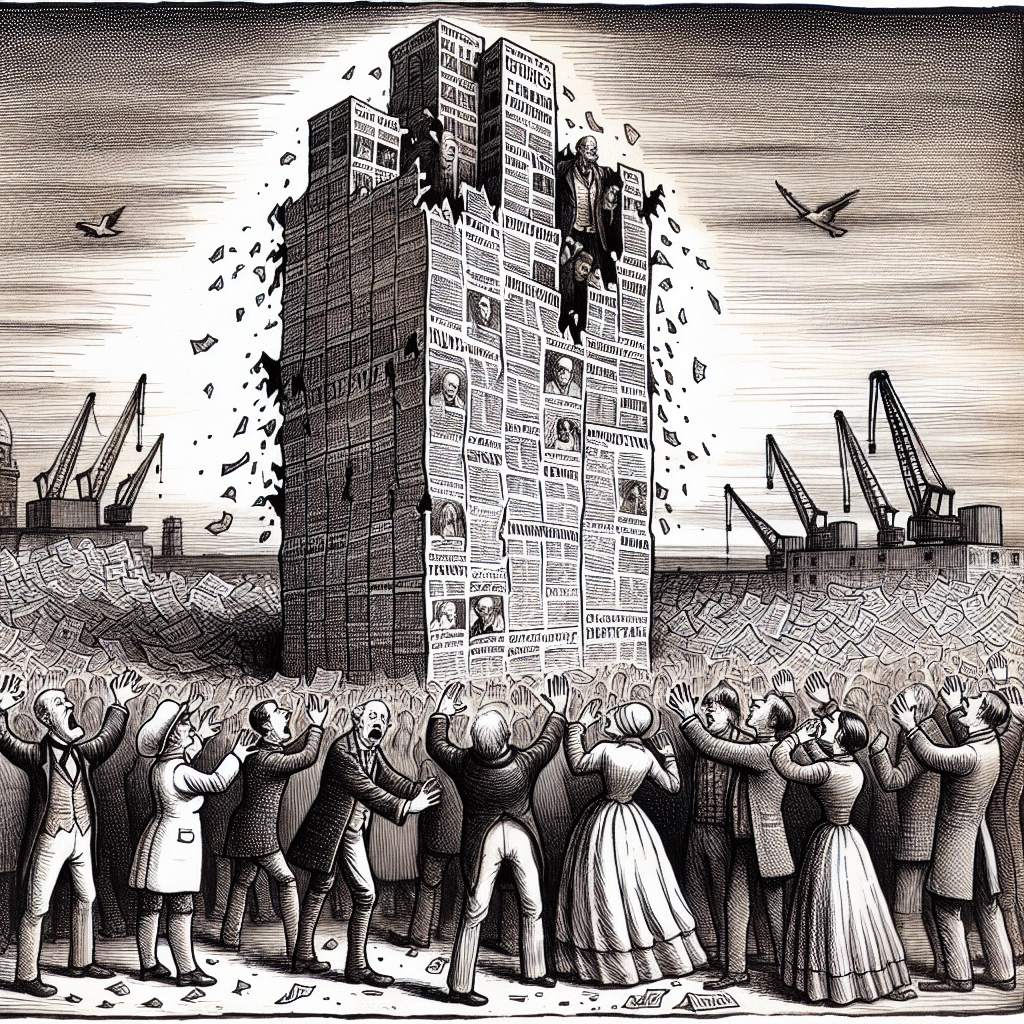
In the past five years, the most significant change in public culture has been the decline in trust in mainstream media. This is not only because we have found many reports to be wrong, but more importantly, we have realized the purpose of being manipulated, with many reports carrying carefully crafted narratives aimed at shaping public opinion to serve specific interests. This situation is much more obvious than in the past.
Thirty-seven years ago, when Noam Chomsky and Edward S. Herman co-authored “Manufacturing Consent,” I read the book and expressed admiration, having little to disagree with. However, for some reason, the book did not change my thinking habits, seeming a bit exaggerated and certainly not reflective of everyday reality. I continued to read and believe in the media as before.
Indeed, I had developed a sense of reliance on The New York Times, thinking I had found the key to extracting useful value from this media outlet, even with its evident bias as being “liberal,” which I considered as normal diversity of opinions.
Overall, I thought the newspaper’s reporting had a sense of civic consciousness, overall fairness, albeit not reflecting some nefarious agendas. I used to believe I had enough wisdom to see through the flaws and extract the essence. Additionally, candidly speaking, by reading the paper, I connected myself with the class seeking belonging. Yes, it’s sad, but I have been involved in it and understand the motives and perspectives.
Even during the “Russiagate” farce after 2016, when The New York Times collaborated with Trump’s opponents to concoct a false narrative aimed at ensnaring the new government in chaos, I didn’t fully grasp what was happening. It wasn’t until the beginning of the pandemic narrative that I realized the complete nonsense being imposed on us.
For me, February 27, 2020, was a pivotal day when the podcast I faithfully listened to exploited the presence of pathogens to incite public panic. I was convinced that The New York Times had never done this in previous pandemics. Whether during the AIDS crisis, the 2009 H1N1 concerns, the 2003 MERS outbreak, tracing back to 1968-1969 and 1957-1958, The New York Times consistently advised people to remain calm, sensible. This time was evidently different, and I knew The New York Times was definitely wrong.
In shock, I turned off the podcast. Did they not know what they were doing? Did they not anticipate the consequences? Of course, they did. What were they thinking? What had happened? Weeks later, the truth became apparent. They willingly became mouthpieces of complete destruction, all for the sake of achieving specific political goals, namely ousting Trump and populist leaders worldwide.
That day changed everything for me. That was nearly five years ago, and my view of mainstream media has never been the same. I don’t think this is solely my issue. Market share dominated by media conglomerates is declining, as many are beginning to see the truth. It’s quite shocking but a significant shift.
Subsequently, The New York Times has fully embraced what now appears to be pre-scripted narratives, blindly following government directives where every interaction is viewed as contamination, every infection labeled as a “case,” erasing semantic distinctions existing for at least 100 years. This was followed by mass use of highly inaccurate testing methods, and incorrect death classifications, making everything seem much more severe than reality.
All these factors led to nationwide mass hysteria, propelled by a complex web of governmental agencies extending from the top to people’s hometowns, with strong support from media elites. Any dissenting voice against the mainstream narrative was accused of spreading false information and silenced on social media. Those of us noticing the issues felt isolated, as if our concerns were not endorsed by the experts.
Against this backdrop, significant changes occurred in voting rules. Queueing up for voting was deemed too risky due to disease transmission. The CDC early on declared that elections must be conducted via mail-in ballots, despite the widespread knowledge for decades of the susceptibility to fraud in this method.
All these developments unfolded exactly as expected and planned: millions of ballots appeared out of nowhere, court challenges to these were dismissed. To this day, doubts persist widely regarding the 2020 election. Speaking out like this poses a risk of being silenced, but it’s better to face the public’s skepticism. The mainstream media’s full cooperation, most likely due to their dislike of the then-president, is truly infuriating.
Furthermore, people are well aware of this narrative. Next came the push for mandatory vaccination under the guise of public safety, exaggerating the effectiveness of the multi-dose vaccines. Simultaneously, people are puzzled by a series of unscientific preventive measures, from masks to air filtration and maintaining social distancing.
Amidst all this, the credibility of narrative creators took a significant hit. As Chomsky and Herman pointed out long ago, perhaps this credibility should not have been granted from the start. The public now sees through this game, understanding its operation, making it less likely to be fooled next time.
There will be a next time. The latest target of The New York Times is the widely acclaimed cultural group – Shen Yun Performing Arts. Shen Yun performs in the US and worldwide, being one of the few largest arts groups not accepting any government funding or major foundation support, yet remains profitable.
The New York Times launched numerous aggressive reports targeting Shen Yun. I read all these reports, which bear characteristics of the “Russian election interference” and COVID-19 coverage: a lot of empty boasts lacking real content, and we clearly see what’s going on. Note that Shen Yun has been sponsored by The Epoch Times for many years, a direct competitor to The New York Times in the industry.
Undoubtedly, The New York Times’ credibility in various areas has taken a significant hit. In simple terms, if a media outlet’s main driving force is reporting news according to government agencies and corporate sponsors’ scripts, it cannot pretend to be independent or free. We now know this has always been the modus operandi of The New York Times, making it easier to see through all of this.
People are no longer passively accepting conveyed information. Moreover, we have entered a new era of citizen journalism, where the power of mainstream media is under continuous scrutiny. This phenomenon is unprecedented, and there is no turning back.
As we enter 2025, we must keep our eyes wide open and look forward to what might happen in a potential second term of the Trump administration. This is not just about Trump: there is a real determination in the United States and worldwide to have a genuine cultural revival rooted in the desire for truth widespread and decentralized. It is time, and it makes me optimistic about the future.
We have all gone through a postgraduate course on how the world operates. The process has been painful, but the outcome is that we have all become better.
The author:
Jeffrey A. Tucker is the founder and president of the Brownstone Institute based in Austin, Texas. He has published thousands of articles in academia and mainstream media and has published ten books in five languages, with the latest work being “Liberty or Lockdown” (2020). He is also the editor of “The Best of Mises” magazine. He regularly writes an economics column for The Epoch Times and delivers speeches on economics, technology, social philosophy, and culture.