
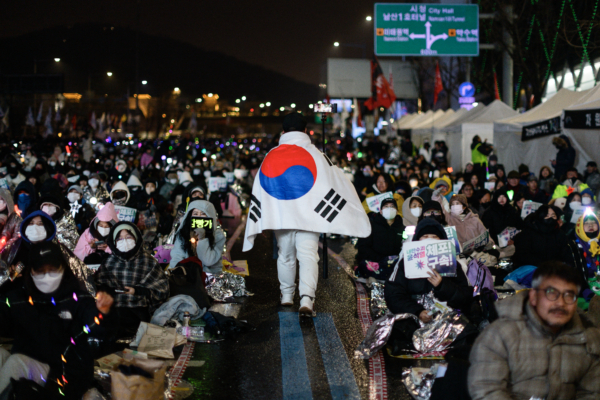
Since the South Korean district court issued a warrant for the detention of President Yoon Suk-Yeol, supporters of President Yoon have been gathering around the presidential residence to hold rallies and speeches, sharing their personal journeys from initially not understanding the imposition of martial law by the president to now standing in support. Legislators are urging unity among the public to fight until victory, vowing to defend freedom and democracy and resist communism.
On January 3, the South Korean Supreme Prosecutors’ Office attempted to execute the detention order for President Yoon, but it was halted due to resistance from the presidential security services. The Supreme Prosecutors’ Office stated that about 100 personnel were dispatched to the presidential residence to carry out the detention, but they were blocked by over 200 security personnel and military officers, leading to physical confrontations. The Supreme Prosecutors’ Office mentioned that they would consider future actions.
The presidential security forces had previously announced that they might prevent search personnel from entering the presidential residence during the execution of the detention order for President Yoon.
Despite facing impeachment and suspension by the parliament, Yoon remains the legal president of South Korea and is entitled to presidential-level security. According to Japanese media reports, the standoff between the Supreme Prosecutors’ Office personnel and the presidential security forces lasted for over 5 and a half hours, with no entry into the presidential residence achieved. This marks the first time in South Korea that a sitting president is subject to a detention order.
Under South Korean law, a suspect is detained first, and within 48 hours, a decision is made whether to formally request an arrest warrant. Following the detention review, the case is usually handed over to the prosecution, who then decides whether to press charges, initiating the trial process.
The detention order issued on December 31 was valid until January 6. So far, the Supreme Prosecutors’ Office has made three unsuccessful attempts to have President Yoon voluntarily surrender.
President Yoon’s defense lawyer indicated opposition to the Supreme Prosecutors’ Office’s action, stating that they would take legal measures against the detention order, considering it as illegal and ineffective. Presently, the Constitutional Court and regular courts are reviewing their objections and will take legal actions against any unlawfulness in the execution of the detention order.
Prior to this, President Yoon’s legal team challenged the Supreme Prosecutors’ Office’s lack of authority to investigate cases of insurrection, condemning the court’s issuance of the detention order as an encroachment on presidential powers. They have lodged an jurisdiction dispute request with the Constitutional Court and objected to the execution of the detention and search of President Yoon.
The atmosphere in South Korea has been described as tumultuous since President Yoon declared a state of emergency on December 3. The execution of the detention order has heightened tensions within the country.
On New Year’s Day, President Yoon delivered a message to his supporters gathered outside the official residence, stating, “Patriotic citizens, South Korea is facing threats from sovereignty-infringing forces and anti-national powers. I will stand by you steadfastly in this fight. The masters of freedom and democracy are not the state or political parties but the people; freedom and democracy will prevail.”
However, some interpreted his remarks as incitement, suggesting that Yoon remaining at the presidential residence was shielded by his supporters against the enforcement of the detention order by the Supreme Prosecutors’ Office.
On January 3, during the execution of the detention order, an estimated over 10,000 supporters gathered in front of the presidential residence, blocking the roads and preventing the order’s execution. Despite the freezing temperature of -3 degrees Celsius, the supporters remained resolute, with some individuals distributing food and encouraging others.
In the evening of January 4, Professor Am Kwang-Kyu from Korea University addressed the crowd in front of the presidential residence, emphasizing the crucial fight for the protection of President Yoon as a symbol of defending the South Korean system. He stressed the need for unity to emerge victorious.
Other citizens expressed their unwavering support for President Yoon, highlighting their awakening to the importance of safeguarding national values and resisting external pressures. The gathering encompassed a diverse range of individuals, from older citizens to young couples and families with children.
The tensions extended to conflicts between left-wing organization “National Democratic Labor Union Alliance” and right-wing patriots near the presidential palace, leading to the arrest of two individuals from the labor union for allegedly assaulting police on January 4.
The Constitutional Court of South Korea has completed the preliminary procedures for the impeachment trial of President Yoon and scheduled a formal trial for January 14. The trial proceedings will focus on determining the constitutionality of President Yoon’s actions rather than criminal offenses.
The legal battle surrounding President Yoon’s detention has sparked a public discourse on the nation’s future direction, positioning him as a pivotal figure in the struggle between democratic forces and authoritarian influences. The outcome of the trial is anticipated to be influenced by public sentiment and President Yoon’s support among the populace.