
“Investment banking is my dream,” Sun Zhan, who is about to work as a waiter in a hotpot restaurant in Nanjing, told the BBC. At 25 years old, he just obtained a master’s degree in finance and had hoped to secure a high-paying job to make a lot of money, but his wish did not come true.
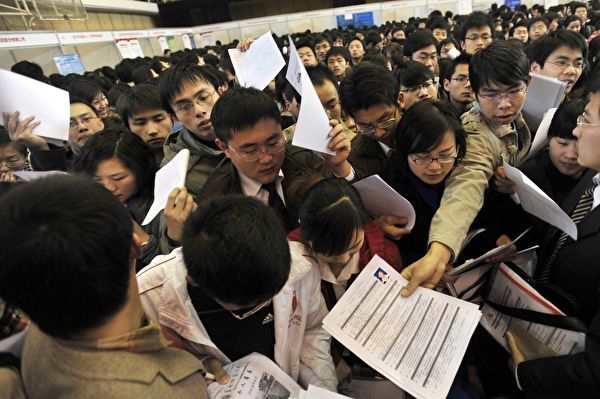
Amid the current economic challenges in China, it is becoming increasingly common for highly-educated individuals to take on low-skilled jobs. Physics masters are working as repairmen, philosophy graduates are becoming delivery drivers, and even a Ph.D. graduate from Tsinghua University has applied for a position as an auxiliary police officer. With youth unemployment rates lingering at high levels (reaching 18.8% in official data in August 2024), many college students are struggling to find jobs aligned with their expertise. Faced with the pressure to survive, they are forced to choose low-paying industries or readjust their career expectations.
Sun Zhan’s parents were dissatisfied upon learning that their son, a graduate from a prestigious school, would be working as a waiter in a hotpot restaurant, adding to his already considerable pressure. “After all, I have studied for many years and attended a fairly good school,” he said. His family felt embarrassed by his choice of job, as they had hoped he would become a civil servant or a government official.
Professor Zhang Jun from the City University of Hong Kong expressed to the BBC, “The job market in mainland China is indeed very challenging, so I believe many young people must readjust their expectations.”
“This is my choice,” Sun Zhan said. He revealed that he has a secret plan: to learn about business while working as a waiter and eventually open his own restaurant, hoping to change his family’s attitude.
Finance master Wu Dan, using a pseudonym, graduated from the Hong Kong University of Science and Technology and returned to Shanghai to find work. He initially hoped to secure a suitable position in the finance industry. However, due to personal circumstances not aligning with market conditions, Wu Dan ultimately chose to pursue a career in sports massage despite opposition from his family.
“The job market is truly challenging,” Wu Dan, 29, told the BBC, revealing that he is currently an intern at a sports injury massage clinic in Shanghai. However, for many of his fellow master’s degree classmates, “very few people eventually find jobs.”
According to the 2024 University Graduate Employment Capability Survey report by Zhaopin.com in China, the employment rate for postgraduate and doctoral graduates from non-elite schools is only 33.2%, a decrease of 17% from last year and lower than the 43.9% for undergraduate graduates.
Zhang Jun mentioned that many students pursue higher degrees in hopes of better prospects, but the harsh reality of the job market has left them disheartened.
In recent years, Chinese university graduates have faced unprecedented challenges in employment. In 2024, the number of university graduates reached 11.79 million, an increase of 210,000 compared to the previous year, setting a new historical record. However, amidst fierce job competition, many graduates are finding it difficult to secure their ideal job.
“I mainly stand next to the male lead, acting as a ‘pretty decoration’,” said Wu Xinghai, a 26-year-old graduate in electronic information engineering, leveraging his outstanding appearance to play a bodyguard role in a drama. “People see me next to the main character, but I have no lines.”
“This is the current situation in China, right? Unemployed right after graduation,” said a respondent surnamed Li who did not wish to disclose their name. They majored in film directing and screenwriting but also signed a contract to work as an extra in films.