
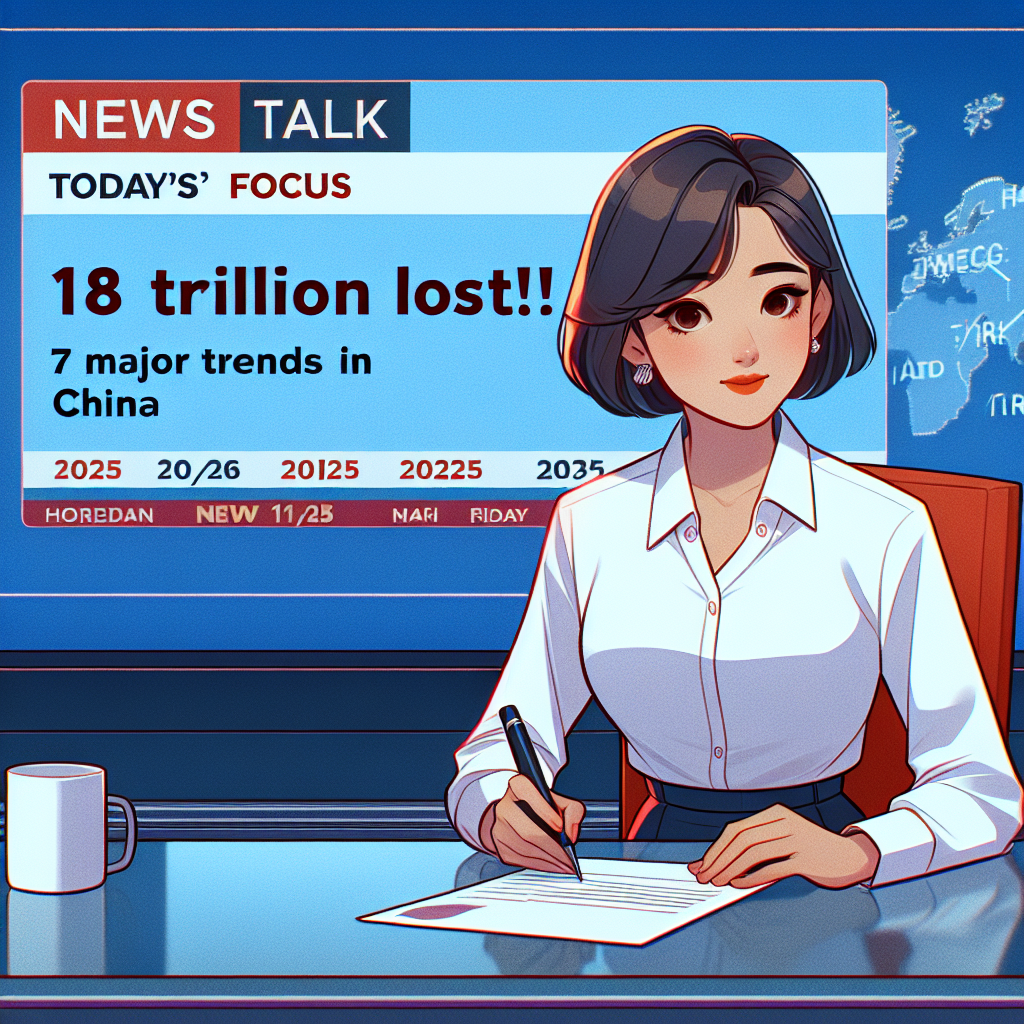
Hello everyone, welcome to the live broadcast of “News Talk” for the first issue of 2025. I am Fuyao, and today is January 3, Friday. I am delighted to meet with you in the new year.
Today’s focus: 18 trillion lost! 7 major trends in China in 2025, “Huari”: Economic Supremacy Over the US has become a mirage; 82 executives of listed companies have been arrested, why is “Far Seas Fishing” in China so rampant? The Trump administration 2.0 is about to take office, what direction will US-China relations take?
Our guests for this episode are Mr. Li Hengqing, an economist from the American Institute for Economic Research, and Mr. Qin Peng, a current affairs commentator and senior political and economic analyst.
Against the backdrop of weak economy, growing public discontent, and military turmoil, China has entered 2025. The world is paying attention to what changes will occur in China in the new year and how China’s relationship with the world will evolve.
Radio Free Asia recently published an article looking ahead to China in 2025, summarizing seven major trends:
1) Internal power struggle within the CCP;
2) US-China relations could be in a dangerous state;
3) China’s economy urgently needs new dynamics;
4) Intense factional infighting within the CCP’s military;
5) Beijing is likely to intensify cultural and military intimidation towards Taiwan;
6) China is stepping up stability maintenance, but extreme events may resurface;
7) Human rights in China in 2025 are not optimistic.
1. Mr. Li Hengqing, which of these seven major trends do you think are most worthy of our attention? They are also the seven major crises facing the CCP.
2. Mr. Qin Peng, regarding the situation in the Taiwan Strait in 2025, some analysis suggests that China’s weak economy, frequent purges of the CCP military, and Trump’s return to the White House will make it difficult for the CCP to have the objective conditions to provoke Taiwan. What is your opinion on this?
One of the primary challenges facing the CCP in 2025 is undoubtedly the economic issue. A recent article by The Wall Street Journal used the keyword “surplus” to describe the current state of China’s economy, including excessive debt, surplus construction, excess capacity, and more.
The article mentioned that China currently has millions of unoccupied or unfinished apartments, local governments facing debt crises in trillions of dollars, and surplus production capacity that cannot be absorbed domestically, leading to tension in relationships with other countries. These issues are described as time bombs for the Chinese economy.
3. Mr. Li Hengqing, how do you view the issue of “surplus” in the Chinese economy?
4. Mr. Li Hengqing, we know that one of the major problems facing the current Chinese economy is deflation, and The Wall Street Journal’s mention of “surplus” – how does it relate to the current deflation in the Chinese economy?
According to estimates by Barclays Bank, since 2021, the collapse of the real estate market has destroyed about $18 trillion in Chinese household wealth, exceeding the losses suffered by Americans in the 2008 subprime crisis.
The article in The Wall Street Journal mentioned that the reality is that the United States still drives the global economy, while China struggles amid slowing growth. It is now nearly unimaginable for anyone to expect China under the CCP to surpass the United States before the middle of this century. This is a rare clear statement by mainstream international media that the Chinese economy cannot realistically surpass the United States.
5. Mr. Qin Peng, why do you think The Wall Street Journal can make such a decisive judgment?
Towards the end of 2024, a term frequently appeared on China’s internet, which is “Far Seas Fishing”. Here, “Far Seas Fishing” does not refer to fishing, but metaphorically refers to local governments in China exercising jurisdiction in other regions, using police forces to cross provinces to arrest private entrepreneurs, seizing and freezing corporate and individual assets to create revenue for local governments.
According to a report by the Financial Times at the end of last year, over 80 executives of listed companies were captured across provinces just in 2024, it was like being “Far Seas Fished”.
6. Mr. Li Hengqing, why do you think this phenomenon is so rampant in China?
In light of the rampant “Far Seas Fishing” phenomenon, there have been some template-like statements from the central government. Zheng Zhanjie, Director of the National Development and Reform Commission of the CCP, recently demanded strict prohibition of cross-jurisdictional enforcement and tendency-based law enforcement. The Supreme People’s Procuratorate of the CCP has also stated that it will focus on supervising and correcting the problem of cross-jurisdictional tendency-based law enforcement.
7. Mr. Qin Peng, this kind of statement, in fact, the authorities could turn a blind eye, or rather, they have been tacitly approving of these actions as it can create false prosperity and a harmonious image. Do you think the central government really wants to curb “Far Seas Fishing”?
Domestic private enterprises in China may be subjected to “Far Seas Fishing” by local governments, which poses security concerns for foreign enterprises as well. The Taiwan Mainland Affairs Council has warned Taiwanese businesses that the economic prospects in China may not be optimistic, and the investment environment is becoming more severe, urging careful assessment of risks in investing in China to avoid irretrievable losses. Therefore, this also relates to the issue of the safety of the investment environment for foreign enterprises.
Lastly, let’s discuss US-China relations. In less than 20 days, President-elect Trump will take office. Currently, Trump’s signals towards Beijing are somewhat ambivalent; on one hand he says he is willing to negotiate with China, but on the other hand, additional tariffs on Chinese goods are already poised; on one hand, Trump claims to have a good relationship with CCP leader Xi Jinping, but on the other hand, he has formed a cabinet that is confrontational with the CCP.
8. Mr. Li Hengqing, how do you envisage US-China relations in 2024? In the Trump 2.0 administration, which direction do you think US-China relations will take?
Subscribe to the YouTube channels:
https://www.youtube.com/channel/UC_78IIcKAIDpp6SJOlf3vDA
Subscribe to the Ganjing World channel:
https://www.ganjingworld.com/channel/1eiqjdnq7go5grer6fQLmhsYe1g60c