
Why has the homeless shelter system in New York City shifted from a leasing model to specialized construction? What policies and operations are involved in this transition? In 2017, a major change in the policy of the Department of Homeless Services (DHS) in New York City allowed non-profit organizations to sign 30-year contracts with DHS for the first time, laying the foundation for the specialized construction of homeless shelters. This shift not only changed the way shelters are built but also marked the beginning of a complex mechanism for approval, financing, and operation.
In 2017, Mayor de Blasio’s administration announced the “Turn the Tide on Homelessness” plan and introduced a significant policy change: allowing non-profit organizations to sign 30-year contracts with DHS, including financing for the acquisition, construction, and renovation needed for “specialized shelter construction,” and providing debt service payment funding.
The 30-year contract term brought stability and financial advantages to non-profit organizations, making them eligible for favorable financing conditions and enabling them to focus more on the acquisition, construction, and operation of shelters. These specially designed shelter facilities aim to better serve the homeless and their families. Despite the billions of dollars invested by federal and local governments in homeless services in recent years, the crisis has yet to be alleviated.
Understanding the operational logic of the shelter system is crucial for the Bensonhurst 86th Street Chinese community to better grasp the background of related news and provide basis for challenging homeless shelters. For instance, understanding why shelter operating groups receive high subsidies and key entry points in legal proceedings.
The shelter system in New York City was established in the late 1970s to address the “modern” homeless problem. Prior to that, the homeless were mostly alcoholic single impoverished men. Today, besides alcoholism, homelessness also involves drug addiction and mental health issues. Additionally, many homeless individuals are single mothers seeking shelter with their children.
New York City’s response to the modern homeless problem has evolved over five mayoral terms and forty years, with two milestone events:
The first milestone was the 1979 Callahan v. Carey case. Advocates for homeless rights argued that New York City failed to provide temporary housing for homeless single men, violating its obligations under the New York State Constitution. In 1981, Mayor Koch settled the case by signing a consent decree granting shelter rights to single men, with subsequent litigation and settlements extending this right to single women and families.
Under the settlement agreement, shelter rights were interpreted as the right to immediate housing, requiring applicants to be accommodated on the same day. This forced the city government to rely on temporary facilities, such as hotels or “cluster” apartments temporarily set up in residential buildings. These facilities were generally considered inferior to specifically constructed shelters in recent years, leading to a decline in shelter quality. Furthermore, shelter rights have played a crucial role in shaping urban homeless policies.
According to the Manhattan Institute’s publication “Performance Benchmarks for Homeless Shelters” (author: Stephen Eide), over the years, lawyers from legal aid organizations and those representing the homeless alliance have wielded more influence over New York City’s approach to the homeless challenge than many elected representatives in the city council.
The second milestone was the 1992 Commission on Homelessness report “The Way Home: A New Direction for Social Policy.” Convened by Mayor Dinkins, the report recommended the establishment of DHS as an independent agency and the implementation of a “decentralization” policy, shifting the operation of homeless shelters from municipal to DHS-funded non-profit organizational networks. Mayor Giuliani, Dinkins’s successor, implemented this recommendation.
In the early 1990s, although the term “privatization” was controversial in some circles, government-funded private contractors had become the foundation of social policy formulation in New York City. In the 2017 fiscal year, New York City managed over 9,000 “human services” contracts worth $22.6 billion, with approximately 400 contracts ($4.8 billion) signed with DHS.
Fast forward to 2017, Mayor de Blasio’s administration announced the “Turn the Tide on Homelessness” plan in February.
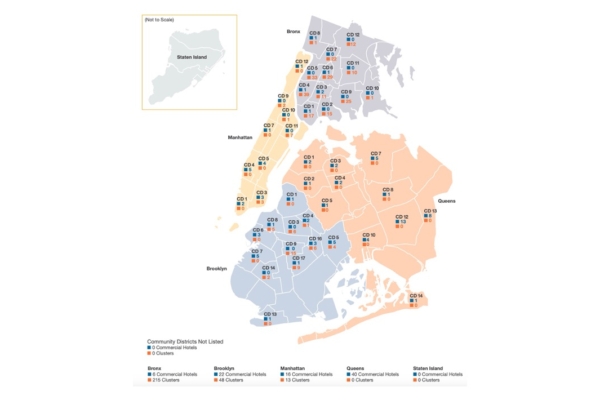
The plan aims to phase out the use of 360 “cluster sites” and commercial hotels as shelters and replace them with 90 shelters distributed across the city’s five boroughs. De Blasio stated that the newly established shelter network would more effectively place the homeless and ensure they remain in locations close to communities, workplaces, schools, religious institutions, and other support systems to help them reenter society.
In the past few years, the proposed new homeless shelters in the Bensonhurst-Bath Beach area of Brooklyn, including those planned at 2147 Bath Avenue and 2501 86th Street, were part of this project. The Chinese community protested against the shelters being located in a major commercial area where residential neighborhoods and proximity to churches, mosques, and schools, suggesting the shelters would not benefit the community.
However, the “Turn the Tide” plan believes that “these shelters should be located in communities near schools, job opportunities, healthcare, or religious sites because stable social support is crucial in helping families and individuals regain stability and accelerate their exit from shelters.” The plan aims to build 90 “community-based” shelters across New York City, with each community sharing the burden equally, ensuring the homeless can remain close to familiar work, social circles, and support systems.
According to the 113-page “Turn the Tide on Homelessness” plan by the NYC government in 2017, the city plans to promote shelter development by eliminating barriers within two years. This includes establishing mechanisms to help non-profit partners finance large capital projects and expediting the establishment process of specialized shelter construction to adapt to the realities of the real estate market.
The plan believes that specialized, non-profit-operated shelters can ensure better customer service. Additionally, the community spaces within the shelters will not only be open to shelter clients but also to the surrounding community, integrating shelters with permanent housing in the same project. For this, the city will support non-profit and private shelters through a combination of capital and expenditure funds, and other financial mechanisms.
New York City’s existing shelter system adopts a “conscious shelter design” approach and sets regulations for shelter establishment, operation, funding arrangements, and legal restrictions based on the long-term contracts between DHS and non-profit owners. Here are some key points summarized:
Contract Form: DHS signs a Principal and Interest (P&I) contract with non-profit shelter providers to pay for the financing costs of shelter development.
Ownership Requirements: P&I contracts must be signed between DHS and non-profit shelter providers, who operate the shelter based on a long-term lease agreement with non-profit owners.
Non-profit owners must be Housing Development Fund Companies (HDFC) established under Article 11 of the Private Housing Finance Law, with HDFC controlled by the non-profit provider.
HDFC can develop shelters alone or in partnership with other entities, including for-profit organizations, but must complete permanent conversion to become the sole owner before paying principal and interest. HDFC transfers the shelter to be operated by the non-profit provider through a long-term lease, even if the contract is terminated midway, the city government still remains obligated to make payments.
Required Documents Before Contract Registration: Applicants must provide proof of site control (such as a quote letter, letter of intent, Option Agreement, or sales contract), development and operating budgets; approved building plans by DHS and pre-construction certificates from architects; completed and satisfactory environmental quality review, if applicable; financing commitment letters from building and permanent loan institutions; and a letter from DHS notifying the shelter development.
Time Limit: Within 60 days of contract registration, funding must be completed and construction initiated to avoid delays in funding or plans.
Land Use Restrictions: HDFC must commit to using the land for shelters, affordable housing, or other public interest purposes for a period of 60 years.
Right of First Purchase: DHS has the priority to purchase the shelter and land at the loan balance price, ensuring resources are devoted to public services in the long term.
According to an official letter from DHS to the Buildings Department on December 6, 2023, DHS is collaborating with the non-profit provider “VIP Community Services” to construct a homeless shelter for single adults with 150 beds at 2501 86th Street in Brooklyn.
In compliance with the long-term contract requirements and terms between DHS and non-profit ownership, “VIP Community Services,” a non-profit provider, must operate the shelter under a long-term lease, with the non-profit owner required to be an HDFC and controlled by the non-profit provider.
Considering that the plot was sold to new Indian owners for $4.8 million in February 2023, if they are not a non-profit entity, they must transfer the land to an eligible HDFC. After obtaining proof of site control, HDFC must hire engineers to design drawings that meet shelter standards and apply for the Buildings Department’s new construction permit.
In conclusion, from the demolition of old buildings to specialized construction and the ownership and control of new homeless shelters by non-profit organizations, this process involves multiple reviews and procedures that must overcome several critical barriers. After complying with the standard procedures, the government will approve P&I contracts and secure project financing to ultimately advance shelter construction and operation.