
On January 2, the Philippines police announced that local fishermen had discovered an unmanned underwater glider suspected to be a surveillance device of the Chinese Communist Party (CCP).
According to the Philippine police, three fishermen found this underwater equipment about 9 kilometers (6 miles) off the coast of San Pascual in Masbate, central Philippines.
Reported by Agence France-Presse, the unmanned underwater glider is yellow in color with the label “HY-119,” approximately 2 meters long, torpedo-shaped, and equipped with tail fins.
The local police chief stated, “Based on our research from open source information on the internet… HY-119 is a Chinese underwater navigation and communication system. It is equipped with antennas and cameras for observation. According to our research, this could be used for monitoring and reconnaissance.”
The police chief mentioned that although the unmanned glider is not armed, authorities believe this discovery poses a “potential national security threat.”
The equipment has been handed over to the Philippine Navy for further investigation.
International maritime observer Ray Powell told the Philippine Star that this unmanned underwater glider could be used to survey the underwater terrain of the Philippines for military purposes, including possibly deploying submarines in Philippine waters.
Powell stated, “If this is a Chinese glider, it indicates China’s interest in the inland island waters of the Philippines has reached alarming levels.”
He further noted that if the unmanned glider is conducting underwater mapping, this could signal China’s preparation for submarine deployment, “which could mean that China intends to deploy submarines in Philippine waters or may want this option in the event of a conflict.”
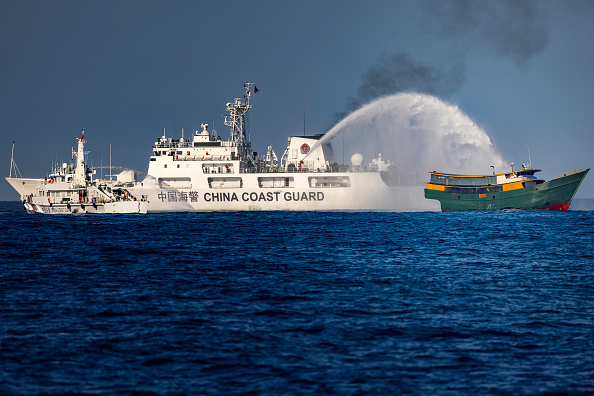
The CCP claims nearly all areas of the South China Sea, including the territorial waters and exclusive economic zones of countries such as the Philippines, Vietnam, Malaysia, Brunei, and Taiwan. However, the Permanent Court of Arbitration in The Hague ruled in 2016 that China’s sovereignty claims over almost the entire South China Sea have no basis in international law. Despite this ruling, China has refused to acknowledge it.
As a result, conflicts between the Philippines and China over maritime rights and island ownership in the South China Sea have been frequent. Since President Marcos took office, the Philippines has lodged nearly 200 protests against China. Indonesia has also had clashes with the Chinese coast guard.
(Information referenced from reports by Agence France-Presse and the Philippine Star)