
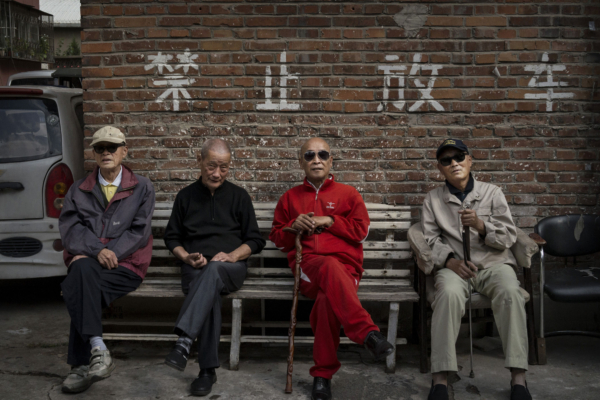
The Chinese Communist Party proposed the gradual retirement plan in July 2024. On New Year’s Day this year, the official announcement of the “Interim Measures for Flexible Retirement System” was made, officially implementing the “Delayed Retirement” policy. Since the proposal of the delayed retirement plan many years ago, it has been heavily criticized, causing concerns about further intensification in the workplace.
The three departments of the Chinese Communist Party – the Ministry of Human Resources and Social Security, the Central Organization Department, and the Ministry of Finance – issued and interpreted the “Interim Measures” on January 1st.
According to the “Interim Measures,” starting from January 1, 2025, employees who have reached the minimum payment years for receiving basic old-age pensions can voluntarily choose early retirement. At the legal retirement age, employees can also choose to delay retirement after reaching an agreement with their respective units. The maximum early retirement age is set not more than three years before the legal retirement age, and the retirement age should not be lower than the original legal retirement age of 50 and 55 for women and 60 for men, respectively.
For example, a male employee reaching the reformed legal retirement age in 2031 with a minimum payment year limit of 16 years could opt for early retirement in 2029, requiring only 15 years of payment. Those opting for “delayed” retirement will still be calculated based on the legal retirement age.
The “Interim Measures” do not explicitly prohibit officials and executives of state-owned enterprises from choosing to delay retirement. The regulations indicate that civil servants, leaders of state-owned enterprises, and other managerial personnel should complete retirement procedures promptly upon reaching the legal retirement age. If officials and employees of state-owned enterprises choose flexible retirement, they should follow the specific approval procedures in line with administrative authority.
How do mainland Chinese citizens perceive the official implementation of the delayed retirement plan?
Blogger Lao Xu from Zhejiang expressed concerns that under the “Interim Measures,” most people will have to extend their retirement age by three years. Many question if employment opportunities will be available for individuals in their 40s and 50s, given the current job market conditions.
He further mentioned that the implementation of delayed retirement will lead to changes in the workplace environment. Having individuals who were supposed to retire continue working will reduce short-term job vacancies, making it harder for new job seekers. This would undoubtedly intensify competition in the job market.
This has driven individuals in the workforce to become “slashed youth.” Some have already embarked on this lifestyle – working as a host for ten years, then becoming a writer for the next decade, and eventually transitioning to a broadcaster in their senior years.
The National People’s Congress Standing Committee announced on September 13 last year that a “gradual increase in the legal retirement age” would be implemented. Starting from January 1, 2025, the legal retirement age for male workers will gradually increase from 60 to 63, while for female workers and female cadres, it will be extended from 50 and 55 to 55 and 58, respectively. From January 1, 2030, the minimum qualifying years for receiving pensions will increase annually by six months, reaching 20 years from the current 15 years. If an individual reaches retirement age but the payment years are insufficient, they must extend or pay off the balance to receive basic old-age pensions.
Upon the authorities announcing the gradual delay in retirement alongside extending the minimum payment years, mainland Chinese citizens widely expressed dissatisfaction, criticizing the lack of contractual spirit from the authorities. Many realized that after the new policy implementation, the resulting retirement benefits might be lower compared to their previous contributions, prompting many to opt-out of the social insurance system.
Economic influencer “Ah Xing” raised questions about the implications of the delayed retirement policy. Firstly, he remarked that the current job market does not have enough openings, leading to an imbalance between job availability and population size. Delaying retirement could result in a surplus of labor, raising concerns about managing excess labor.
Secondly, he highlighted the increasing pressures in the current employment environment. Individuals above 35 are often laid off due to younger replacements, indicating that China does not lack labor force.
Regarding ordinary citizens, he pointed out that many individuals over 30 to 40 years old may struggle to find employment. Delaying retirement to 65 will pose challenges for these individuals in finding work. Companies often have age limitations, leading to awkward employment situations for older workers.
Economic influencer Da Liu previously stated in a video that the issue of delayed retirement has been debated for years and is an inevitable policy. Reports have suggested that China’s basic old-age pension fund may be depleted by 2035.
He further emphasized that for freelancers, the pensions they contribute might not be sufficient upon retirement.
Under his video, many netizens commented:
“The government should extend the payment years rather than delaying retirement.”
“The downsides of delayed retirement are many: firstly, it may prevent young people from seizing job opportunities; secondly, physical laborers may face health concerns beyond a certain age; thirdly, companies are generally unwilling to hire older individuals; fourthly, there is a significant disparity in retirement pensions between state-owned enterprises that needs improvement.”
“Nowadays, fewer young people work in government enterprises compared to private companies. Private companies are quick to terminate employment for those above 35. How can I delay my retirement if the company wants me out?”