
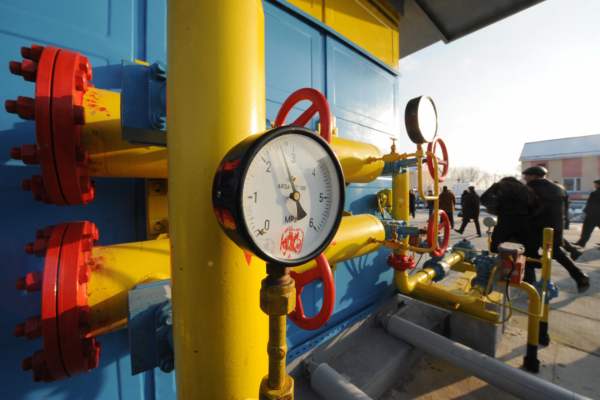
Starting from Wednesday (January 1st)], Russia’s natural gas supply to Europe through Ukraine will cease, marking the end of over 40 years of energy cooperation between the two countries. The reason behind this halt is that the Ukrainian state-owned gas company Naftogaz has refused to renew a new five-year transit agreement with the Russian gas giant Gazprom.
Amidst the ongoing conflict between the two nations, Ukrainian President Volodymyr Zelenskiy mentioned on December 19th that Kyiv could consider allowing Russian gas transit, but on the condition that payments to Moscow would be frozen until the end of the war.
One week later, Russian President Vladimir Putin stated that it is no longer possible to sign a new agreement this year.
According to Reuters, based on the forecasted average gas price of $339 per thousand cubic meters by the Russian government, Russia’s revenue from gas sales through Ukraine this year could reach around $5 billion, while Ukraine annually earns between $800 million to $1 billion in transit fees.
In 2022, following the loss of Russian supply, natural gas prices in the European Union soared to historic highs. However, with the impending termination of supply, EU officials and traders suggest that given the limited quantities involved and fewer remaining customers, a repeat of price surges is unlikely.
The following outlines the impacts and measures for Europe in response to this change:
As the EU has reduced its reliance on Russian energy following the Russia-Ukraine conflict, Russia’s gas supplies to Europe have decreased from 650 billion cubic meters annually in 2020 to less than 140 billion cubic meters in 2023, with its market share plummeting from 35% to 8%.
The EU indicates that it can completely substitute natural gas from Russia through liquefied natural gas (LNG) and non-Russian pipelines to avoid recurrence of price fluctuations.
Austria and Slovakia are major users of natural gas transiting through Ukraine. Austria is prepared to source supplies from other origins. Slovakia has secured its supply by signing contracts with energy companies like BP and Eni.
Czech Republic can import more natural gas through German pipelines and provide transit and storage capabilities to Slovakia.
Moldova prepares for a potential termination of Russian gas supply, but claims to have diversified its sources and plans to reduce consumption by at least one-third starting from January 1st.
Most other Russian natural gas routes to Europe have ceased operations, including the Yamal-Europe pipeline via Belarus and the Nord Stream pipeline in the Baltic Sea. The only feasible alternative currently is the TurkStream pipeline to Turkey via the Black Sea, but its capacity is limited.
With Russia’s diminishing control over the European gas market, the EU is turning its focus towards non-Russian energy suppliers like Norway, the United States, and Qatar. Meanwhile, Ukraine asserts that its energy security is unaffected as it does not rely on Russian transited gas.
In conclusion, as the Russian-Ukrainian gas cooperation ends, the European energy market is further reducing its reliance on Russia. Although this marks the conclusion of a historic partnership, thanks to diversified energy supply strategies, the impact on European energy security is limited.