
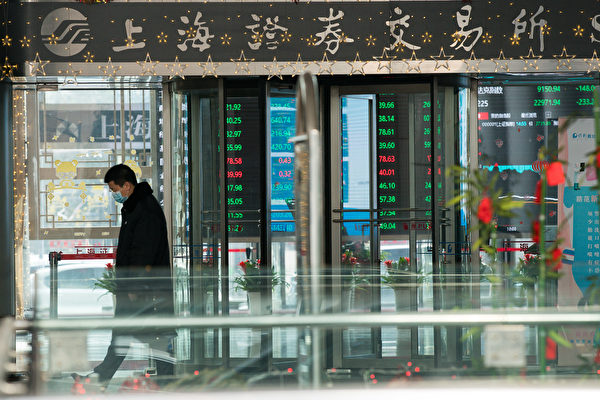
On the last trading day of 2024, the A-share market in China witnessed a widespread decline with major indexes tumbling collectively.
On December 31st, the three main A-share indexes opened flat and then took a sharp downturn in the afternoon. By the closing bell, the Shanghai Composite Index fell by 1.63% to 3351.76 points, the Shenzhen Component Index dropped by 2.4% to 10414.61 points, and the ChiNext Index plummeted by 2.93% to 2141.60 points. Additionally, the Sci-Tech Innovation 50 Index fell by 3.11%, the SSE 50 Index dropped by 0.8%, and the CSI 300 Index went down by 1.6%.
Individual stock performance was even worse, with only 705 out of 5324 stocks in Shanghai, Shenzhen, and Beijing showing gains and 4619 experiencing declines, resulting in an average price drop of 2.5%. According to Wind data, as of December 31st, there were a total of 5383 stocks in the A-share market. The combined turnover of Shanghai and Shenzhen amounted to 1.3458 trillion yuan, an increase of 69.6 billion yuan compared to the previous trading day.
The semiconductor sector took a heavy hit, with companies like Kuawei Tech, Cansun Corp, and Xingchen Technology experiencing significant declines. The copper cable high-speed connectivity concept saw a sharp drop of over 7%, with Derun Electronics, Jindata Shares, and Xinke Materials hitting the limit down. Huawei HiSilicon concept led the decline, with companies like Huiboyun Communications, Wolcore Materials, and Skyworth Digital falling. The food and beverage sector started strong in the morning but gradually weakened, with companies like Emperor Liquor, Laiyifen, and JOINTHING showing limit-up gains.
Analyst Liu Changsong from Hexun Investment Consulting pointed out that in the midst of structural adjustments, with technical indicators yet to recover, investors should maintain a high level of caution until effective stabilization is observed. Those investors who are holding high short positions need to continue patiently waiting and observing.
Financial blogger “Yunjie Finance” analyzed in a post: “Today’s market performance is truly anomalous. For the past nine years, the end-of-year closings have mostly been positive, but on the final trading day of 2024, we closed with a bearish candlestick, showing a breakthrough in technical levels, serving as a stark warning. The halt of trading by foreign institutional investors, likely caused by domestic institutional selling off, including mutual funds choosing to dump weighted stocks, has set a new low. Can we still expect a positive start to 2025 after the holiday period?”
Dr. Li, a Ph.D. in Natural Sciences from the Chinese Academy of Sciences, stated in a blog post: “Consumption is sluggish, and financial consumption is following suit. Today’s (A-share) trends seem to highlight once again the seriousness of deflation: If falling commodity prices due to deflation persist, what will happen to stock prices?”