
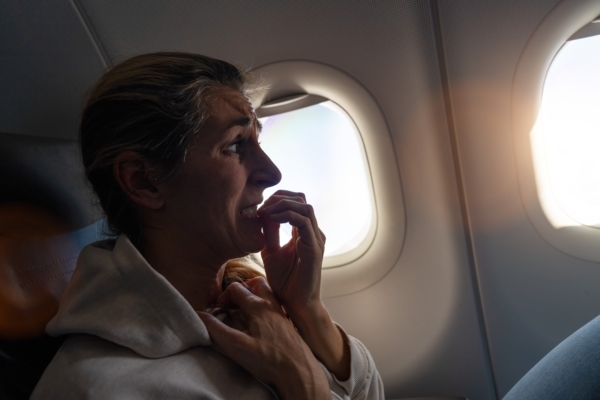
A tragedy struck on December 29th when a passenger plane belonging to Jeju Airline from South Korea crashed upon landing at the airport, resulting in 179 fatalities and 2 injuries, shocking the international community. This incident has raised concerns about the safety of air travel for some individuals. If you are someone prone to nervousness, you might wonder where it’s safest to sit on a plane. Let’s hear what the experts have to say.
According to a report by Travel and Leisure magazine, Dan Bubb, an associate professor at the University of Nevada, Las Vegas, an aviation expert, and former pilot, mentioned that there are indeed safer areas on an airplane, with the back seats being the preferred choice for safety.
Time magazine analyzed data from the Federal Aviation Administration’s aircraft accident database spanning 35 years to determine which seating areas have higher survival rates during accidents. The results revealed that the death rate in the back third of the plane was 32%, the middle third was 39%, and the front third was 38%. In other words, the back seats are considered safer.
Specifically, statistics show that the middle seats at the back of the plane are the safest, with a death rate of only 28%. In comparison, the death rate for aisle seats in the middle section is 44%.
In a study published by the University of Greenwich in 2008, passengers seated near emergency exits were found to have a higher chance of survival in the event of a plane crash.
However, the likelihood of surviving an aviation disaster is more related to the circumstances of the crash rather than the seat you are in. For instance, in the case of the 1989 crash of United Airlines flight 232 in Sioux City, Iowa, most of the 184 survivors were seated in the middle third of the plane.
The Tenerife Disaster in 1977, which is the deadliest accident in aviation history, resulted in 583 fatalities. Surprisingly, most of the 61 survivors were seated towards the front of Pan Am flight 1736, while all passengers on KLM flight 4805 in the collision perished.
It is worth noting that air travel is generally safe and has become even safer over the past decades, especially when compared to other modes of transportation. The probability of dying in a car during one’s lifetime is 1 in 112. For pedestrians, this probability is 1 in 700, and for motorcyclists, it is 1 in 900. In contrast, the risk of death while flying reduces significantly to 1 in 8,000.
A study released by the National Transportation Safety Board in 2020 indicates that between 2001 and 2017, 98.2% of passengers involved in aviation accidents sustained minor injuries or were unharmed, 0.6% suffered severe injuries, and 1.3% succumbed to their injuries.
David Rimmer, CEO of AB Aviation Group, a survivor of a plane crash, mentioned that while sitting at the back of the aircraft is safer, it may not be as comfortable. He emphasized that during turbulence, which is a common occurrence, the back seats can be uncomfortable.
Rimmer stated, “Data indicates that while the safest seats on the plane are towards the back, it’s also the most uncomfortable during turbulence.”
He advised passengers who fear flying to pay attention to turbulence, a prevalent factor, rather than focusing solely on selecting a “safer” seat on the plane. Rimmer suggested opting for seats closer to the middle of the aircraft—considered “less safe” in comparison—to mitigate the potential impact of severe weather conditions.
Bubb highlighted that instead of fixating on choosing a “safer” seat on the plane, it is more crucial to take proactive measures to safeguard oneself in emergency situations, such as following crew instructions, reviewing the safety card located in the seat pocket, counting the rows to the nearest emergency exit for a swift evacuation in critical circumstances, and more.