
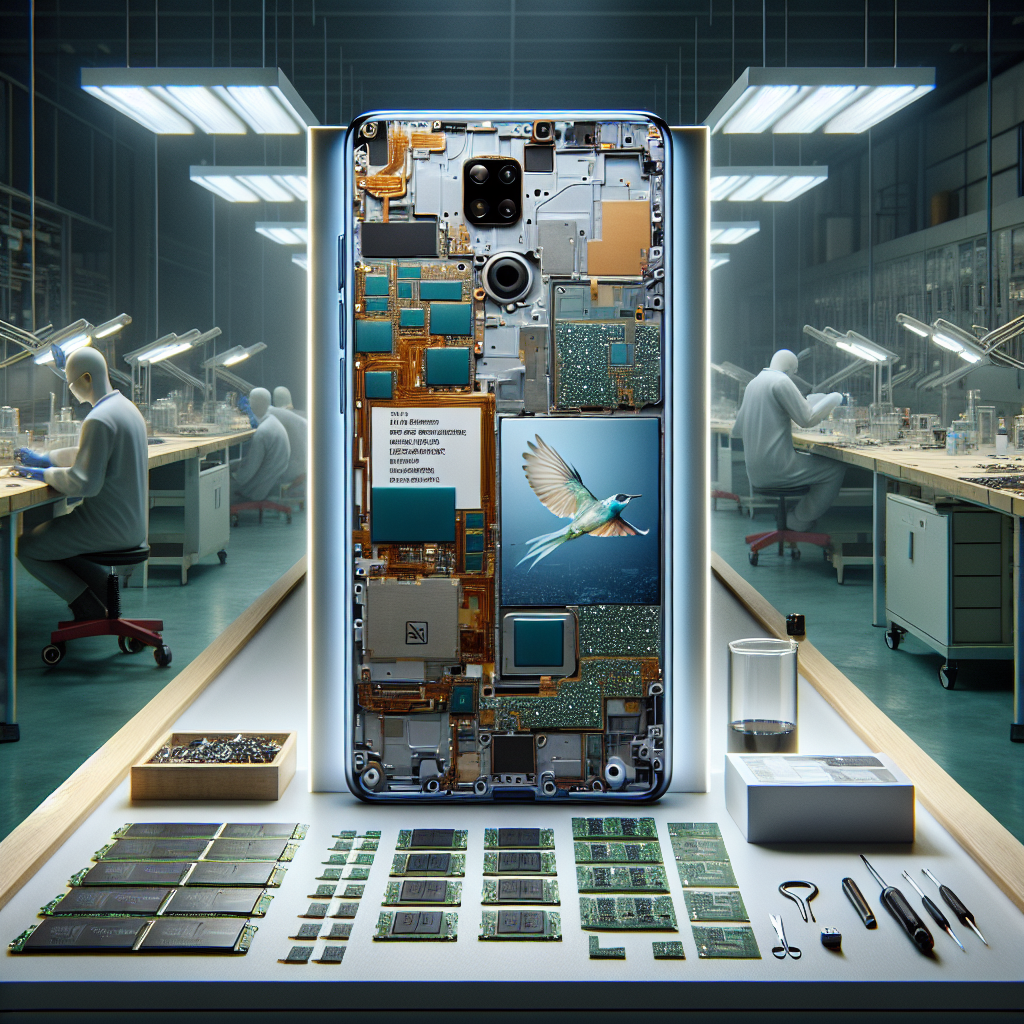
【Epoch Times, December 29, 2024】Huawei’s latest flagship smartphone, the Mate 70, heavily utilizes regulated South Korean memory chips, indicating a widening gap between Chinese chipmakers and international standards under U.S. sanctions.
TechInsights, a Canadian research company, dismantled Huawei’s latest flagship smartphone, the Mate 70, and found that it still uses NAND and DRAM memory chips produced by South Korean company SK Hynix, rather than domestic chips.
NAND is a type of memory used for flash storage, while DRAM (dynamic random-access memory) is commonly used in smartphones and computers.
Last year, Huawei’s high-end phones, including the Mate 60 Pro, still featured SK Hynix DRAM and NAND chips. SK Hynix had stated that it no longer conducted business with Huawei, leading analysts to believe that these chips may have come from Huawei’s existing stock.
However, this year, Huawei appears to be shifting more towards products from ChangXin Memory Technologies (CXMT) and Yangtze Memory Technologies (YMTC).
According to Reuters, iFixit and TechSearch found that Huawei’s Pura 70 series, introduced in April this year, still contained DRAM chips manufactured by SK Hynix, but the NAND flash chips were likely packaged by Huawei’s HiSilicon division.
TechInsights’ report revealed that Huawei’s mid-range phone, the Nova 13 Pro, released in October this year, utilized DRAM from ChangXin Memory Technologies and NAND from Yangtze Memory Technologies.
Initially, researchers believed that the Huawei Mate 70 series would also feature DRAM from ChangXin Memory Technologies and NAND from Yangtze Memory Technologies, but the dismantling results surprised them.
Taiwan’s Industrial Technology Research Institute Policy and Regional Studies Group Director Lee Guan-hua told Epoch Times that for high-end smartphones, fitting diverse advanced features into a limited space requires choosing components that provide the best functionality in the smallest area. From this perspective, opting for South Korean memory chips is very reasonable, as currently Chinese storage chips cannot match the density per unit area of advanced South Korean manufacturers.
Assistant Researcher Wang Xiuwen from the National Defense Institute of the Communist Party of China Military and Operational Concept Research Institute told Epoch Times that this indicates that Chinese domestically produced memory chips, whether from ChangXin Memory Technologies or Yangtze Memory Technologies, currently do not match the performance and quality of South Korean memory chips.
“This time, Huawei may be considering market factors and must maintain the quality of its high-end products rather than demonstrate defiance against U.S. sanctions. This also indicates that even though SMIC (Semiconductor Manufacturing International Corporation) has the capability to manufacture 7nm chips for high-end smartphone processors, China still cannot fully rely on domestic products for other components like memory chips, as poor quality could affect its market share.”
TechInsights’ report revealed that the memory chips used by Huawei have been on the market since early 2022, indicating that Huawei may have purchased these devices before the sanctions were imposed in October 2022.
On the 26th, SK Hynix responded to media reports, stating, “Since the announcement of restrictions against Huawei, the company has strictly complied with relevant policies and halted any transactions with Huawei.”
Wang Xiuwen suggested that these might be goods purchased by Huawei before the implementation of U.S. sanctions, with Huawei frantically acquiring vital chips from various countries, even transporting them back from Taiwan via airplanes, suggesting that its stockpile is substantial. Additionally, the U.S. is currently investigating whether companies in China or other third countries are buying restricted chips and reselling or providing them to Huawei. Just like NVIDIA’s most advanced processors, they could potentially be acquired through black market channels.
Lee Guan-hua also stated that Huawei likely stockpiled relevant chips in the past, so it is reasonable to assume that they are still using older stock, but with more caution. Lower-end phones will favor domestically produced chips, while for high-end phones, they will try to use existing inventory as much as possible.
“Of course, there may be other channels to obtain chips, but once detected by the U.S., they will clamp down on each one. Just like a tech company in Xiamen recently acting as a proxy for Huawei, acquiring chips from TSMC but being caught resulted in being blacklisted by the U.S.”
Industry professionals pointed out that nearly all equipment used to produce chips at 10nm and below can also be used to produce less advanced chips at 14nm and above, and vice versa.
SK Hynix and Samsung have introduced EUV (extreme ultraviolet lithography) equipment for producing more advanced DRAM chips, remaining the market’s mainstream technology due to its reliability and higher production yields.
Currently, SK Hynix has announced the production of 321-layer NAND, while Samsung claims to have completed the development of 400-layer NAND technology and is preparing for mass production. After the U.S. government added Yangtze Memory Technologies to its Entity List in October 2022, the supply chain for 128-layer and higher NAND Flash from Yangtze Memory Technologies was disrupted.
Chinese chip manufacturers face little chance of narrowing the gap with international leading manufacturers due to the inability to access EUV technology.
The Wall Street Journal reported in October that according to Bernstein, ChangXin Memory Technologies’ bit density is only 55% of its more advanced competitors. Bit density is an indicator of the actual storage capacity per unit area. ChangXin Memory Technologies also has lower yields, meaning that it produces fewer usable chips under a given capacity.
Bernstein estimated that there is a technological gap of about six to eight years between ChangXin Memory Technologies and global counterparts.
Wang Xiuwen pointed out that this time Huawei’s high-end phones were considered to have made negligible progress, showing a halt in its chip technology under strict U.S. sanctions. Particularly, with the stringent restrictions on extreme ultraviolet lithography (EUV) imposed by the U.S., the iterative pace of Chinese manufacturers’ chip technology has begun to slow down.
Lee Guan-hua stated that Chinese manufacturers are restricted to processes, such as only being able to use 14nm and above. Chips produced domestically with the same maturity will have larger areas compared to those made in Korea or the U.S., which means they are relatively lacking in cost and competitiveness.
“At present, as long as the U.S. continues to restrict China’s access to advanced processes and even some semiconductor talent, I think it may be challenging to bridge this gap in the short term.”
Huawei’s high-end smartphones heavily rely on South Korean chips regulated by the U.S. Once separated from foreign technologies, its potential competitiveness will continue to decline.
Lee Guan-hua said that currently, Huawei’s development of high-end phones relies on more advanced foreign components to sustain its products, but there will come a time when this won’t be sustainable. In the future, Huawei’s flagship phones may face challenges in continuing to upgrade due to the gap in domestic chip capabilities and the aging of its existing inventory, which may consist of older specifications in a few years.
“In the case of mid-range and low-end phones, they are mainly dominated by domestic chips, which still have a certain gap compared to foreign chips. In the future, Huawei may rely more on the domestic market, possibly excelling in markets like some African countries or third-world countries due to its cost advantage.”
Wang Xiuwen added that the market is very realistic. Once Chinese consumers discover that Huawei’s high-end smartphones are expensive and not user-friendly, they may quickly switch to Apple smartphones. Despite receiving strong support from the Chinese government, Huawei still has to consider market, profit, and revenue factors. Moreover, outside of China, can Huawei continue maintaining its “good quality at a fair price” and market share internationally? Or will it specialize in selling to third-world countries? These are also key points to observe in the future.