
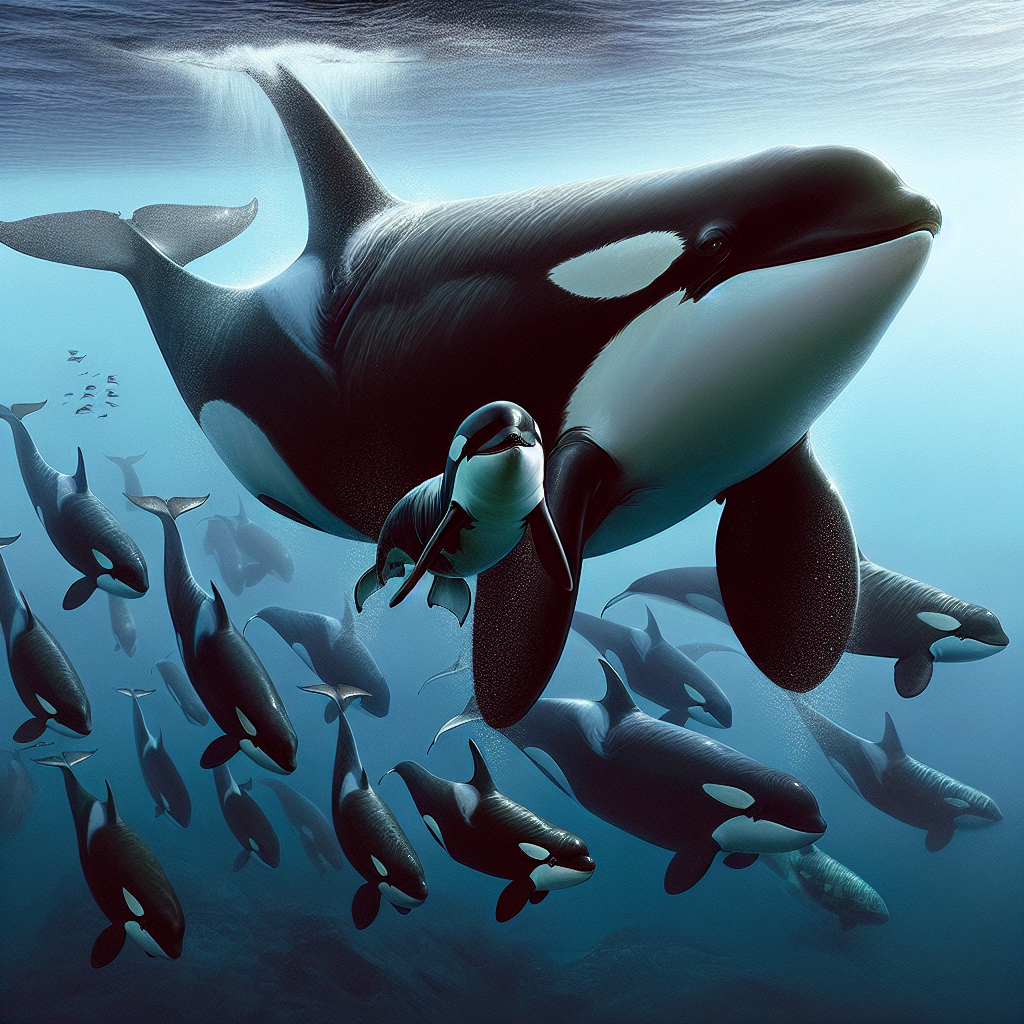
In 2018, a killer whale mother named “Tahlequah” captured global attention by carrying her deceased calf for 17 days, in an emotional display of mourning. Recently, scientists joyfully announced that this female killer whale has given birth to a new calf, injecting new hope into her critically endangered family of dolphins.
Tahlequah, identified as J35, is approximately 26 years old and belongs to the highly endangered Southern Resident killer whales, living in the Pacific waters between Washington state in the United States and British Columbia in Canada.
During the summer of 2018, Tahlequah gave birth to a calf that tragically survived only half an hour before passing away. What touched many was how Tahlequah did not immediately abandon her calf but instead carried it on her forehead for 17 days, swimming over 1,600 kilometers in the waters of the northwestern Pacific before finally letting go, a journey that moved people around the world.
However, there is uplifting news from the Center for Whale Research in the U.S. recently. Last Friday, on December 20th, they spotted Tahlequah in Puget Sound, Washington, with a new calf by her side. By Monday of this week, scientists and researchers were “confident” in confirming that the new calf, identified as J61, is indeed the offspring of J35 and a female.
It is estimated by researchers that J61 was born between November and December 2024, but there are concerns about the health of this young killer whale.
In a post on social media on Tuesday, the Center for Whale Research stated: “For newborn calves, life is always challenging in the early stages, with very high mortality rates in the first year. But J35 is an experienced mother, and we hope that this time she can guide J61 through this difficult period.”
J61 is the second calf born to J35 since the loss of her calf in 2018. The last recorded birth was in September 2020 when she bore a male calf named “Phoenix” (J57). Additionally, she has an older offspring, J47, born in 2010.
While the news of Tahlequah giving birth again brings joy to researchers and whale enthusiasts, the outlook for her Southern Resident killer whale population remains bleak.
According to the non-profit Orca Conservancy dedicated to protecting killer whales, this year’s census data shows that there are only around 73 Southern Resident killer whales left, facing numerous survival challenges including food shortages, environmental pollution, and disturbances from ship noise.