
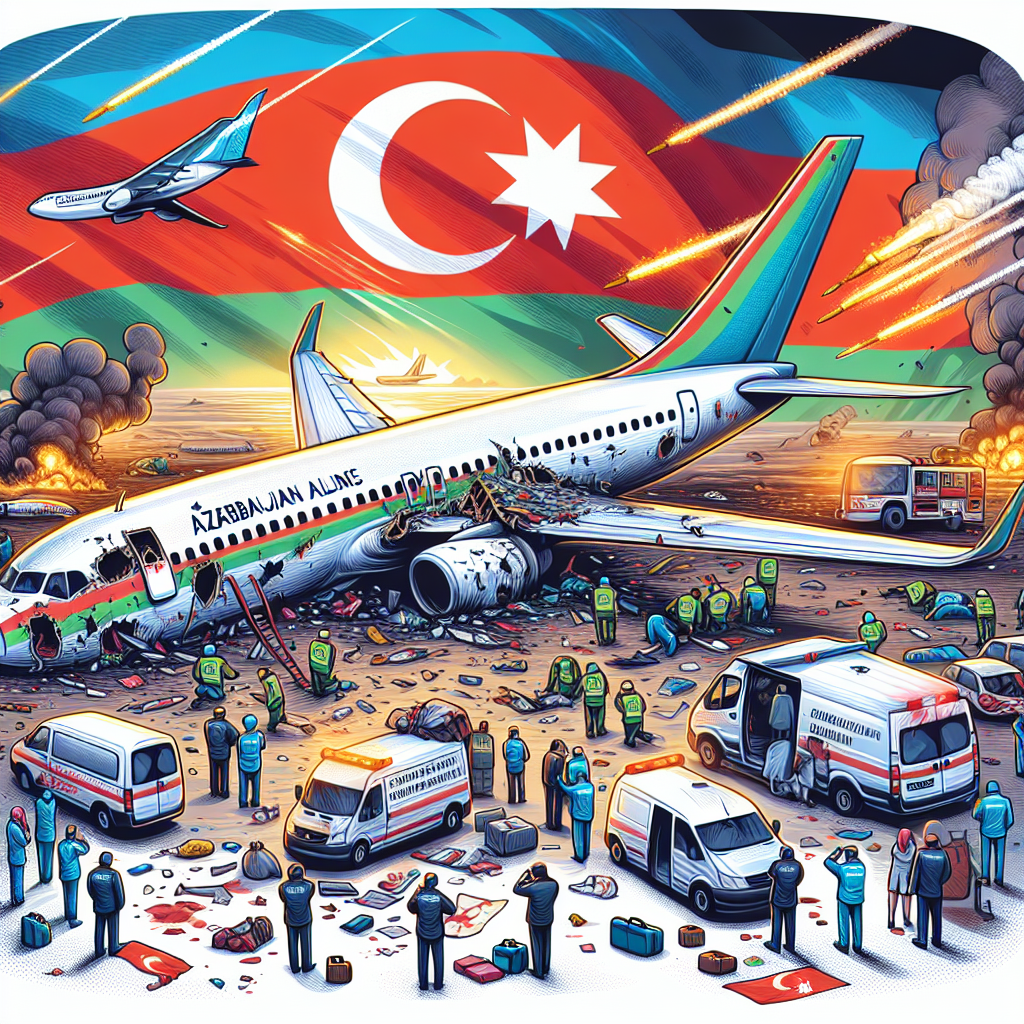
On December 27, 2024, a U.S. official told CNN that preliminary indications suggest that the Azerbaijan Airlines plane that crashed the day before may have been shot down by a Russian air defense system, resulting in the deaths of dozens of people.
According to the U.S. official on December 26, the preliminary signs indicate that Azerbaijan Airlines Flight J2-8243 was hit by the Russian system and eventually crashed near Aktau, Kazakhstan.
This is the first assessment made by the U.S. regarding the plane crash that occurred on Wednesday, causing at least 38 out of the 67 passengers on board to perish.
The U.S. official stated that if the preliminary signs are confirmed, this could be a case of mistaken identity: under-trained Russian forces might have mistakenly thought the flight was a Ukrainian drone, leading to a negligent firing.
NATO spokesperson Farah Dakhlallah expressed condolences to the victims and their families on social media, stating, “We wish a speedy recovery to those injured in the crash and call for a comprehensive investigation.”
According to The Wall Street Journal, Osprey Flight Solutions, based in the UK, also warned airlines that the flight “may have been downed by the Russian military air defense system.”
Officials from Azerbaijan, Kazakhstan, and Russia, the three countries involved in this tragedy, are urging people not to speculate on the plane crash until the investigation is complete.
Here is what is currently known about the crash:
On Wednesday, Azerbaijan Airlines stated that their Flight J2-8243 took off from Baku, the capital of Azerbaijan, at 7:55 local time (10:55 PM Eastern Time on Tuesday), heading to Grozny, the capital of the South Russian republic of Chechnya. The plane made an emergency landing and crashed about 3 kilometers (1.8 miles) from Aktau, Kazakhstan, at around 10:28 AM (1:28 AM Eastern Time on Wednesday).
Kazakhstan’s Minister of Transport, Marat Karabayev, stated on Thursday that a control center in Kazakhstan received a signal from Russia approximately 45 minutes before the plane crash, reporting a malfunction in the aircraft’s control system. The crew decided to divert to Aktau after receiving adverse weather reports.
The dispatcher later reported, “The oxygen tanks in the passenger cabin exploded, causing passengers to lose consciousness.”
Karabayev mentioned that the aircraft deviated from its flight path upon landing and lost contact with the Aktau dispatcher during the crash.
Flightradar24 posted on social media that the plane experienced “GPS interference and spoofing” near Grozny, which likely significantly affected the aircraft’s navigation and communication capabilities.
Kazakh authorities confirmed that at least 38 out of the 67 passengers on board the aircraft perished in the crash, including two pilots and one flight attendant.
Kanat Bozumbayev, the Deputy Prime Minister of Kazakhstan, stated that approximately 29 people were rescued from the wreckage, including two children.
Preliminary data from Kazakhstan’s Ministry of Transport shows that among the passengers, 37 were from Azerbaijan, 16 from Russia, 6 from Kazakhstan, and 3 from Kyrgyzstan. Bozumbayev mentioned that there were no Kazakh survivors among the passengers.
Videos and images after the crash showed punctures on the fuselage, resembling shrapnel or fragments, but the exact cause is yet to be confirmed.
Initially, Azerbaijan Airlines informed ANS News Agency that the incident was caused by a collision with a flock of birds, while the Russian Federal Air Transport Agency, Rosaviatsia, also stated that the plane crashed after colliding with birds.
Justin Crump, the CEO of risk consultancy firm Sibylline and an expert in intelligence, security, and defense, told BBC Radio 4 on Thursday that it makes more sense that the plane was hit by Russia. Crump added that the Russian air defense system in Grozny was active at the time.
“I don’t think this was intentional,” he said, noting that Ukrainian long-range drones have put Russia on edge.