
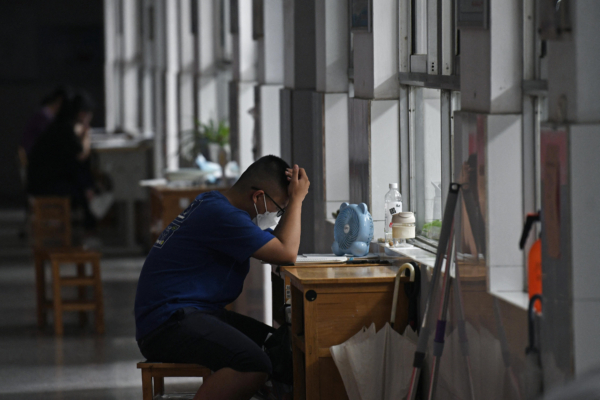
Recently, the “2025 National Master’s Entrance Examination” in China has concluded. This year, the number of graduate exam takers has decreased for the second consecutive year, with reports of as many as 600,000 people deciding not to take the exam on the first day. Analysts point out that as the pressure of youth employment intensifies, more and more people are starting to question the actual value of pursuing master’s and doctoral degrees, reflecting a phenomenon of “downgrading” in higher education in China.
The “2025 National Master’s Entrance Examination” took place from December 21st to 22nd.
According to a report by the “Southern Metropolis Daily,” this year’s total number of graduate student applicants in China was 3.88 million, a decrease of 500,000 compared to last year. This marks the second consecutive year of decline in graduate exam registrations.
According to data from the Chinese Ministry of Education, the number of graduate exam takers was 4.57 million in 2022, reaching a historical peak of 4.74 million in 2023. However, the number of registrations has continued to decline in the following two years, with a decrease of 360,000 in 2024, and a further decline this year.
On the first day of the exam this year, rumors circulated online that as many as 600,000 people decided not to take the exam, sparking a trend on Weibo with close to 35 million reads. However, these numbers have not been officially confirmed.
Apart from the number of applicants, another focus of this year’s graduate exam that has attracted attention is the significant increase in the difficulty of the exam questions.
On December 22nd, an article by “影像溫度” on the online platform NetEase pointed out that many experts and candidates have given feedback that the political exam questions this year were “the most difficult in the past 10 years,” and the high difficulty of the English questions also became a hot topic. It was claimed that many people were “successfully discouraged” after taking these two subjects.
The article criticizes the emerging trend of “examination-oriented education” in China, where the difficulty of the graduate exam is increasing, making the last two years of university life feel like a nightmare from high school, forcing students to frantically review and prepare for exams. This intense focus on exams is leading to a decline in the quality of talent cultivated by universities, which is the main cause of the devaluation of academic qualifications.
Another article titled “The ‘Examination-oriented’ Dilemma of Graduate Exams Returns to the Hot Search: When Can the ‘Examination-oriented’ Predicament be Resolved?” also questions the increasing resemblance of graduate exams to the college entrance examination (known as Gaokao) and how some universities even use the “graduate exam rate” as a benchmark to evaluate teaching quality.
The article argues that the trend of “examination-oriented education” in graduate exams leads to a large number of candidates blindly following the trend of taking the exams, exacerbating the waste of educational resources and unequal distribution.
The magazine “Life Weekly” raised doubts on Weibo by questioning whether it is necessary to take the graduate exam when the employment rate for postgraduate students has decreased. The article mentioned that in the graduation season of 2024, only 44.4% of master’s and doctoral students were successfully employed.
The article straightforwardly pointed out that the most important thing is economic development, as only through this can new job opportunities requiring higher academic qualifications be continuously created. Otherwise, no matter how impressive one’s academic achievements may be, it may not lead to a way out.
Voice of America reported on December 25th that regarding the decline in the number of graduate exam takers and the “examination-oriented education” trend, Xie Tian, a professor at the Department of Management at the University of South Carolina’s Moore School of Business, stated that these phenomena actually indicate a “downgrade” in China’s higher education system.
Xie Tian expressed that in the past, the Chinese Communist Party blindly expanded higher education, constantly incorporating communist doctrines into the curriculum. The result of this “Great Leap Forward in Higher Education” not only led to a lack of qualified teachers but also resulted in the hollowing out of higher education. Moreover, with the serious recession of the Chinese economy, companies have stopped hiring, even closing down or moving operations, leading to a higher youth unemployment rate. Following the impact on college students, graduate students are also unlikely to be spared.
Xie Tian believes that the excessive expansion of higher education in China, like many other situations in Chinese society, is a mistake made by the government but borne by the people.
To address the current issues, Xie Tian suggests that significant reforms are needed in higher education in China, including streamlining the scale and abandoning communist subjects that waste a large amount of educational resources. Additionally, even if the economy rebounds, it will take time to absorb the oversupply of master’s and doctoral students to achieve synchronous development of higher education and the economy.