
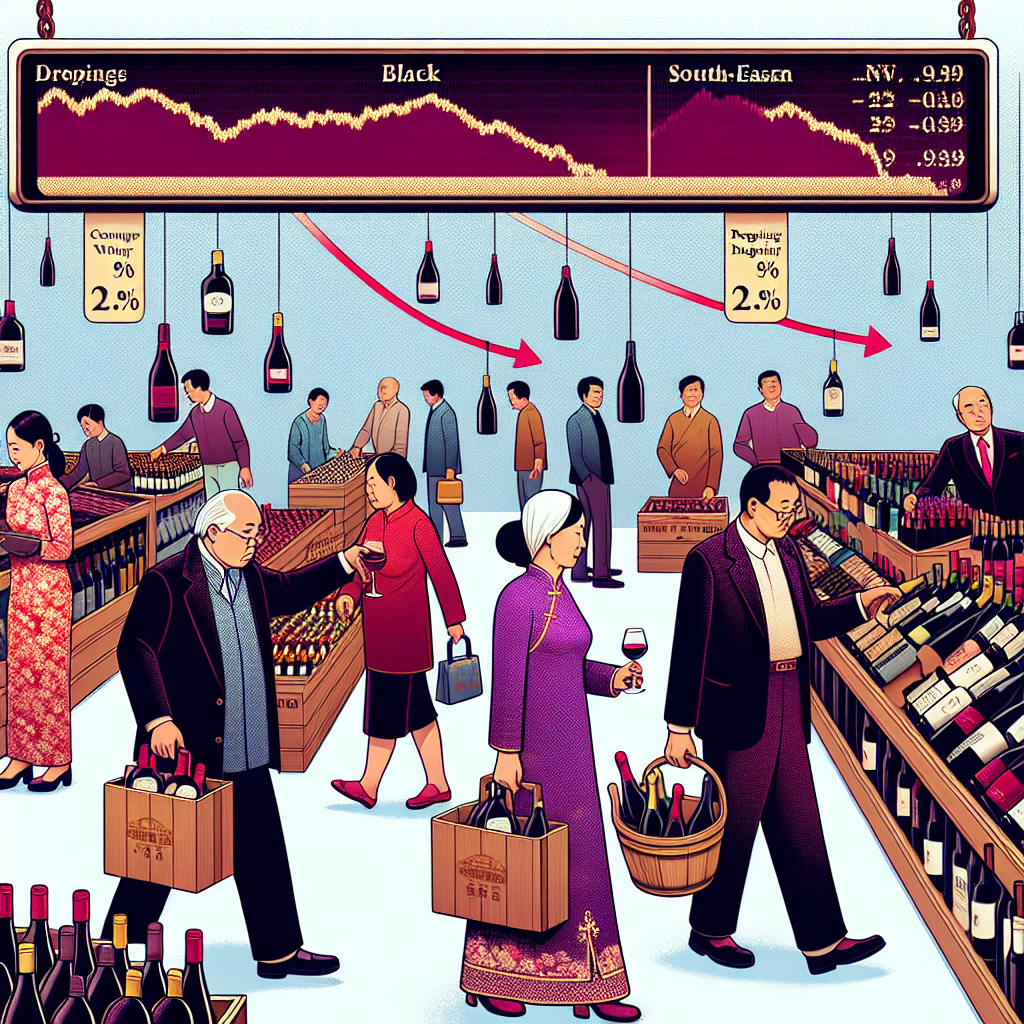
China’s economic downturn has led to Chinese buyers controlling their consumption, impacting the high-quality wine market. Prices of premium Burgundy and vintage Champagne have seen a significant decrease.
According to a report by the Financial Times, as of the end of November this year, prices of Burgundy wines have dropped by 14.4% based on Liv-ex’s Burgundy 150 index; vintage Champagne prices have fallen by 9.8%, and Bordeaux wine index has decreased by 11.3%. This marks the second consecutive year of difficulty for the high-quality wine market.
By the end of November, the overall Liv-ex Fine Wine 100 index has declined by 9.2%.
The report quoted Gregory Swartberg, CEO of wine investment company Cru Wine, as saying, “The situation is very severe. November 2024 was one of the worst months this year. We haven’t yet emerged from the crisis.”
Unusual weather patterns related to climate change, such as a warm early growing season followed by severe frosts damaging buds, have limited the supply of new wines. Prices for vintage Champagne and Burgundy wines have risen as a result. Some insiders believe that the rapid and excessive price increases have set the stage for the market downturn.
The decrease in demand from Chinese buyers has also dealt a heavy blow to the market. Chinese buyers have been significant purchasers of top Burgundy wines, but with the economic slowdown in China, they are now exercising control over their consumption.
The high-quality wine market may face even worse conditions. Some insiders point out that the selling behavior of Asian collectors is further driving down prices in that region. Additionally, many European producers are concerned that a potential trade tariff imposition by the newly-elected US president Trump could impact the market.
Despite an overall sense of pessimism pervading the industry, some investors are seizing the opportunity presented by this year’s price decline to purchase high-quality wines at lower prices.
With the long-standing stagnation of the Chinese economy and its inability to recover, sales of luxury goods beyond high-end wines are also being affected. According to a market report released in November by consulting firm Bain & Company, personal luxury goods sales are expected to decline by 2% this year, marking the weakest year on record. The drag from the Chinese market is a major factor.
The report predicts a 20%-22% decrease in luxury goods sales in China, ending the years-long luxury “boom” that existed before the outbreak of the pandemic in China.
Some Chinese consumers are turning to cheaper channels like the second-hand market to purchase luxury goods, further complicating the situation for luxury companies like LVMH operating in China.
According to consulting firm iResearch, the Chinese second-hand luxury goods market, including platforms like Plum, ZZER, and Alibaba’s Xianyu, has seen a compound annual growth rate of over 30% since 2020.