
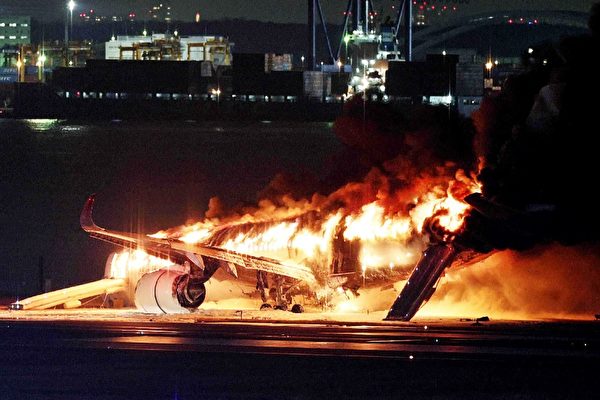
On Wednesday, December 25, the Japanese government released a report on a serious plane collision incident that occurred at Tokyo Haneda Airport in January. The accident was attributed to a pilot misunderstanding instructions, mistakenly believing they had been cleared for takeoff, leading to them inadvertently entering the runway.
On January 2, a plane from the Japan Coast Guard collided with a Japan Airlines (JAL) aircraft landing at Haneda Airport, causing both planes to catch fire. Five people on the Coast Guard plane died, with only the captain surviving but sustaining severe injuries. All 379 passengers on the JAL aircraft safely evacuated. The Coast Guard plane was on a disaster relief mission for an earthquake at the time.
The Japan Transport Safety Board released a 166-page report detailing the confirmed facts and summarizing the potential causes of the accident. According to the Japan Transport Safety Board Establishment Act, if an accident investigation is not concluded within a year, progress reports must be made public.
Approximately two minutes before the accident (at 5:47 p.m. local time), the control tower instructed the vice captain of the Coast Guard plane to “number one, proceed to holding point C5.”
C5 was a stop position where the pilots were supposed to wait for further instructions. Cockpit voice recorder (CVR) transcripts revealed that upon hearing the instruction, the captain in flight said to the vice captain, “number one, C5, okay?” without fully repeating the command.
The surviving captain stated that he misunderstood the instruction as permission to enter the runway. Subsequently, he and the vice captain initiated the “pre-takeoff checks” and taxied the aircraft past the C5 stop position. The captain later told investigators that he remembered a minute before the accident, the controller saying, “Proceed to the runway and stand by, number one.”
The report highlighted pilot haste as a possible factor in misinterpreting the instruction. The Coast Guard plane was tasked with delivering relief supplies to an area affected by an earthquake the day before.
The instruction “number one” implied priority for takeoff, potentially leading the pilots to believe the control tower wanted them to act swiftly.
Fifteen seconds before the collision, the controller responsible for the airport’s surrounding airspace noticed that the system indicated the Coast Guard plane had entered the runway. However, the controller in charge of the runway, focused on the landing JAL Flight 516, did not realize the Coast Guard plane’s incorrect position and overlooked the runway collision warning light displayed on the system.
The airspace controller mistakenly assumed that the runway controller was aware of the Coast Guard plane’s entry onto the runway and asked, “How about the (JAL aircraft) situation?” without clearly informing the runway controller of the actual situation. Ultimately, the control tower did not instruct the JAL plane to go around, missing the opportunity to prevent the accident.
According to NHK reports, the JAL aircraft was unaware of the Coast Guard plane’s position. The accident occurred after sunset, with poor visibility due to no moonlight. Additionally, both the Coast Guard plane’s anti-collision light and runway lighting were white, making it difficult for the JAL aircraft’s captain to visually confirm if there were other planes on the runway.
When the JAL plane descended below 150 meters, there was no abnormal discussion between the captain and copilot. At the time of the accident, the aircraft was being piloted by the copilot who was still in training, with the captain providing instructions, and another copilot monitoring the runway from the rear.
The Japan Transport Safety Board stated that they will further confirm the facts and analyze the causes over the next 1 to 2 years and propose improvement measures for the evacuation and rescue process after the accident.