
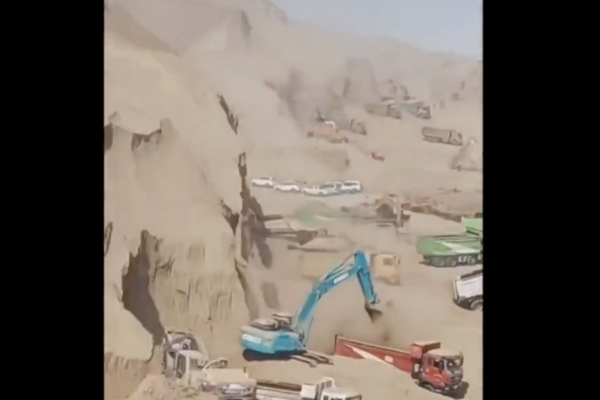
Recently, information about plans to invest 1 trillion yuan in flattening the Loess Plateau and rebuilding 500 million mu of fertile farmland in provinces such as Shaanxi and Gansu has sparked controversy in China after videos showing the implementation of the project circulated rapidly on the mainland internet. Following this, several provincial authorities denied the existence of such a plan, leading to speculation about the true intentions behind the fluctuating propaganda on the highly controlled Chinese internet.
Numerous videos and articles circulating online at the end of 2024 mentioned a massive plan to invest 1 trillion yuan in flattening the Loess Plateau and developing 500 million mu of fertile farmland. The widely spread videos also depicted scenes of large machinery operating on the Loess soil.
Some videos claimed that the steep slopes of the Loess Plateau were undergoing a project known as the “beloved by the people” and the “benefit future generations” project, with Gansu, Shaanxi, and other regions accelerating the implementation of the project to transform the high Loess Plateau into a fertile land. Keywords in the videos included: Western development, 2024 new farmers plan, earthwork engineering, agriculture, Shaanxi, Gansu, and more.
Some Chinese netizens labeled it as a “heaven-defying mega project.”
One netizen who reposted a video on an overseas platform commented: “The project to flatten the Loess Plateau and transform millions of mu of farmland has already begun. Whether or not the country falls doesn’t matter, but the Chinese Communist Party is really going after extinction! After coming to power, they have failed countless times and suffered heavy losses in their battles against the elements! It’s unimaginable! Unreasonable! The physical body and skin should not be easily damaged, let alone the mountains and rivers…”
In response, another netizen explained, “People overseas don’t understand because China has a so-called redline for farmland, the total area cannot be reduced. So what about the farmland area occupied by building houses, roads, and development near cities? You have to develop an equivalent area of so-called farmland in barren mountains and ridges to replace that index, with subsidies, regardless of whether it can be used for farming or not.”
Another netizen pointed out, “People are saying there’s no water to plant, but having water is all it takes. This is called wet collapsible loess, it quickly collapses when water hits it. Those gullies will be filled with water. After completely flattening the land, how will the water drain? If left to flow naturally, it will create new loess gullies, and wherever the mud flows, disasters will follow.”
Some netizens humorously commented, “Rice crops don’t grow on mountains, they are playing the Fools Campaign of moving mountains.”
Reports by mainland media outlets such as “First Financial” on December 24 titled “Spending 1 trillion yuan to flatten the Loess Plateau, reconstructing 500 million mu of good farmland? Several provinces respond” stated that provinces including Shaanxi, Gansu, Shanxi, and Ningxia denied the existence of such a plan. Regarding the video footage of large machinery operating on the Loess soil, the media mentioned that there was no official confirmation from relevant departments at the time of reporting.
According to official responses, several key provinces related to the Loess Plateau do not have similar “super projects” or plans. Experts cited in the reports emphasized that the government’s policy focuses on improving the quality of arable land rather than blindly expanding the land area. Therefore, the feasibility of flattening the Loess Plateau and transforming it into “500 million mu of good farmland” is deemed very low in practice.
Professionals pointed out that the videos circulating online may represent two common scenarios: one involves high-standard farmland construction in local areas to link fragmented land for convenient mechanized farming, and the other involves land occupation and compensation operations where land is flattened to meet compensation requirements based on a principle of “take as much as replaced.”
Reports from media outlets like Phoenix News, Observer Net, and Henan Business Daily have restricted user comments on their Weibo platforms.
In April this year, Chinese leader Xi Jinping advocated for the Western development during a meeting in Chongqing. Now, the Chinese propaganda machine first allows the dissemination of such articles and videos before official statements refute them, sparking skepticism among netizens on Weibo and other platforms.
On December 25, mainland commentator Zhou Peng’an expressed his skepticism on Weibo, saying, “I have seen this video too, and I believe it is not generated by AI. It must be a ‘brainchild’ project of some local leader, and it appears to be an extremely ambitious undertaking. Regardless of environmental concerns, I am worried about where the region’s finances are coming from for such excessive ventures.”