
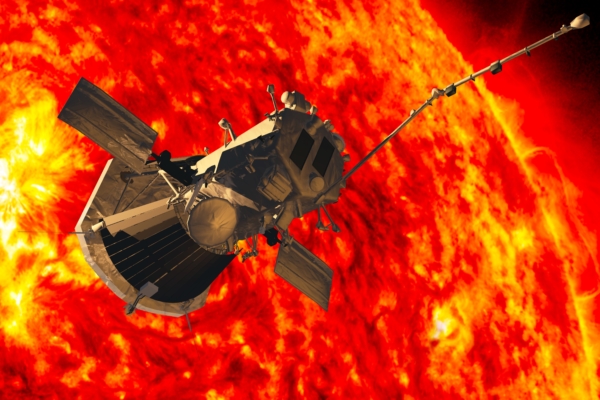
【Epoch Times News on December 25, 2024】As people around the world celebrate Christmas Eve, the Parker Solar Probe of the National Aeronautics and Space Administration (NASA) is poised to make history in space by getting closer to the Sun than ever before, helping scientists better understand this star that provides us with sunlight and warmth.
On Tuesday, December 24th, the Parker Probe will fly into the outer solar atmosphere known as the corona, facing harsh temperatures and extreme radiation.
Nick Pinkine, Mission Operations Manager at the Johns Hopkins Applied Physics Laboratory, stated in a NASA blog post, “No artificial object has ever been this close to a star (the Sun) before, so Parker will truly be transmitting data from uncharted territory.”
The Parker Probe is expected to arrive in an area approximately 3.8 million miles (6.1 million kilometers) from the Sun’s surface at 6:53 AM Eastern Time on Tuesday. At that point, the probe will lose contact with Earth, and mission operators on the ground will have to wait until Friday, December 27th, to confirm the specific status of Parker following its close flyby of the Sun.
NASA, on its website, disclosed that the Parker spacecraft is flying at speeds of up to 430,000 miles per hour (692,000 kilometers per hour, 195 kilometers per second), enduring temperatures as high as 1,800 degrees Fahrenheit (982 degrees Celsius). Parker’s flight speed equates to traveling from London to New York in less than 30 seconds.
Dr. Nicola Fox, Associate Director of NASA’s Heliophysics Division, told BBC News, “For centuries, people have been studying the Sun, but you really have to go there to feel its atmosphere.”
“Unless we fly past it, we can’t really feel the atmosphere of our star,” she added.
Launched in 2018 towards the center of the solar system, the Parker Solar Probe has made 21 close passes by the Sun, getting progressively closer each time, with this Christmas Eve visit smashing records.
Although 3.8 million miles away from the Sun’s surface may seem far, Fox explained, “We are 93 million miles away from the Sun, so if I assume the Sun and Earth are one meter apart, Parker Solar Probe is only 4 centimeters away from the Sun – so it’s very close.”
While Parker is shielded by a 4.5-inch (11.5 cm) thick carbon-composite heat shield, the onboard electronics face the risk of damage in such high-temperature and high-radiation environments. Therefore, NASA’s strategy is for Parker to make swift passes through.
Why is NASA going to such lengths to send Parker to “touch” the Sun?
Scientists hope that as Parker passes through the solar corona, it may unlock a long-standing mystery.
“The corona is very, very hot, and we don’t know why,” explained Dr. Jenifer Millard, an astronomer at the Fifth Star Labs in Wales, to BBC.
This mission will also help scientists better understand solar winds – streams of charged particles that erupt from the corona.
Once the signal returns to Earth, the team will send Dr. Fox a green heart-shaped message to let her know that the probe is functioning properly.
*(This article references reports from BBC and Reuters.)*