
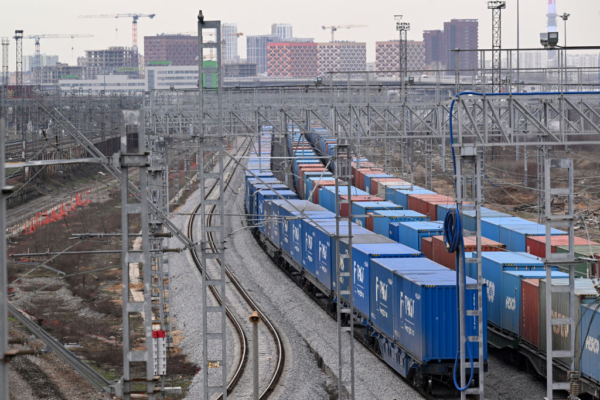
As the conflict between Russia and Ukraine continues, and with the exacerbation of Western sanctions, the challenges faced by the Russian economy are becoming increasingly severe. The difficulty of railway transportation in the eastern part of Russia is also on the rise.
According to a report by Bloomberg citing the Russian news agency TASS, last week the Russian Railways Company approved a 30% reduction in investment plans for next year to cope with the soaring borrowing costs. This company is responsible for all railway transportation in the country.
The increase in war-related goods has exacerbated existing bottlenecks, with Western sanctions putting pressure on cross-border payments, coupled with long-standing logistics issues, slowing down the transportation of goods such as coal and aluminum.
MMI Research in Moscow stated in a Telegram post earlier this month that the railways are “experiencing the most severe downturn since the crisis of 2008-2009, and this trend is ongoing.”
The outlook for the Russian Railways Company is not optimistic. Due to the sanctions, the company has been largely shut out by international business partners. The Russian government’s budget prioritizes war needs, so support for the company is limited.
Since the outbreak of the Russia-Ukraine conflict, European and American countries have imposed multiple rounds of sanctions, and Russia has been removed from the SWIFT system, leading Russia to shift its trade towards Asia, further relying on the eastern railway network. However, this railway network has long been plagued by loading delays and inefficient infrastructure, and the pressure is now even greater.
According to data from MMI Research, as of November, Russian railway freight volumes have declined by 5.2% year-on-year.
The Russian Railways Company did not respond to Bloomberg’s request for comment.
The economic plight of Russia, coupled with inadequate investment in railways, is also having a ripple effect on the transportation of goods in the east. Several executives of coal mining companies told Bloomberg that due to railway bottlenecks, they are unable to ship goods as planned, requesting anonymity due to sensitivity of the information.
Sources familiar with the matter revealed to Bloomberg that due to limited railway capacity, United Co. Rusal International PJSC, a Russian aluminum company, has accumulated hundreds of thousands of tons of inventory at its aluminum smelting plant in Siberia, unable to transport them in a timely manner.
Furthermore, as the war has led Russia to shift its export focus to China, the volume of goods transported through the Russia-China land border ports has been increasing year by year. A large number of goods require inspection and clearance at the border ports, leading to congestion. In the first half of this year, Beijing raised the railway tariffs for goods directly from Russia and Belarus, with increases ranging from $800 to $1500 depending on the departure station, a substantial hike.