
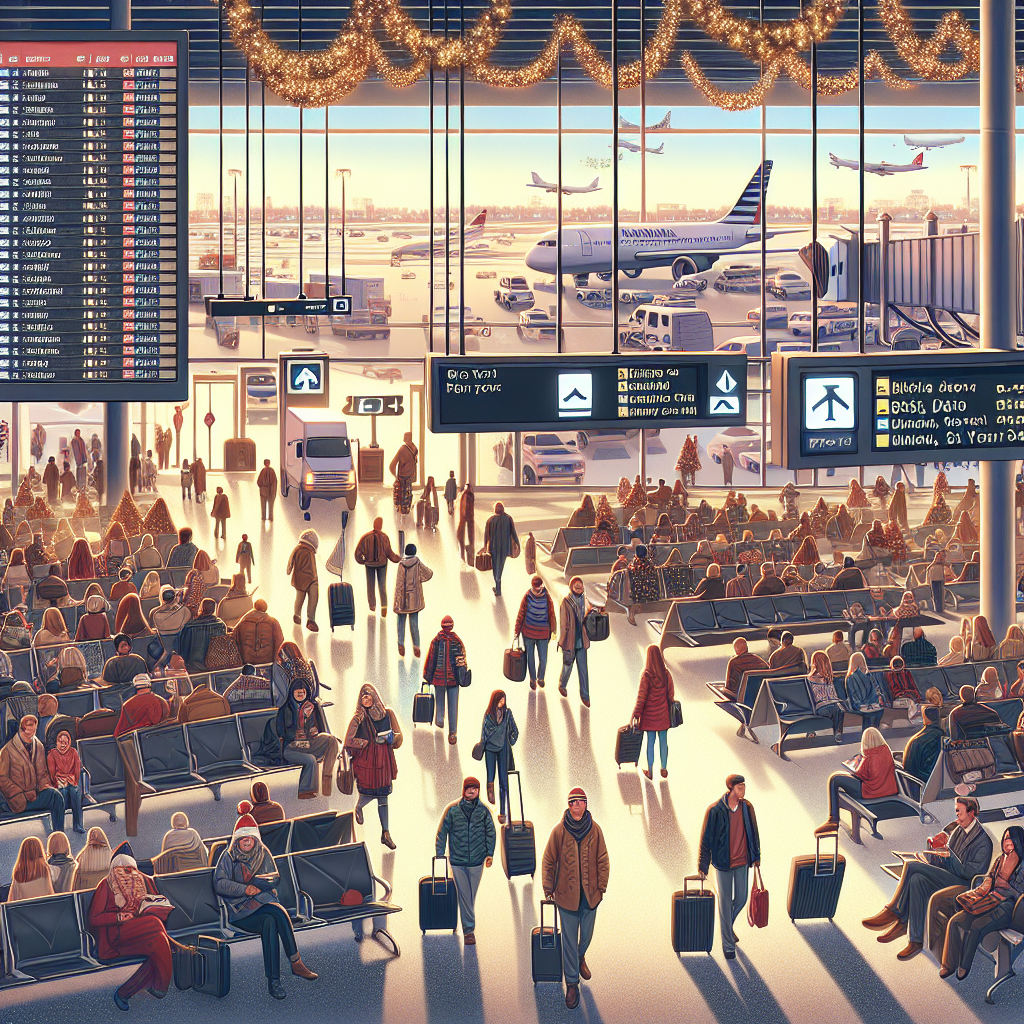
In the next few days, it is expected that 119 million people across America will travel to celebrate Christmas and New Year’s, making airports and roads unusually busy. If you are planning to travel, first take a look at the traffic forecast for the year-end holidays.
The American Automobile Association (AAA) predicts that during the period from December 21 to January 1, a total of 119.3 million people will travel 50 miles or more away from home for vacation. In Southern California alone, the number of travelers is expected to reach 9.9 million.
Stacey Barber, Vice President of AAA Travel, stated, “Since Christmas falls on a Wednesday this year, we anticipate record-breaking travel numbers around the weekends before and after the holiday.”
Among the various travel options, nearly 90% of holiday travelers will drive to their destinations. This means that it is estimated that 107 million people will be traveling by car in the next ten days. The good news is that gas prices are relatively cheap during this time.
As of Friday the 20th, the average price of regular self-serve gasoline in the United States is $3.05 per gallon, while in California it is $4.313 per gallon.
Hertz, a car rental partner of AAA, mentioned that Denver, Las Vegas, Los Angeles, Miami, Oahu, Orlando, Phoenix, and Tampa in Florida are the cities with the highest demand for holiday car rentals. The busiest days for picking up rental cars are expected to be December 20 and 21.
Additionally, it is estimated that nearly 7.2 million Americans will travel by plane, marking a 14% increase from last year, leading to crowded airports.
The collective travel of over a hundred million people indicates that traffic conditions will become exceptionally busy. According to data from traffic information company INRIX, drivers are expected to face the most severe traffic delays on the weekends before Christmas and New Year’s, with December 22 projected to be the worst travel day in the U.S.
Drivers in Boston, New York City, Seattle, and Washington D.C. may need to allocate twice as much time on the roads. Across the United States, drivers might need an additional 30% of travel time.
INRIX has summarized the best and worst times for driving during Christmas and New Year’s:
1) December 21: Worst travel time is from 4 p.m. to 8 p.m., best travel time is before 2 p.m.;
2) December 22: Worst travel time is from 3 p.m. to 8 p.m., best travel time is before noon;
3) December 23: Worst travel time is from 1 p.m. to 6 p.m., best travel time is before 11 a.m.;
4) December 24 and 25: Traffic conditions are expected to be good throughout the day;
5) December 26: Worst travel time is from noon to 5 p.m., best travel time is before 11 a.m.;
6) December 27: Worst travel time is from 3 p.m. to 7 p.m., best travel time is before 2 p.m.;
7) December 28: Worst travel time is from 1:30 p.m. to 7 p.m., best travel time is before 11 a.m.;
8) December 29: Worst travel time is from noon to 6 p.m., best travel time is before 11 a.m.;
9) December 30: Worst travel time is from 5 p.m. to 7 p.m., best travel time is before 2 p.m.;
10) December 31 and January 1, 2025: Traffic conditions are expected to be good throughout the day;
11) January 2, 2025: Worst travel time is from 4 p.m. to 8 p.m., best travel time is before 3 p.m.