
On December 21, 2024, President of the Republic of China (Taiwan) Lai Ching-te expressed his concern over the passing of three controversial bills by the Legislative Yuan on the 20th. He criticized that these bills infringed upon the principle of the separation of powers in democratic countries and deviated from the essence of people’s sovereignty in a democratic nation. President Lai emphasized the need to resolve democratic disputes with even greater democracy and urged the gathering of collective strength to protect democratic Taiwan.
In a move that sparked controversy, the Legislative Yuan of the Republic of China passed three bills – the Public Official Elections and Recalls Act, the Constitutional Litigation Act, and the Fiscal Receipt and Expenditure Division Act – during the session on the 20th.
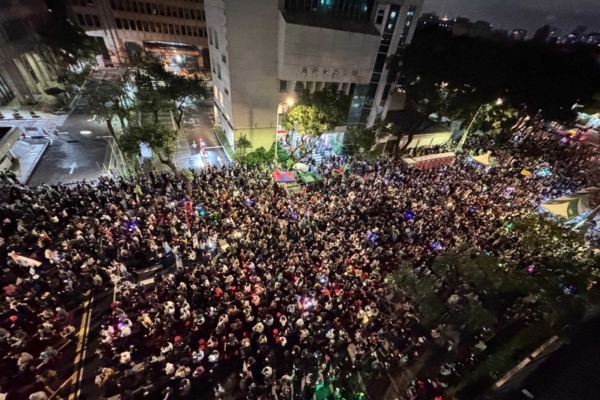
In response to the passage of these bills with the joint efforts of Kuomintang (KMT) and People First Party (PFP) legislators, various civic groups in Taiwan organized the “Winter Green Wings Series: Restore Parliamentary Democracy, Reject the Three Controversial Bills” event on the same day. They rallied citizens outside the Legislative Yuan, with the organizers reporting a crowd of over 20,000 people by around 9 p.m. The event concluded around midnight.
President Lai took to Facebook on the night of the 20th to express his concerns, highlighting the significance of the Legislative Yuan as the highest legislative body embodying Taiwan’s freedom and democracy. However, he criticized the forceful passage of the three bills without sufficient deliberation and public opinion input, noting the violation of people’s supervisory rights and the threat to judicial independence. This move not only compromised the fair distribution of national resources affecting every citizen but also disregarded the fundamental principle of the separation of powers in a democratic country.
President Lai pointed out that the amendments to the Public Official Elections and Recalls Act, in particular, deprived the people of their right to oversee the parliament, while the Constitutional Litigation Act and Fiscal Receipt and Expenditure Division Act significantly impacted individuals but were rushed through without proper cross-party negotiations.
He highlighted the importance of constitutional litigation systems in democratic countries worldwide as a final recourse to safeguard people’s rights and uphold the rule of law. In Taiwan, 99.1% of cases heard by the Constitutional Court originate from citizen petitions.
President Lai criticized the forcible passing of the Constitutional Litigation Act on the 20th, which he argued sidelined the judiciary’s independence through legislating unreasonably high thresholds, effectively choking off the people’s last safeguard and recourse.
Furthermore, President Lai underscored the critical role of the Fiscal Receipt and Expenditure Division Act, emphasizing that its implications extend beyond mere numbers and formulas to directly impact individuals’ livelihoods. He presented data showcasing the significant increase in central funds allocated to local governments since the Democratic Progressive Party (DPP) took office, highlighting improved financial conditions in local administrations.
President Lai clarified that his opposition was not against amending the Fiscal Receipt and Expenditure Division Act but rather a call for inclusive participation from both central and local governments to promote diverse discussions and enhance policy effectiveness. However, the legislative amendments passed would result in a substantial reduction in central government revenues, raising concerns about future childcare subsidies, tuition fee aid for private universities, and the implementation of inter-county metro projects.
In response to these challenges, President Lai warned that continuing to centralize these responsibilities could severely impact the defense budget, jeopardizing national security and endangering the lives of Taiwan’s 23 million citizens.
“In these recent days, amidst the chilling winds, many young people have stepped forward, holding the torch of democracy in Taiwan. They stand not to seek employment but to defend the people’s rights. The people have the right to oversee every individual, regardless of political affiliation, and should not be ridiculed or mocked,” President Lai stated.
He disclosed that the DPP legislative caucus had committed to exhaust all legal remedies against the three bills, and the Executive Yuan vowed to protect the constitutional system of freedom and democracy as empowered by the Constitution. President Lai pledged the unity of the ruling team in safeguarding the hard-won democratic system of freedom and constitutional governance. He stressed that resolving democratic disputes required a more extensive democratic approach and called for the convergence of greater forces to protect democratic Taiwan.