
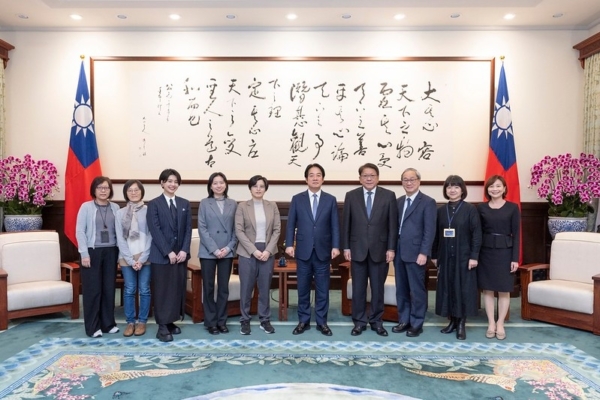
Taiwan President Lai Ching-te met with the winner of the 2024 American National Book Award for Translation Literature, “Taiwan Travelogue,” author Yang Shuangzi and translator Jin Ling, on the afternoon of December 19. He congratulated the two translation literature award winners on their first-ever achievement of the highest honor in the American literary world, showcasing Taiwan’s literary influence and strength on the global stage.
“Taiwan Travelogue,” a novel by Taiwanese writer Yang Shuangzi, was awarded the 10th Japanese Translation Award in May of this year for its Japanese version, marking the first time a Taiwanese literary work has won the top prize in the Japanese Translation Award. The English version translated by Taiwanese translator Jin Ling subsequently won the American National Book Awards Translation Literature Award, becoming the first Taiwanese literary work to win this prestigious honor in the United States.
The novel “Taiwan Travelogue” tells the story of two women from Japan and Taiwan who grew up under different cultural backgrounds during the Japanese colonial period and embarked on a cross-country railway gourmet journey by chance. Taiwan’s Minister of Culture, Lee Yuan, offered his congratulations to the author and translator, calling it a proud moment for Taiwanese literature and a significant milestone for the Ministry’s support of literary translations.
President Lai Ching-te delivered a speech congratulating author Yang Shuangzi and translator Jin Ling for their book winning the 75th American National Book Award, a remarkable achievement. He praised “Taiwan Travelogue” for its depiction of two women on a railway and gourmet journey in Taiwan, reflecting on issues of colonialism and national identity from a unique perspective that he admires.
President Lai Ching-te noted that during the acceptance speech, Yang Shuangzi mentioned that the purpose of writing the book was to answer the question of “who are the Taiwanese people.” He empathizes with this sentiment, acknowledging Taiwan’s history of being governed by different ethnicities for centuries. As the President of Taiwan, he hopes to unite all Taiwanese people to work together towards a common goal of self-identification and autonomy on the island.
According to CNA reports, Yang Shuangzi mentioned in a phone interview that during a visit by the head of China’s Association for Relations Across the Taiwan Straits, Chen Yunlin, to Taiwan in 2008, she felt a profound shock when she realized, “we can’t even display our national flag.” Growing up in a military village, her initial identity leaned towards the pro-unification stance of the Republic of China, but she suddenly questioned, “why did I grow up on this land, yet I don’t fully understand it?” After graduating from the Chinese Department at National Chung Hsing University, Yang pursued further studies in Taiwanese literature and transcultural studies at the same university, aiming to deepen her understanding of Taiwan.
Yang Shuangzi pointed out that after completing her studies in Taiwanese literature, the “318 (Sunflower) Student Movement” occurred two years later. While she believed her Taiwanese identity was firm, she realized she still lacked the ability to make a difference in Taiwan, feeling powerless to contribute to her homeland. “After the 318 Movement, I became more aware that I had to do something for Taiwan.”
Yang Shuangzi emphasized, “We may think the country is stable, but we are constantly threatened by China. We must protect different domains and positions, whether through social movements, addressing societal issues, literature, or art. Everyone must explore from various perspectives what they can do for Taiwan and answer the question of what Taiwan is.”