
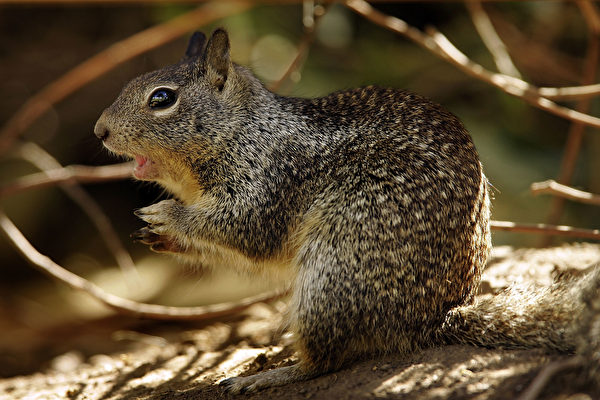
Despite squirrels appearing cute and primarily feeding on nuts, scientists have surprisingly discovered that some squirrels in the California area have developed an interest in meat, preying on field mice.
According to a report by Agence France-Presse, in a study led by Jennifer E. Smith, an associate professor of biology at the University of Wisconsin-Eau Claire in the United States, researchers have documented carnivorous behavior widely found among squirrels for the first time.
Smith stated, “There is always something new to learn, and wildlife never ceases to amaze us.” She emphasized the importance of direct observations of nature, including observing squirrels and birds frequently visiting backyard settings, in a world where technology continues to advance.
Smith’s research team conducted a long-term study in a park in Contra Costa County, California. This summer, they observed squirrels hunting field mice, marking the 12th year of their observation at this location.
During June and July, researchers recorded 74 interactions between California ground squirrels and field mice, with 42% involving squirrels actively hunting the mice.
One of the authors of the study, Sonja Wild, a postdoctoral researcher at the University of California, Davis, admitted that she was initially skeptical when students first reported witnessing this behavior.
Wild expressed, “I couldn’t believe my eyes.” However, once they began observing it, they found this behavior to be prevalent.
While scientists previously knew that up to 30 squirrel species occasionally consume meat, ranging from small fish to birds, it was unclear whether this behavior stemmed from scavenging or active predation.
This study has confirmed for the first time that hunting is a common behavior among squirrels.
The study also found that the squirrels’ carnivorous behavior peaked in the first two weeks of July, coinciding with a surge in field mouse populations.
In addition to squirrels, other animals such as raccoons, coyotes, and hyenas adjust their hunting strategies based on environmental changes caused by humans.
Smith mentioned that in a changing world, animals must consider all the challenges brought about by human presence, habitat loss, and climate change.
She stated, “Our research offers an exciting ray of hope, proving that some animals possess incredible adaptability.”
Researchers hope to study how widespread this hunting behavior is among squirrels, whether it is inherited by offspring from parents, and how it impacts the broader ecosystem.
Smith told CNN that squirrels are an integral part of California’s ecosystem, and understanding foraging behaviors as social transmission features in these populations can provide crucial clues for how other species adapt to constantly changing environments.
The above research findings were published on December 18 in the Journal of Ethology.