
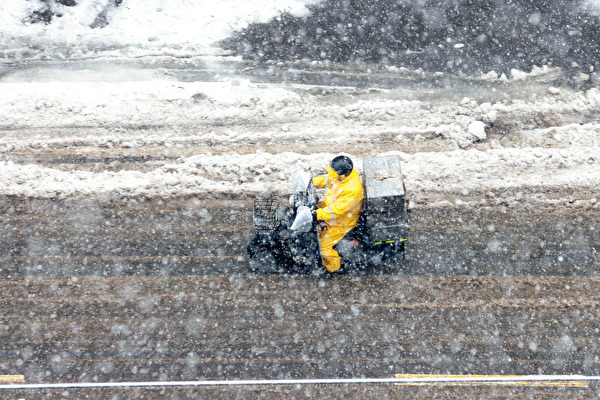
In China’s major cities, apart from leisurely strolling elderly people, many middle-aged and young individuals are hustling for a living in the streets, including food delivery drivers braving the cold on their bikes or ride-hailing drivers. More and more people who have fallen from the middle class are joining the ranks.
According to official Chinese communist sources, in the small city of Hefei, the number of qualified ride-hailing drivers has exceeded 100,000, yet the ride-hailing vacancy rate is over 45%. The number of food delivery workers in Beijing in the first half of the year increased by a staggering 49.7% compared to the same period last year, but the profit of the catering industry plummeted nearly 90%.
Reports from Lumei News revealed that on December 17th, the Hefei Road Transport Management Service Center issued a warning about the situation and risks of the ride-hailing industry in Hefei. As of November 30, 2024, the city had 46 licensed ride-hailing platforms, about 50,000 ride-hailing vehicles, and 100,000 qualified drivers. From January to November this year, the daily average order volume for ride-hailing bikes was 11.5 orders, with a vacancy rate of 45%. Nearly 80% of drivers earn less than 300 yuan per day, and overall revenue is declining.
Recent reports from Central News Agency in Beijing stated, “32-year-old Xiao Yang, after 11 p.m., continued to drive his hybrid car, picking up passengers one by one in the winter night on Beijing’s roads.”
Xiao Yang used to be a deputy manager at a company in Beijing’s high-tech Zhongguancun district. During the peak period before the pandemic, together with his friends, he had a monthly income approaching 30,000 yuan. However, with the downturn in business after the pandemic, he closed his joint venture company in October last year and was laid off by the Zhongguancun company in April this year.
Under the financial pressure, Xiao Yang had to tighten his belt, sell his BMW SUV, and replace it with an affordable Chinese made hybrid second-hand car to work as a ride-hailing driver. After over four months, he felt that the economic situation was worsening, with fewer passengers and more drivers. Sometimes he couldn’t get any orders for almost an hour, and the orders he received were often less than 30 yuan, leaving him with very little after deducting platform fees. In November, working 10 hours a day with bi-weekly rest, after deducting fuel and platform fees, he only earned a net income of 4500 yuan.
It was revealed by Xiao Yang that due to China’s rapidly declining economy, many companies in Beijing industrial clusters such as Zhongguancun, Shangdi, and Yizhuang have laid off employees, closed down, leading to many mid to high-level employees becoming unemployed, with few finding ideal jobs. Those who couldn’t find jobs were lucky if they could become private tutors or drive for ride-hailing services like him. Unlucky ones had to deliver food or return to their hometowns, some still remaining jobless, unable to pay mortgages and even selling houses, including former corporate executives.
Recently, the blogger “Huozhi Xin Chuan” wrote that his small business owner friend in Guangzhou, around 2019, despite owning luxurious properties, driving a Mercedes-Benz, and running a small factory, lost all their assets in less than three years. Upon clearing their assets, besides their two children and a few hundred thousand cash, they found themselves back to the beginning of entrepreneurship.
Now, the man’s Mercedes-Benz had been replaced with a new energy vehicle specifically for Didi ride-hailing, while the woman’s factory job had failed, forcing her to work as a domestic helper.
Apart from ride-hailing, working as a food delivery driver has become an “alternative” for fallen middle-class individuals. A large number of unemployed in China rely on “flexible employment” through odd jobs to make ends meet, and food delivery is a major form of flexible employment.
Earlier, the local airline company Xingfu Airlines in Xi’an was exposed for long-term wage arrears and social security payments. A pilot of the airline disclosed to the media on November 30 that for the past three years, many pilots, crew, and ground staff had to support their livelihoods by delivering food, driving for ride-hailing services, or setting up street stalls. The pilot himself had been surviving on food delivery for a year and a half.
In August 28, the Beijing Municipal Bureau of Statistics published data showing that in the first half of this year, the number of food delivery and catering service employees in Beijing increased by a staggering 49.7% compared to the same period last year. However, during the same period, the operating income of Beijing’s catering industry decreased by 2.9%, operating costs decreased by 1%, and the overall profit dropped significantly by 88.8%.
According to the Catering Industry platform “Can Guan Ju”, data cited in a recent article revealed that in the first half of this year, over a million catering establishments on the mainland closed, nearly matching the total for last year and doubling the number of closures in 2022.
Surviving as a food delivery driver is tough these days. Sun Jiayu (pseudonym), a food delivery worker interviewed by Epoch Times, is in her thirties, originally from Shandong. Nine years ago, after divorcing her husband, she came to Beijing alone to work as a food delivery driver. Her daughter is currently in the second year of high school, and to support her daughter’s education and plan for her own future, she has to work 12 hours a day to earn money.
She revealed that the food delivery industry in Beijing is not as good as before; she used to earn over ten thousand yuan per month, but now it’s only six to seven thousand yuan. The number of food delivery workers in Beijing has tripled compared to before, with many fresh graduates joining the delivery teams, and the industry becoming increasingly competitive.
On September 6th, a food delivery worker in her fifties in Hangzhou, Zhejiang, suddenly passed away while sitting on her electric bike parked by the roadside. Those who knew her revealed that she worked very hard, fulfilling hundreds of orders each day on two food delivery platforms, earning over 500 yuan a day, making her the “order queen” in her area.
Financial blogger and Weibo influencer “Meta Mama” said, “Who knows the suffering of the grassroots common people? In the past, there were rare cases of death from exhaustion among taxi drivers.”
As the year-end and New Year approach, the food delivery platform Meituan recently introduced a “fatigue prevention mechanism” to force food delivery workers who exceed the time limit of continuous orders to go offline forcibly until the next day for recovery, similar measures are also implemented by another platform, “Ele.me”. Although the platforms claim it is to prevent fatigue affecting safety, the reactions from riders vary. Some riders want to earn more for the Lunar New Year and switch platforms to continue receiving orders.
According to a report by Hong Kong’s “Ming Pao” on December 20th, part-time food delivery worker Lin Zi said, “In Beijing, riders who earn over tens of thousands per month run orders all day.” Forced offline is disgusting. They are considering other ways or switching to other food delivery platforms.
Several interviewed riders expressed that during the Lunar New Year, the population in urban areas like Beijing drops sharply, requiring food delivery workers to take more orders to ensure normal income. Riders coming to work in the city also aim to earn more before returning home for the festival. Thus, the end of the year and the beginning of the year are a peak period of overwork in the rider industry.
Earlier this year, the drastic decline in the sales of pianos in China became a trending topic, continuously drawing attention to the reality of the extinction of the middle class.
Fupeng, Chief Economist of Northeast Securities, recently spoke at an internal event of HSBC Group, mentioning the collapse of the population structure and the middle class. He stated, “The big problem this year is the collapse of the middle class. Not to mention this year, for the past two years, the lower class slowly ‘Pin Duo Duo,’ and now it should be the middle class starting to ‘Pin Duo Duo’… Remember, the shrinkage of the middle class has the biggest impact on the overall macro economy.”
He pointed out that “Many of the 20 million ride-hailing drivers who suddenly appeared this year were originally from the middle class,” directly leading to a continuous decline in total demand.
Chief Economist of Guotou Securities, Gao Shanwen summarized the post-pandemic Chinese society in three sentences during a speech, “Vibrant elderly, lifeless youth, and desolate middle-aged.”
The speeches of Fupeng and Gao Shanwen have disappeared from the strictly controlled Chinese internet. Their WeChat accounts, short videos, and other social media accounts have been blocked.