
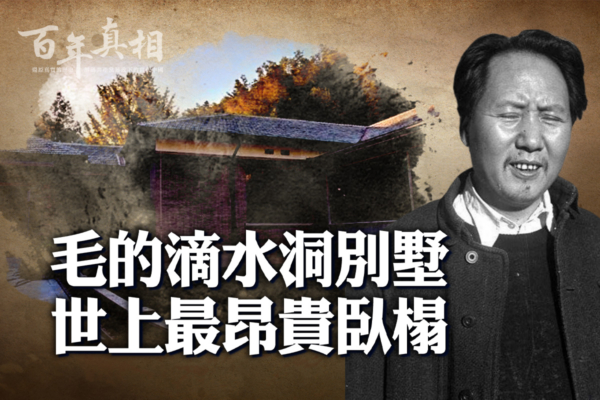
Audience friends, hello! Welcome to watch “A Century of Truth”.
From 1959 to 1961, the Great Leap Forward movement led by the Chinese Communist Party caused a nationwide three-year famine, with starving people everywhere and even tragic incidents of cannibalism, resulting in nearly 40 million deaths. However, what the seven hundred million Chinese people at that time could never have imagined was that while they were suffering, the “red sun” they sang praises to was secretly building a new villa for himself in his hometown.
In 1960, Mao Zedong personally instructed the construction of Dìshuǐ Dòng Villa. It is estimated that the cost at that time was over 3.55 million Chinese yuan. This does not include the cost of building materials, construction labor, and a large number of subsidiary facilities such as road repairs. Some estimates even put the actual cost at 100 million.
However, in the 14 years from completion until Mao’s death, he only spent 10 nights at Dìshuǐ Dòng. Even without taking into account the villa’s operating, maintenance, and security costs, in the actual currency value of the 1960s, the cost of Mao’s one night’s stay was approximately around 10 million Chinese yuan, making it one of the “most expensive beds” in the world.
So what does this “bed” look like? What significance did it hold for Mao? In this episode, we will talk about Dìshuǐ Dòng Villa.
Mao Zedong instructed the Party Secretary of Hunan Province twice to build a villa for him.
The Chinese Communist Party’s monthly Party History Journal “Party History Collection” once revealed in an article that in June 1959, Mao returned to his hometown and after swimming in Shaoshan Reservoir, he told the accompanying Party Secretary of Hunan Province, Zhou Xiaozhou, that he wanted to “build a thatched cottage” in Shaoshan Dìshuǐ Dòng to live in after retirement. In May 1960, Mao mentioned to the newly appointed Party Secretary of Hunan Province, Zhang Pinghua, about the Dìshuǐ Dòng in Shaoshan, suggesting building a house there was a good idea.
Given Mao’s status at the time, what kind of “thatched cottage” or “house” could accommodate him? Thus, “building a thatched cottage” and “building a house” were interpreted as a long and costly national-level top secret project.
In the second half of 1960, the top-secret construction of the Dìshuǐ Dòng Villa project, codenamed “203,” was launched, strictly confidential and constructed by the People’s Liberation Army Engineering Corps. Due to the strict secrecy measures, even local residents were unaware of this project.
After more than two years of construction, the Dìshuǐ Dòng project was basically completed in 1962. The main building consists of three buildings, with Building 1 exclusively for Mao Zedong. It comprised an office, bedroom, conference room, etc., serving as Mao’s living and working place. It was a Soviet-style blue brick T-shaped bungalow with enclosed corridors on both sides, a blend of Eastern and Western elements, comfortable in all seasons, and easy to keep secure. Building 1 was the core of the entire project, similar to Mao’s residence in Zhongnanhai.
In 1970, a 100-meter-long air-raid shelter was built at the rear of Building 1. The shelter was stocked with a certain amount of supplies and necessities. One side of the shelter also had military facilities like earthquake-resistant rooms and command rooms. Huge lead-lined iron doors weighing several tons were installed at both ends of the shelter, capable of withstanding a certain amount of atomic bomb explosions.
Building 2 had a total of 24 rooms, serving as a rest place for accompanying central officials, directly connected to Building 1; Building 3 was located over a hundred meters from Buildings 1 and 2, serving as the residence for security personnel and other staff. In addition, the construction team also built a road from Mao’s former residence to Dìshuǐ Dòng.