
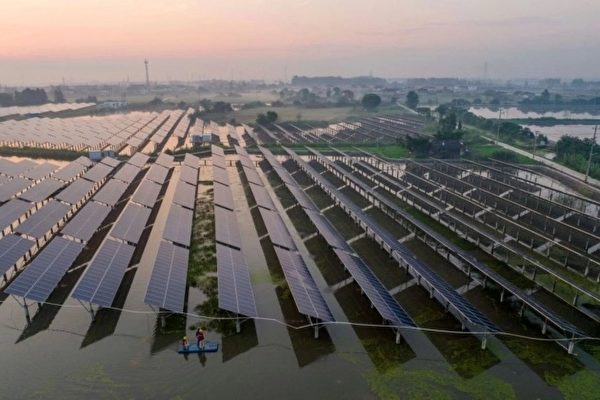
Recently, China’s new energy power generation has been facing a dilemma of low electricity prices. The spot market price of photovoltaic power generation during certain periods has dropped to 0.5 cents/kWh. Analysts believe that the withdrawal of subsidies by the CCP and market competition are the main reasons for the low electricity price dilemma.
According to a report by Huaneng Energy Network, based on data provided by the power market trading service provider “Saihe Technology,” the average spot price of photovoltaic power generation in Shaanxi during peak hours in November (11:00 a.m. to 4:00 p.m.) ranged between 0.1 yuan/kWh and 0.2 yuan/kWh. In neighboring Ningxia, during peak hours in November (12:00 p.m. to 3:00 p.m.), the average spot price of photovoltaic power generation was below 0.15 yuan/kWh.
Not only western provinces like Shaanxi and Ningxia, where centralized photovoltaic power generation is predominant, but also eastern provinces such as Henan, Jiangsu, and Hebei, where distributed power generation is the focus, are deeply embroiled in the issue of low electricity prices.
In the Southern Power Grid area of Hebei Province, during peak hours in November (12:00 p.m. to 3:00 p.m.), the average spot price of photovoltaic power generation remained below 0.15 yuan/kWh, dropping to just 0.05 yuan/kWh at 1:00 p.m. The lowest average spot price of photovoltaic power generation in Henan in November also fell to 0.05 yuan/kWh.
According to industry statistics, after new energy electricity from most provinces enters the market, the settled price is more than 10% lower than the benchmark grid-connected price, with some provinces experiencing a staggering drop of over 30% (such as Shaanxi, Ningxia, Hebei, Shanxi, Gansu, Inner Mongolia West, Inner Mongolia East, Xinjiang, and other regions).
The benchmark electricity price, also known as the grid-connected price, is the electricity price set by the local government price supervision department based on energy types. It mainly includes prices for coal, gas, oil, hydropower, nuclear power, wind power, photovoltaic power generation, etc.
The report points out that an oversupply of electricity during peak generation periods is the direct cause of the drop in electricity prices.
Due to the inherent limitations of new energy electricity – randomness, intermittency, and volatility, the market has at times labeled the unstable output curves of wind and solar power generation as “junk electricity.” During the peak hours of photovoltaic power generation (12:00 p.m. to 3:00 p.m.), it is actually when the overall network’s electricity demand is at its lowest, meaning there is an excess of electricity supply that is “essentially unused.” Following the economic laws of supply and demand, the only options are either to waste electricity or accept lower prices.
The deeper reasons for the decline in new energy electricity prices are the CCP’s withdrawal of national subsidy policies and the entry of new energy electricity prices into market-driven competition.
He Yongjian, Chairman of the State Power Investment Corporation Research Institute, stated at the 2023 Global Energy Transition Summit that in the past, new energy electricity enjoyed priority purchase and post-subsidy prices that were even higher than thermal power prices. However, after 2018, new energy electricity began transitioning from subsidy dependence to grid parity, and is now about to enter the electricity spot market, moving towards market-driven competition.
Today, the consumption of new energy electricity has evolved into two parts: policy-consumption ensuring price and quantity stability, and market-driven consumption. The policy-driven consumption can still fetch around 0.4 yuan per kWh, while the market-driven component has declined to around 0.2 yuan/kWh, or even lower.
He explained that electricity consumption refers to the process of digesting and absorbing the electricity produced by power plants. When the quantity and timing of electricity generated by power plants do not match the amount consumed by the load, electricity dispatching is necessary to achieve dynamic balance within the entire power system, which is the process of electricity consumption.
According to industry estimates, even in the past two years when the consumption rate of new energy electricity was relatively secure, large-scale wind and solar power projects would need electricity prices to reach 0.26 yuan to 0.3 yuan/kWh to cover costs.