
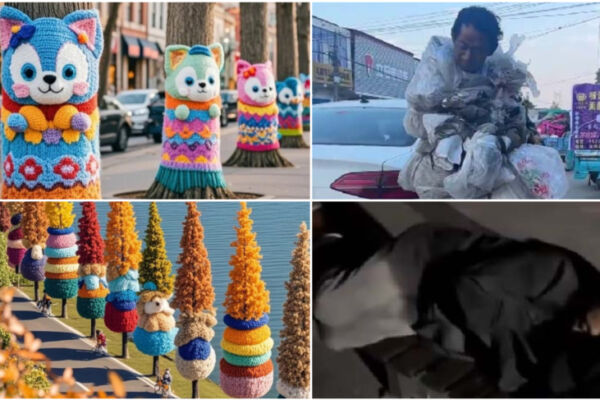
In China, as the economy declines, consumer spending downgrades, and many people are unable to find jobs, leading them to wander the streets. However, numerous local governments in mainland China have been adorning roadside trees with elaborate “sweaters,” attempting to portray a “golden age” scenery. This action has been endorsed by official media through the remarks of “experts.” However, netizens criticized the Chinese Communist Party for “wasting” resources, drawing parallels to the extravagant displays of wealth during the era of Emperor Sui Yangdi, where silk was wrapped around trees to showcase luxury, leading some netizens to see this as a harbinger of national downfall.
According to a compilation of media reports, starting in October of this year, an increasing number of cities in mainland China have been circulating videos or photos showcasing trees in city centers adorned with colorful and intricately designed “sweaters.” These sweaters come in vivid colors, some embellished with various patterns, accessories, and even styled as cartoon characters.
Reportedly, the practice of “dressing trees in sweaters” began when a park in Beijing dressed trees in colorful sweaters in alleys, aiming to provide winter protection for trees and shrubs by covering them with insulating materials. Dressing trees in colorful sweaters was praised for enhancing the ambiance and enriching the streetscape, prompting other cities to follow suit.
Based on incomplete online statistics, cities where trees have been “dressed in sweaters” include Beijing, Changchun, Dongying, Binzhou, Linyi, Qingdao, Chongqing, Shanghai, Zaozhuang, Hohhot, Hefei, Wuhan, and many others, spanning across the country.
Official reports from Beijing revealed that these “sweaters” for trees are costly, with some streets requiring a week of manual knitting for each tree, using approximately 200 catties of yarn for five trees.
Officials claim that “this significantly enhances the human touch and warmth in society.” On December 15, China Central Television (CCTV) sought the guidance of forestry experts on the program “Do Big Trees Need Sweaters to Stay Warm in Winter?” The expert stated, “From the standpoint of winter tree insulation and environmental aesthetics in the northern regions, dressing big trees in sweaters during winter is commendable.”
However, the practice of “dressing trees in sweaters” has continued to spark criticism. Some netizens vehemently condemned the authorities, deeming this as a pointless “waste.” Others pointed out that many underprivileged individuals in mainland China lack adequate clothing and food, drawing the stark comparison that “people live worse off than trees.”
Numerous videos circulating online depict the plight of migrant workers in former manufacturing hubs like Guangzhou, Shenzhen, Dongguan in Guangdong province, Jinhua in Zhejiang, Kunshan in Jiangsu, where many struggle to secure employment, leading to prolonged periods of homelessness. In cities like Beijing and Shanghai, many individuals seek shelter at train stations or sleep in parks. Reports even surfaced about individuals starving to death, although such news is heavily censored by authorities.
Some netizens highlighted a stark contrast in a December 8 incident in Henan’s Zhumadian, where a man had to bundle himself up in plastic bags to keep warm, showcasing the disparity with the lavish dressing of trees.
Furthermore, netizens in their comments pointed out, “The practice of dressing trees, the last time seen, occurred over a thousand years ago during the reign of Emperor Sui Yangdi.”
According to historical records in the “Zizhi Tongjian,” during the period of Emperor Sui Yangdi, various countries requested to conduct business with China, which pleased him greatly. To flaunt the prosperity and strength of the nation, every New Year when minority groups, foreign dignitaries, and traders gathered in Luoyang, the emperor ordered the presentation of numerous recreational activities across the streets, spanning over eight miles. Foreign merchants in the market were treated to lavish decorations, including silk wrapping on trees and luxurious seating for vegetable sellers. Innkeepers were mandated to warmly welcome foreign guests, who were allowed to dine without payment.
Chinese merchants boasted to foreign traders, “China is vast and rich, and meals and drinks are always free.” However, when foreign visitors witnessed trees in the capital wrapped in silk to welcome them, they questioned, “Even in China, there are poor people without adequate clothing, so why are you using this silk on trees? What about those in need?” The local merchants were left speechless with shame.
In an episode of the self-media program “News Perspectives,” host Li Muyang highlighted that this situation underscores a vision of the Chinese Communist Party’s impending decline. He mentioned that during the reign of Emperor Sui Yangdi, in an attempt to flaunt luxury, silk was wrapped around trees, leading foreign envoys to question, “Your country still has impoverished individuals without proper clothing, why not use this silk to make clothes for them?” Shortly thereafter, the Sui Dynasty came to an end.
Netizens commented, “An extravagant trend is a move towards national demise.” “The historical recurrence of Emperor Sui Yangdi’s practice of dressing trees in silk signifies the beginning of a nation’s decline.” “Emperor Sui Yangdi meets Emperor Chongzhen of the Ming Dynasty.”