
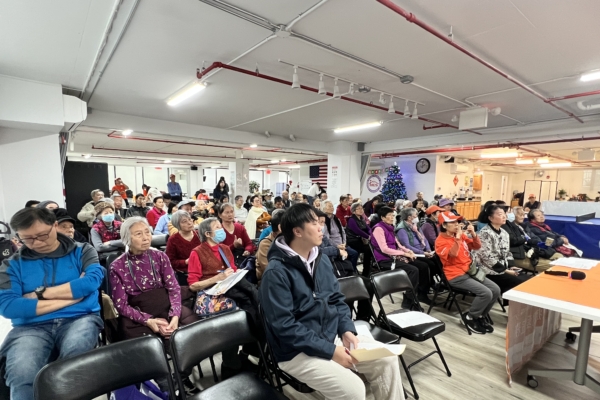
To support families with members suffering from dementia, the Alzheimer’s Caring Service Center, in collaboration with the Songbai Community Service Center and the Love Relay Foundation, organized the “Love Follows, Hearts Connect” dementia family event at the Bensonhurst Service Center. The event aimed to provide support for families caring for dementia patients, share caregiving techniques, and distribute compassionate necklaces while offering practical tracking solutions.
The event featured Dr. May Yuchen, a professor at the Columbia University School of Social Work in New York, as the keynote speaker. She along with Shih Weijing, Vice President of Chinese Community Development at the Alzheimer’s Caring Service, conducted a thematic lecture on “Challenges of Dementia for Us”. The lecture covered the causes, symptoms, and coping methods of dementia, emphasizing the importance of early diagnosis and preparation.
Weijing emphasized the need for the elderly to continue learning and maintain a calm mind to promote brain health. Professor Mei delved into differentiating between genuine and false dementia as well as the characteristics of different stages. She highlighted the importance for caregivers to adopt a “non-argumentative” attitude to reduce conflicts and improve the quality of care.
Mei recounted her own experiences to stress the importance of wisdom and patience in caregiving, addressing questions from participants regarding late-stage patient symptoms and coping strategies. She pointed out the significant variations in the conditions of late-stage patients – some may still be mobile but could get lost or exhibit unusual behaviors, while others may be bedridden and require tube feeding.
The lecture particularly emphasized the crucial nature of early detection of dementia for both patients and families. Mei cited a case where failure to promptly address the condition resulted in significant losses for the family and business. She urged families to seek medical attention at the first sign of abnormality and to seek assistance from social workers and other professional resources for early preparation.
Additionally, Mei proposed the “M&M” strategy: Mood Management and Non-Argumentative. She advised caregivers not to argue with patients, even if the patients make verbal mistakes or say provocative things. She recommended responding with encouragement and acceptance, likening the patient’s brain to a New York subway system without key stations like 42nd Street or 34th Street–Herald Square, making communication challenging.
Therefore, caregivers need to respond with wisdom to reduce conflicts, such as responding to the patient’s erroneous statements with a light-hearted “That’s interesting, you’re smarter than me” to maintain patience and a sense of humor, making interactions more relaxed and enhancing daily coping abilities. Mei also stressed the importance of simple, understandable communication with patients at a slower pace to reduce stress.
At the end of the event, the Love Relay Foundation distributed compassionate necklaces with built-in trackers to the elderly to assist families in tracking the whereabouts of patients. Technical guidance was provided on-site to help individuals download relevant applications, pair devices, and offer practical usage instructions.